
12 U.S. OFFICIALS TRAPPED AS HOUTHI MISSILE HITS RIYADH'S PIF TOWER!
12 U.S. OFFICIALS TRAPPED AS HOUTHI MISSILE HITS RIYADH'S PIF TOWER!
RIYADH, Saudi Arabia — November 20, 2026 — A Houthi missile attack damaged the headquarters of Saudi Arabia's sovereign wealth fund in Riyadh on Thursday, shattering windows across several floors and forcing the evacuation of a major financial district. The strike has intensified concerns about the vulnerability of commercial landmarks as the kingdom's conflict with Yemen's Houthi movement escalates.
The attack on PIF Tower, the capital's tallest skyscraper, damaged windows across seven to eight floors and bent sections of the building's metal exterior, according to Reuters.
Saudi civil defense officials reported material damage to the tower and nearby buildings but said there were no injuries.
Emergency vehicles arrived as authorities closed entrances to the King Abdullah Financial District and moved people away from the area.
The Saudi-led coalition said it had responded to a missile threat launched toward Riyadh and that its initial assessment indicated falling debris had caused damage. Three sources familiar with the incident told Reuters that an incoming Houthi missile struck the building.
The attack occurred on November 19, during an escalation in fighting between Saudi Arabia and the Houthi movement in Yemen.
Residents and journalists in Riyadh reported hearing a powerful explosion.
The target area was the King Abdullah Financial District, a major commercial center containing offices, financial institutions and prominent skyscrapers.
PIF Tower stands at the center of that district.
The building houses the headquarters of the Public Investment Fund, Saudi Arabia's sovereign wealth fund.
The attack damaged the tower's exterior, leaving shattered windows and distorted metal panels across multiple floors.
Nearby buildings also sustained damage.
The incident prompted an emergency response involving fire trucks, ambulances and security personnel.
The district's entrances were closed while authorities assessed the threat.
The strike demonstrated that Riyadh's commercial center had become a target in a conflict previously associated heavily with military installations, airports and energy infrastructure.
Eyewitness footage circulated after the attack.
Reuters verified the location of the video by comparing visible buildings with archive and satellite imagery.
The recording appears to show a projectile traveling toward the illuminated city skyline before a flash near PIF Tower.
The footage provides visual evidence of the attack.
However, it cannot independently establish the exact type of projectile or whether the damage resulted from a direct warhead impact or falling missile debris.
Reuters also documented damage to the building's exterior.
The combination of eyewitness video, photographs and official statements establishes that the tower was damaged during a missile attack.
The precise mechanism remains a technical question.
A full assessment would require examination of impact points, debris and structural damage.
Reuters reported that windows were blown out across seven to eight floors.
Parts of the tower's metal facade were bent.
The damage was visible from outside the building.
That level of exterior destruction is significant because glass fragments and falling debris can create dangers beyond the immediate impact area.
A damaged facade may require inspection before people can safely return to affected floors.
Engineers may also need to examine whether structural components or building systems were affected.
However, shattered windows do not automatically establish damage to the tower's primary load-bearing structure.
Saudi officials reported material damage rather than a building collapse.
The public reporting does not establish that the skyscraper was structurally unstable or at risk of falling.
The confirmed damage concerns its exterior and several floors.
The available reporting does not identify 12 American officials as occupants of the tower during the attack.
Reuters, Associated Press and other major news organizations reported the strike, emergency response and damage.
They did not identify a trapped American delegation.
Saudi civil defense officials reported no injuries.
That statement does not provide a complete list of everyone present in the district, but it does not support a claim that 12 U.S. officials were trapped.
The PIF Tower houses offices associated with Saudi Arabia's sovereign wealth fund.
It is not identified in the reporting as the site of a confirmed emergency involving an American diplomatic delegation.
Any claim about specific U.S. personnel would require an official statement, authenticated witness account or reliable documentation.
Reuters reported that entrances to the King Abdullah Financial District were closed and people were being evacuated.
Ambulances and fire trucks were present.
Those measures indicate that authorities treated the incident as a serious security emergency.
Evacuation can be necessary even when no injuries have been reported.
Emergency personnel may need to establish whether additional projectiles are approaching, whether debris remains dangerous and whether buildings are safe to occupy.
The public reporting confirms an evacuation of the district.
It does not establish that occupants were trapped inside PIF Tower.
Nor does it provide a verified number of people evacuated.
The distinction matters because an evacuation involves moving people away from danger, while an entrapment incident involves people unable to leave.
Only the former is documented in the available reports.
The impact raised questions about whether the tower's elevators, electricity and communications systems were affected.
High-rise buildings depend on multiple systems to support daily operations and emergency evacuations.
Elevators may be taken out of service during a fire alarm, security incident or building inspection.
However, the published reports do not establish that the PIF Tower's elevators failed during the attack.
They also do not document people becoming trapped in elevator cars.
Those are specific operational claims that would require information from building management, emergency responders or people inside the tower.
The visible exterior damage cannot establish the condition of the internal elevator systems.
An engineering inspection could determine whether any equipment was damaged.
Until such findings are available, the confirmed event remains an attack that damaged the building and prompted an evacuation.
Emergency communications are especially important during an attack on a high-rise building.
People inside may attempt to contact colleagues, family members or emergency services.
Building security teams may need to communicate with emergency responders while managing evacuation procedures.
But a temporary difficulty contacting someone is different from a confirmed missing-person emergency.
The reports reviewed do not identify any American officials who lost contact with colleagues inside PIF Tower.
They also do not describe a search for missing foreign personnel.
Saudi civil defense reported no injuries.
That account provides an important indication of the officially reported human impact, although it does not independently document every occupant's movements.
The available evidence supports an evacuation and property damage, not a confirmed disappearance or communications blackout involving a U.S. delegation.
The Houthis claimed responsibility for attacks on Riyadh's financial district.
The group's military spokesman, Yahya Saree, said Houthi forces had targeted the district twice on November 19.
He described separate operations earlier and later in the day.
The group also claimed attacks on King Khalid International Airport, an airbase in Khamis Mushait and a petrochemical facility in Jubail.
Saudi authorities did not independently confirm every target claimed by the Houthis.
The claims must therefore be distinguished from the damage documented at PIF Tower.
Reuters reported that three sources familiar with the incident attributed the damage to an incoming Houthi missile.
Saudi authorities also identified a Houthi missile threat.
The competing accounts concern the precise impact mechanism rather than the existence of the attack.
Saudi coalition spokesman Turki al-Malki said air defenses had dealt with a missile threat targeting Riyadh.
According to the coalition's initial assessment, debris fell and caused material damage.
Reuters cited three sources who said an incoming missile struck the building.
Those descriptions are not necessarily identical.
A missile that reaches a building directly may produce different damage from fragments falling after an interception.
Distinguishing between the two requires technical evidence.
Investigators would need to examine debris, impact patterns and the condition of the building's exterior.
The eyewitness video adds important visual context but does not settle the question.
Both accounts recognize that the attack damaged the tower.
The unresolved issue is whether the destructive material came from an intact incoming projectile or fragments produced during an attempted interception.
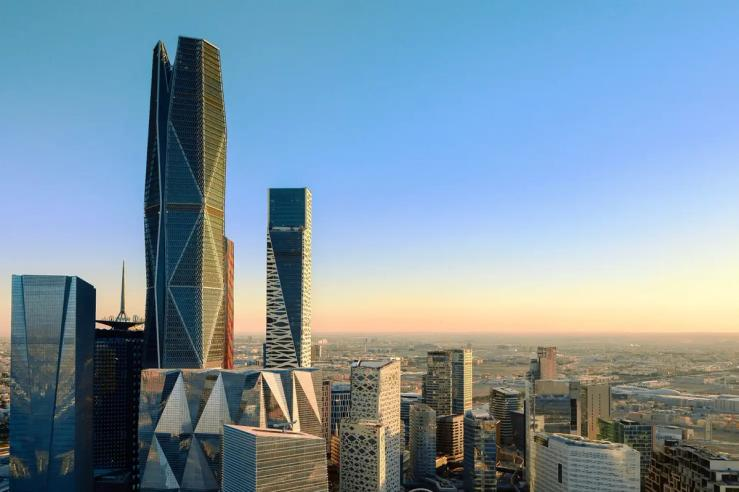
PIF Tower is one of the most recognizable buildings in Saudi Arabia's capital.
The 80-story skyscraper is associated with the Public Investment Fund, a central institution in the kingdom's economic development strategy.
The fund manages investments in domestic infrastructure, technology, tourism and international businesses.
It plays a major role in Crown Prince Mohammed bin Salman's Vision 2030 program, which seeks to diversify the economy beyond oil.
The Wall Street Journal reported that the fund manages approximately $1.2 trillion in assets.
That financial significance makes the tower more than an ordinary office building.
Damage to its headquarters carries symbolic importance because the fund represents Saudi Arabia's efforts to attract international capital and expand its economic influence.
The attack does not establish that the fund's investments or financial assets were directly damaged.
The Wall Street Journal
The King Abdullah Financial District was developed as a major business center.
Its skyscrapers house companies and institutions involved in finance, investment and commercial activity.
The district's infrastructure is intended to support Saudi Arabia's ambitions as an international financial hub.
Foreign executives, consultants and business representatives regularly travel to Riyadh for commercial meetings.
That international role makes the district's security important beyond Saudi Arabia.
A missile attack can disrupt offices and transport even when casualties are avoided.
It may also affect decisions about travel, business continuity and workplace security.
However, the international character of the district does not establish that a specific group of American officials was present during the attack.
A claim about particular visitors requires evidence of their identities and schedules.
The claim that a meeting schedule was leaked before the strike is not supported by the available reporting.
No authenticated schedule identifying 12 American officials at PIF Tower has been published in the sources reviewed.
Reuters and Associated Press reported the attack and its aftermath.
They did not describe a verified leak of diplomatic meeting information.
A document circulating online would require authentication before it could be treated as evidence.
Investigators would need to establish who created it, whether its dates and locations were accurate and whether it was available before the attack.
Even a genuine meeting schedule would not automatically establish that the attackers possessed or used it.
The documented Houthi operation targeted Riyadh's financial district.
There is no publicly established evidence that the attackers selected the tower because of a particular American delegation.
Determining what an armed group knew before an attack requires evidence about its intelligence and targeting decisions.
A prominent skyscraper can be identified as a symbolic or strategic target without knowledge of every person inside.
PIF Tower is publicly associated with Saudi Arabia's sovereign wealth fund.
Its location and importance are widely known.
Those facts alone could explain why the building attracted attention during a campaign against Saudi economic infrastructure.
However, they do not establish the Houthis' actual targeting process.
The group's public statements identify broad categories of targets, including financial, aviation and energy facilities.
They do not provide authenticated evidence of a plan to target named American officials inside PIF Tower.
The question of who knew about any particular meeting remains unanswered because no such meeting has been established in the public record.
The PIF Tower incident followed an earlier attack on a prominent building in Riyadh's financial district.
On November 8, a strike damaged a tower associated with Saudi Aramco.
That earlier incident made the November 19 attack especially significant.
Two high-profile commercial landmarks had sustained damage within less than two weeks.
The pattern suggests an escalating focus on economic and institutional targets.
However, each incident requires its own assessment.
The fact that both buildings were damaged does not establish that the same weapon or targeting method was used.
Reuters reported that the November 19 attack was the second recent Houthi operation to damage a major landmark in the district.
The repeated incidents have intensified concerns about protecting Riyadh's commercial infrastructure.
The Houthis have expanded their attacks beyond the financial district.
Reuters reported claims involving Saudi airports, oil infrastructure and military facilities.
Riyadh's King Khalid International Airport has been among the targets cited in the wider campaign.
Saudi authorities previously acknowledged several airport attacks in October that caused fatalities.
The Houthis have also claimed operations against the East-West Pipeline and other energy infrastructure.
Some claims have not been independently confirmed by Saudi officials.
The broader pattern matters because it demonstrates the range of facilities potentially exposed to missile and drone threats.
Commercial aviation, energy exports and financial operations are all economically significant.
Attacks on those sectors can create disruption beyond the immediate physical damage.
They also increase pressure on Saudi authorities to strengthen defenses.
The Houthis emerged as a major armed force during Yemen's civil war.
They control substantial territory, including the capital, Sanaa.
Saudi Arabia intervened in the conflict in 2015 as part of a coalition supporting Yemen's internationally recognized government.
The war has caused extensive casualties, displacement and humanitarian suffering.
Periods of reduced fighting have been followed by renewed confrontations.
In 2026, regional hostilities intensified amid the wider conflict involving Iran, Israel and the United States.
The Houthis are aligned with Iran, although the precise relationship between their operations and Iranian decision-making varies by circumstance.
Saudi Arabia has conducted military operations against Houthi-controlled areas.
The November 19 attack occurred within that broader cycle of military escalation.
It cannot be understood solely as an isolated incident involving one skyscraper.
Saudi Arabia condemned the attack and emphasized its right to defend the country.
The foreign ministry said the kingdom reserved the right to take necessary measures to protect its sovereignty, citizens and national assets.
That statement signaled the government's position without specifying an immediate retaliatory operation.
Saudi authorities also deployed emergency personnel and restricted access to the affected district.
The coalition reported responding to the incoming missile threat.
Those actions addressed both the immediate safety emergency and the wider security challenge.
The government must balance protecting civilian and commercial infrastructure with the risks of further military escalation.
The available statements do not establish a final decision on additional retaliation specifically for the PIF Tower incident.
The United States maintains significant security and diplomatic relationships with Saudi Arabia.
American military and diplomatic personnel are involved in regional security cooperation.
U.S. businesses also have substantial commercial interests in the kingdom.
Those relationships make attacks on Saudi infrastructure relevant to Washington.
However, the presence of American interests in Saudi Arabia does not establish that U.S. officials were inside PIF Tower during the strike.
The distinction is particularly important when discussing diplomatic personnel.
A claim that American officials were trapped would require confirmation from relevant authorities or reliable firsthand reporting.
The sources reviewed provide no such confirmation.
The documented U.S. connection concerns the wider regional security environment, not an identified group of 12 officials inside the damaged building.

Modern financial districts concentrate large numbers of people and valuable infrastructure in relatively small areas.
They depend on electricity, telecommunications, transportation and building safety systems.
A missile attack can disrupt several of those systems even when the primary structure remains standing.
Broken windows and damaged facades can also create hazards for pedestrians and emergency responders.
Security officials must assess whether additional threats are approaching.
Building managers may need to inspect damaged floors before permitting normal operations to resume.
These challenges help explain the closure of the King Abdullah Financial District after the attack.
The public reporting confirms that authorities evacuated people and deployed emergency vehicles.
It does not establish that the tower's internal systems suffered a prolonged failure.
High-rise evacuations are complex operations.
Emergency personnel must determine whether people can safely use stairwells and exits.
They may also need to account for individuals requiring assistance.
Access restrictions can prevent people from returning until hazards are assessed.
In a missile incident, falling glass and exterior debris can create dangers even after the initial explosion.
The evacuation of the Riyadh financial district therefore served an immediate protective purpose.
But the published reports do not describe a confirmed rescue operation involving trapped Americans.
They do not identify a group stranded on upper floors.
The distinction between an evacuation and a rescue is important.
The first is documented.
The second would require additional evidence.
Saudi civil defense officials reported no injuries from the attack.
That finding is significant given the visible damage to a major skyscraper.
It indicates that the officially reported immediate human toll was far lower than the physical destruction might suggest.
However, the statement should be understood within its reporting period.
Emergency assessments can evolve as authorities gather additional information.
The absence of reported injuries does not establish the location of every individual who might have been in the district.
But it directly contradicts claims that a large group of officials had been confirmed injured or trapped.
The most reliable reported outcome remains substantial property damage without reported casualties.
The Public Investment Fund is central to Saudi Arabia's plans for economic diversification.
Its investments support major domestic projects and international commercial relationships.
The fund's headquarters is therefore a prominent symbol of the kingdom's economic strategy.
An attack on that building can create reputational and operational concerns.
Businesses may review security arrangements, travel plans and contingency procedures.
However, the visible damage does not establish a financial loss to the fund's investment portfolio.
Nor does it demonstrate that sensitive financial information was compromised.
Those would be separate claims requiring financial or cybersecurity evidence.
The documented economic impact begins with damage to a major office tower and disruption of the surrounding financial district.
Longer-term consequences will depend on repairs, security measures and the course of the regional conflict.
The November 19 strike occurred amid repeated Houthi attacks and Saudi military responses.
Reuters reported that Saudi officials were preparing for a campaign that could continue for months.
The conflict also overlaps with broader regional hostilities involving Iran.
That combination increases the complexity of diplomatic efforts.
Saudi Arabia must protect critical infrastructure while managing military operations.
The Houthis have continued to claim attacks against economic and military targets.
The potential for additional strikes remains a security concern.
However, the timing and targets of future attacks cannot be established from the November 19 incident alone.
Officials will need to assess the evolving threat based on intelligence and confirmed developments.
The attack demonstrates a current vulnerability, not a verified schedule of future operations.
Several questions remain about the physical strike.
Authorities need to establish whether the tower was hit directly or damaged by interception debris.
They must assess the structural and operational condition of the affected floors.
They may also need to determine whether neighboring buildings sustained hidden damage.
The status of repairs and the timetable for normal access have not been fully established in the reports reviewed.
Investigators will also examine the wider missile threat and the effectiveness of defensive systems.
Those findings could influence security procedures for Riyadh's financial district.
The public record does not establish an investigation into a leaked American meeting schedule.
The confirmed inquiry concerns the attack, the damage and the measures required to protect the area.
Saudi authorities are expected to continue assessing the damage and security conditions around PIF Tower.
The district's reopening depends on decisions by local authorities and building managers.
The kingdom has said it reserves the right to respond to attacks on its territory.
The Houthis have continued to claim operations against Saudi targets.
The situation therefore remains part of a wider regional confrontation.
Further official statements may clarify the exact mechanism of the November 19 strike.
They may also provide additional information about repairs and access restrictions.
For businesses and residents in Riyadh, the immediate concern is the safety of the city's major commercial areas.
For regional governments, the larger question is whether military escalation can be contained.
The November 19 attack damaged the headquarters of Saudi Arabia's Public Investment Fund.
Windows were shattered across seven to eight floors.
Emergency crews responded, entrances to the financial district were closed and people were evacuated.
Saudi authorities reported no injuries.
Reuters documented the damage and attributed the attack to a Houthi missile, while the Saudi coalition said falling debris caused the destruction.
The unresolved questions concern the precise impact mechanism, the building's operational condition and how Saudi Arabia will respond to the growing threat.
Comments (0)
Loading comments...
May You Like

IRAN THREATENS SHIPS OVER HORMUZ PASSAGE AFTER CLAIMING A MINE STRIKE

TRUMP'S NVIDIA STOCK DEALINGS — IS THERE ANY TRUTH TO THE $14 MILLION PROFIT CLAIM?

AMERICA’S NEW-GENERATION AIRCRAFT CARRIERS — MILITARY MIGHT BUILT AT THE EXPENSE OF THE PEOPLE














