
The $47.1 Billion Iran War Bill and Trump’s Private Resorts: What Taxpayers Are Paying For—and What the Records Actually Show
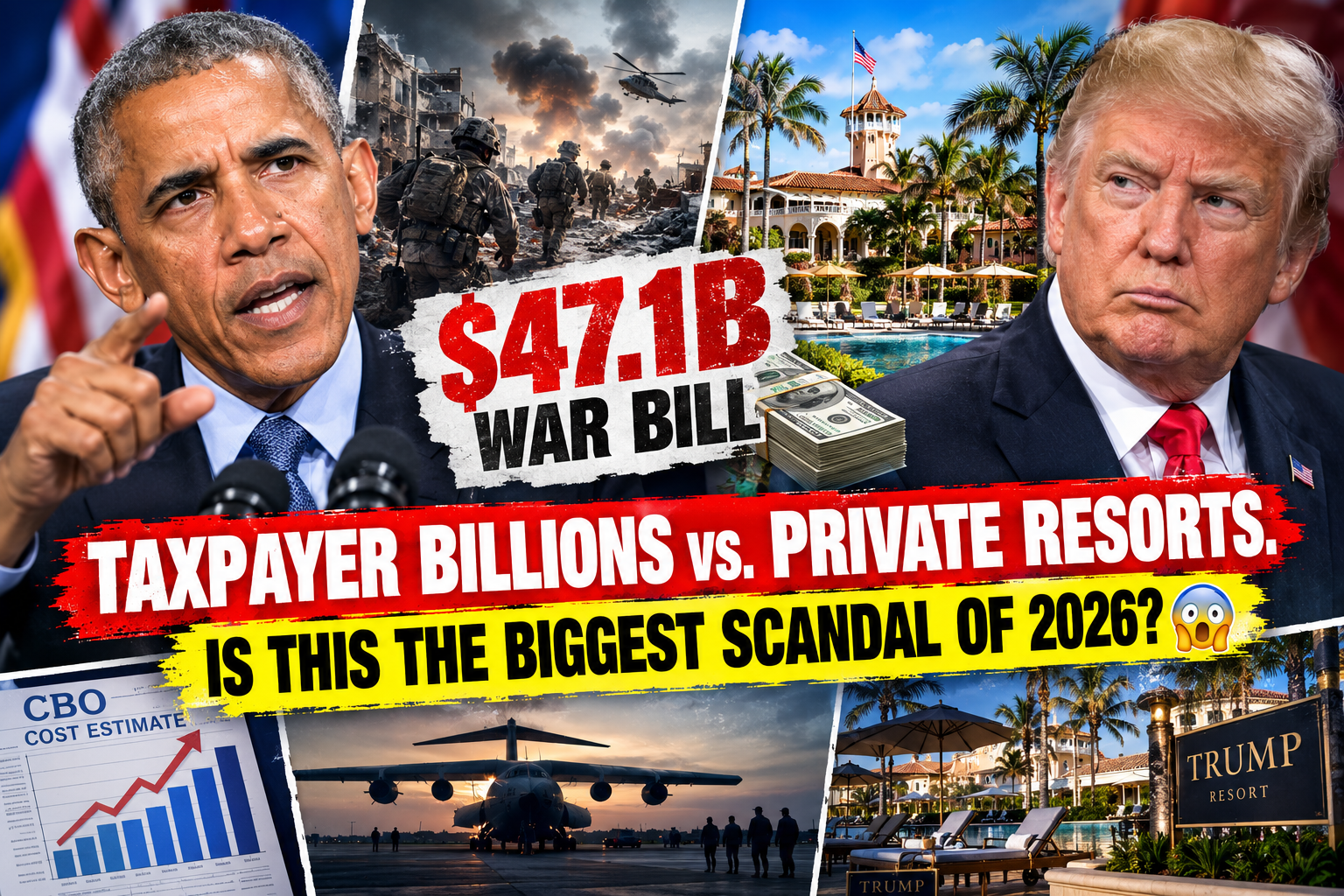
The estimated cost of the U.S. war with Iran has climbed above $47 billion, intensifying questions about military spending, congressional oversight and the financial consequences of President Donald Trump’s foreign policy. At the same time, renewed scrutiny of spending at Trump-owned properties has revived concerns about the boundary between public business and private financial interests.
The two issues are politically connected, but they are not the same financial story. The $47.1 billion figure is a Pentagon estimate of the cost of the war through October 16—not a Congressional Budget Office finding that the money was spent at resorts or on presidential security. Meanwhile, questions about lodging, official travel and payments to Trump businesses require separate documentation.
The central issue is transparency: how much the war is costing, how the administration is paying for it, and whether public resources or official decisions are creating financial benefits for private interests.
The $47.1 billion war estimate: where the money is going
The latest estimate was reported by Reuters on October 28, based on a Pentagon document. It puts the cost of the conflict at more than $47 billion through October 16—over 25% higher than Defense Secretary Pete Hegseth's July estimate of $37.5 billion.
The reported breakdown is substantial:
|
Category |
|---|
Estimated cost
Replacement of expended munitions
More than $29 billion
Military operations
Approximately $11.9 billion
Lost equipment and platforms
More than $6 billion
Total
Approximately $47.1 billion
These are rounded figures, and the categories are based on the Pentagon's accounting. The estimate may not include the full cost of repairing U.S. military bases damaged by Iranian attacks.
The military has also faced pressure to replenish weapons stocks while maintaining a substantial deployment in the region. The Washington Post reported that billions of dollars were being shifted within existing Pentagon budgets to cover expenses associated with the conflict.
One important correction to the viral graphic: the $47.1 billion estimate is attributed to U.S. military officials and the Pentagon, not a newly released CBO chart. The Congressional Budget Office has separately provided analysis of the war's economic and budgetary effects. A September 15 announcement from Senate Budget Committee Democrats described CBO findings that the war had cost the Defense Department nearly $40 billion as of August 1, excluding damage to hundreds of buildings and structures at U.S. bases.
The Mar-a-Lago question: when presidential security meets private business
The controversy surrounding private properties is not entirely hypothetical. Federal records and investigative reporting have documented taxpayer-funded security expenses connected to Trump's businesses during both his first and second administrations.
A Government Accountability Office investigation into presidential trips to Mar-a-Lago during Trump's first term examined Secret Service and Defense Department lodging expenses, security arrangements and the creation of secure areas for handling classified information.
The GAO found that the agencies had procedures for vetting visitors and establishing secure facilities. It also found that the personnel expenses and lodging reviewed for the four trips examined complied with applicable travel regulations. The report did not establish that every expense associated with Trump's properties was improper.
More recently, Citizens for Responsibility and Ethics in Washington reported in October 2025 that records obtained through a Freedom of Information Act request showed nearly $100,000 in Secret Service spending at Trump properties during the first months of his second term. The organization argued that the spending raised questions about the financial consequences of protecting a president at businesses he owns.
The underlying issue is a structural one: the government must protect the president wherever he travels, but when that travel involves a privately owned business, security and accommodation arrangements can create payments to businesses connected to the president.
That does not automatically make every payment unlawful. It does, however, make transparent accounting and independent oversight especially important.
A new White House security controversy adds to the scrutiny
Another controversy emerged in June 2026, when The Washington Post reported that the administration had redirected $352 million in Secret Service funding toward what it described as White House security measures.
The money had originally been intended in part to strengthen Secret Service recruitment, training and personnel resources. A person familiar with the agency's budget told the newspaper that the transfer was intended to help finance security elements connected to the White House East Wing modernization and ballroom project.
The White House defended the spending as necessary security infrastructure. Critics questioned whether funding originally intended to strengthen presidential protection was being redirected toward a construction project.
The controversy is particularly relevant because Trump has repeatedly described the proposed ballroom as a privately funded project. The Washington Post's reporting raised questions about how much public money could ultimately be involved.
Separately, Reuters reported in April that an agreement governing private donations for the ballroom allowed donors to remain anonymous and did not impose comparable conflict-of-interest requirements on the White House and president as those imposed on certain government agencies. The arrangement has prompted transparency concerns from government-watchdog groups.
These reports concern a White House construction project, not the $47.1 billion Iran war estimate. They should be examined separately rather than combined into one supposed spending total.
Political spending at Trump businesses is another documented concern
The relationship between political organizations and Trump's private properties has also drawn scrutiny.
An October 26 Washington Post analysis of federal campaign-finance records found that Republican campaigns and political action committees spent approximately $2.9 million at Trump businesses between January 2025 and September 2026.
The Republican National Committee accounted for nearly $1.8 million of that amount. Spending shifted increasingly toward Mar-a-Lago after Trump's Washington hotel closed, and inflation-adjusted spending at the Florida property more than tripled compared with the equivalent period during his first presidency.
Republican officials defended the spending, arguing that Trump's properties attract donors and provide valuable fundraising opportunities. The newspaper's analysis concerns political committee expenditures, however, not military or national-security lodging costs.
The distinction is important: campaign spending at a private property, government security expenses and the operational cost of a foreign war are different categories of expenditure, with different legal rules and oversight mechanisms.
What did Obama actually say?
The supplied caption attributes two particularly sharp descriptions of the Iran conflict to Obama: that it was an “unnecessary drain” and that it was being run by “not serious people.”
Those exact quotations are not substantiated by the reliable reporting reviewed for this article. Obama has criticized Trump's foreign and domestic policies during his recent campaign appearances, but the two phrases should not be presented as authenticated direct quotations without a recording or transcript.
There is, nevertheless, a documented political argument over the cost of the war. Democrats have questioned the administration's decision-making, the financial burden on taxpayers and the consequences for energy prices. Republicans have defended military spending as necessary to protect U.S. interests and respond to security threats.
The Pentagon's estimate gives Congress a concrete financial figure to examine. It does not, by itself, settle whether the war was necessary, whether its objectives justify the expense or whether the administration has managed the operation effectively.
What taxpayers should be asking
The most important questions extend beyond the headline figure:
1. How will the war be funded? Congress needs to examine whether existing military budgets can absorb the costs or whether additional appropriations will be required.
2. How much will replacing weapons cost? The reported $29 billion in munitions replacement represents a substantial demand on defense production and future military budgets.
3. Are presidential security expenses properly accounted for? Government agencies should disclose what can safely be disclosed about payments to private properties connected to public officials.
4. Are private financial interests influencing public decisions? Oversight should examine whether official actions create direct or indirect benefits for businesses associated with the president or his family.
5. What is the long-term cost of the conflict? The $47.1 billion estimate does not necessarily capture all future spending, reconstruction, medical care, equipment replacement or the wider economic consequences.
The bigger story: war spending and public accountability
The $47.1 billion figure is a serious fiscal development, and the reporting on Trump-related properties raises legitimate questions about public spending, private business interests and transparency.
But the evidence does not establish that the entire war bill has been diverted to private resorts, that military delegations have improperly enriched Trump through their lodging, or that Obama made the exact statements attributed to him in the caption.
The strongest documented story is the combination of a rapidly rising military bill, a separate controversy over White House security funding, and millions of dollars in political spending at Trump-owned properties. Each deserves scrutiny on its own evidence.
As the November 3 midterms approach, the debate over war costs and government accountability is becoming part of a wider argument about how the administration uses public resources—and how effectively Congress can oversee those decisions.
Comments (0)
Loading comments...
May You Like


FCC CLEARS SPACEX FOR ONE MILLION AI SATELLITES AS ASTRONOMERS SOUND ALARM

IOWA CRISIS — 150+ WITH LEAD AND MERCURY POISONING, 69 CRITICAL!














