"96 Hours": Inside the Pentagon’s Plans for a Major Strike on Iran—and the Decision That Now Rests With Trump
"96 Hours": Inside the Pentagon’s Plans for a Major Strike on Iran—and the Decision That Now Rests With Trump
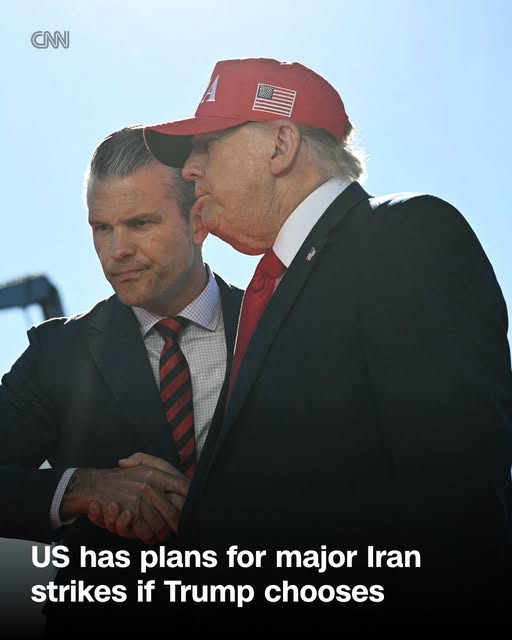
The image is a study in quiet tension: a smiling Donald Trump, clad in a red campaign cap, shaking hands with Defense Secretary Pete Hegseth against a clear blue sky. The CNN chyron below is a stark contrast to the apparent camaraderie of the moment: "US has plans for major Iran strikes if Trump chooses."
The post, which has circulated widely across social media in the final week of October 2026, captures a moment of extraordinary geopolitical gravity. It is not a report of an imminent attack. It is a signal—a carefully calibrated leak from within the defense establishment—that the machinery of war is primed, and that the only thing standing between the Middle East and a new, potentially catastrophic conflict is a single decision by the President of the United States.
The Verdict: A Real Military Blueprint, Not Just a Headline
Unlike many viral political graphics, this one is grounded in serious, detailed reporting. According to CNN, which cited two U.S. officials, American forces in the Middle East are fully prepared to launch new, potentially major military operations against Iran "within 96 hours of receiving" an order from President Trump. The scope of these operations, the officials said, would go far beyond the limited "mow the lawn" strikes that have characterized the U.S. posture since Trump halted full combat operations earlier this year.
"It will be a big effort," one official told CNN. That view has been echoed by other current and former officials, some of whom believe it is no longer a question of if Trump will order the strikes, but when.
The 96-Hour Clock: A Military on a Hair Trigger
The 96-hour window is not a rhetorical flourish. It is a reflection of the immense logistical and operational preparations that have already been completed. According to multiple reports, three aircraft carriers are now operating in or heading to the Middle East, a massive assembly of force. Additional air defense systems, ammunition, and supplies have been rushed to the region in recent weeks. U.S. forces have even been relocated from certain bases considered particularly vulnerable to Iranian retaliation.
The Pentagon, on Trump's orders, has drawn up a wide-ranging target list. According to CNN, potential targets include Iranian energy infrastructure, military sites, and nuclear facilities. The New York Times reported that the plans center on a short, intense campaign lasting about three days, with a focus on Iran's missile and drone arsenal—much of which the Islamic Revolutionary Guard Corps has rebuilt since the early phase of the war—as well as energy facilities and IRGC command posts.
The Timing: Why the World Is Waiting Until After the Midterms
Perhaps the most politically charged element of the reporting is the timing. Multiple officials told CNN that while Trump has not made a final decision, he appears to be leaning toward ordering major action, and that it would most likely come after the U.S. midterm elections on November 3.
Trump himself has publicly stated that he would not attack Iran before the midterms. In a social media post on October 8, he said the two countries were "having productive discussions". But officials caution that his past behavior suggests he could change his mind at any moment—and that the military preparations are designed to ensure he has the option to act immediately if he chooses to.
The midterm timing adds a layer of political complexity. A major military campaign in the final days of a closely contested election could reshape the political landscape. It could rally the country behind the president—or it could be seen as a dangerous escalation that distracts from domestic concerns.
The Risks: A "Devastating Escalation"
The plans are not without significant risk. U.S. intelligence assessments indicate that Iran and its Houthi allies are taking the possibility of renewed attacks "very seriously" and would likely retaliate immediately if struck. The retaliation could target American personnel and facilities across the Middle East—and potentially beyond.
An unclassified October 23 memo from Director of National Intelligence Jay Clayton to Secretary of State Marco Rubio warned that Iran has "substantially increased efforts to target US personnel" and that plotting efforts "have reached advanced stages in both the Middle East and certain other countries". The U.S. is already quietly pulling personnel from its embassies across the region in anticipation of a potential crisis.
Senator Chris Murphy, a Connecticut Democrat who has received classified briefings on the planning, described the plans as "insane." "It will lead to devastating escalation and the likely destruction of our commitment to the rule of law," he said.
The Debate Within: Hegseth's "Locked and Loaded" Posture
The image of Trump and Hegseth shaking hands is a reminder that the decision rests within a small circle of advisers. Hegseth has publicly defended the administration's posture, stating that Trump could restart "major combat operations" against Iran if necessary. "If Iran is not willing to follow through on its side of the bargain or make a deal, then the War Department is postured, locked, loaded and ready to go," he warned.
He also pushed back against claims that Israeli Prime Minister Benjamin Netanyahu was dragging the U.S. into a wider conflict, insisting that "there is only one hand on the wheel" and that Trump is the one making the final decisions. But Ynet reported that Netanyahu has been "pushing hard" for a new offensive before the midterms, while U.S. officials asked to delay until the administration was ready for a joint operation.
The administration is also pursuing a parallel diplomatic track. Vice President JD Vance has reportedly reached out to a senior Iranian hardliner in an attempt to revive negotiations, and Trump has said the two countries are "having productive discussions". But those talks have been hung up on the issue of Iran's nuclear program, with the U.S. demanding a deal on nuclear ambitions first while Iran insists those discussions must come last.
The Bottom Line
The viral headline is accurate: the United States has plans for major strikes on Iran, and the decision rests with Donald Trump. But the story is not just about a military blueprint. It is about a president who has repeatedly threatened action, a military that has positioned itself for a rapid and devastating campaign, and a region that is bracing for the possibility of a new war.
Whether Trump will give the order remains an open question. He has vetoed similar plans at least five times in recent months, according to The New York Times. But the 96-hour clock is ticking. The forces are in place. The targets are list. And the world is watching, waiting to see what the man in the red hat decides to do next.
📸 Suggested Images
-
The Handshake: The original photo of Trump and Hegseth, with a caption noting the date and the CNN chyron that accompanied it.
The Carrier: A photo of a U.S. aircraft carrier strike group in the Middle East, illustrating the massive force posture that has been assembled.
The Targets: A map of Iran highlighting nuclear facilities, energy infrastructure, and military sites, with a caption noting the potential targets of the planned strikes.
The Warning: A photo of Senator Chris Murphy, with a quote overlay of his remark that the plans are "insane" and would lead to "devastating escalation."
The Diplomacy: A split image of Trump and an Iranian official, with a caption noting the parallel diplomatic track that is still ongoing even as military preparations continue.
Comments (0)
Loading comments...
May You Like