A Death Policy’: ICE Halts Medical Care Payments as Detainee Deaths Soar to 57 Under Trump
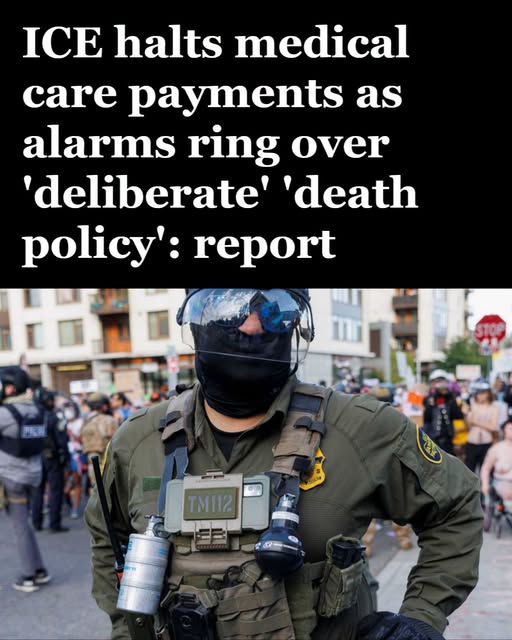
The Trump administration has stopped paying for emergency medical care at multiple ICE detention centers, according to a new investigation, as a separate report warns the agency is operating a system that “deliberately” withholds life-saving treatment. At least 57 detainees have died since January 2025 — the highest death toll in two decades.
WASHINGTON – A growing humanitarian crisis is unfolding inside U.S. immigration detention centers as the Trump administration expands mass detention at a breakneck pace. New reports reveal that ICE has suspended payments to ambulances responding to emergency calls at facilities in Pennsylvania and Georgia, while medical neglect has become so widespread that observers are calling it a “death policy” .
The revelations come as the death toll climbs to unprecedented levels. At least 57 people have died in ICE custody since President Trump returned to the White House in January 2025 . According to ICE data, 2025 was already the deadliest year for detainees in two decades, with 30 confirmed deaths — more than the entire Biden administration combined, which recorded 26 deaths over four years .
ICE Stops Paying for Ambulances
An investigation published by NOTUS found that ICE has halted payments to local emergency services responding to calls at detention centers in Pennsylvania and Georgia. The decision leaves rural communities to absorb the costs of transporting detainees to hospitals, straining local resources .
Records obtained by investigators show that tending to emergencies at ICE facilities in rural areas frequently took first responders out of commission for hours. Audio of 911 calls revealed that local ambulances faced demand from ICE that they could not readily meet, leaving immigrants waiting for care .
Medical Neglect Detailed in Lawsuits
Court records filed by detainees across at least 33 states paint a harrowing picture of systematic medical neglect . According to an investigation by KFF Health News and the Associated Press, hundreds of detainees have alleged in federal lawsuits that facilities failed to provide adequate care .
The allegations include:
-
Untreated infections that worsened to life-threatening levels
Cancer going undiagnosed and untreated
Withheld medications for chronic conditions including hypertension, diabetes, epilepsy, Parkinson’s disease, and HIV
Rationed insulin forcing diabetic detainees to skip doses
Requests for help going unanswered for weeks at a time
One Albanian man told investigators that the pain became so unbearable during his months-long detention in New Mexico that he extracted his own teeth . A Honduran mother of two said she was hospitalized with heart problems after being denied her blood pressure medication while detained in Florida . A Venezuelan man in Vermont said staff failed to take him to scheduled medical appointments, causing a flesh-eating infection to spread and his leg to turn purple and swell .
“I have never seen such disregard or medical negligence,” said Vardan Gukasyan, a political dissident and former emergency responder .
‘Fear as Policy’: The BMJ Sounds the Alarm
In a powerful analysis published in The BMJ, a leading medical journal, researchers warn that immigration enforcement under the Trump administration has become a “fear as policy” system that is causing preventable illness and death .
The journal documents that across the U.S., patients are avoiding hospitals even during emergencies for fear of being detained. In Minnesota, a state that was the center of ICE activity in late 2025 and early 2026, clinics reported appointment cancellation rates of up to 50 percent .
Within detention facilities, overcrowding has created conditions ripe for disease. Measles outbreaks have been reported in family detention centers . Children held in overcrowded, unsanitary conditions have been denied treatment, exposed to trauma, and left without access to education or legal support .
“Words feel insufficient to capture the brutality, injustice, and moral failure of what’s happening daily in a system reportedly driven by pressure to expand detention capacity,” wrote Lucinda Hiam, a Commonwealth Fund fellow .
‘At Least 57 Dead’ — With More Likely Unreported
The death toll continues to rise. A Venezuelan man, Jesús Manuel Arenas-Silva, 45, died on July 13, 2026, just four days after being taken into custody . According to his sister, agents allowed him to bring only one of the medications he needed when they arrested him at home. He called from detention to say he still was not receiving proper care. He was found unresponsive on a bus between two Georgia detention centers and pronounced dead at a hospital shortly after .
On August 1, Edwin López-Cornejo, a 41-year-old Salvadoran man who had lived in the U.S. for nearly 20 years with a valid work permit, died at an ICE facility in Newark, New Jersey . His family said he suffered from epilepsy, hypertension, and diabetes — conditions requiring multiple medications — but staff failed to properly administer his drugs. His mother said he reported numbness on one side of his face and arm the day before his death but was not taken to the hospital .
“My son needed medical care, but he didn’t receive treatment,” María Cornejo told reporters. “He had no vital signs when they took him to the hospital. His heart had already stopped” .
Most recently, Lianyong Wei, a 51-year-old Chinese citizen, died on August 23, 2026, one day after being transferred to ICE custody on Saipan . ICE reportedly waited over a week to announce his death, despite local authorities having revealed it days earlier . Wei is at least the fifth Chinese national to die in ICE or Border Patrol custody since March 2025 .
Under federal law, ICE is required to provide detailed reports on detainee deaths within 90 days. But according to Zeteo, since October 2025, ICE has failed to do so for at least eight immigrants who have died in its facilities .
Why Is This Happening?
The crisis stems from a confluence of factors :
-
Massive expansion of detention: The detained population has surged from approximately 36,000 in December 2023 to over 75,000 today. Over 90 percent are held in privately-run facilities, including those operated by GEO Group, which has been accused of cutting services to maximize profits .
Terminated oversight mechanisms: A JAMA analysis found that recent increases in mortality coincided with major operational changes in 2025, including disrupted or terminated oversight and potentially delayed medical care associated with the termination of VA claims-processing support .
Overcrowded conditions: Facilities are frequently overcrowded and under-resourced, with a rapid detention expansion creating severe shortages of medical staff .
ICE’s Response
ICE has denied allegations of systemic mistreatment, maintaining that “from the moment they enter ICE detention, foreign nationals are provided timely and appropriate medical care, which is both policy and long-standing practice” . Acting Chief Medical Officer Sean Conley has said the care provided “is better and more timely than what many foreign nationals receive in their lifetime” .
However, a 2024 ACLU report found that up to 95 percent of deaths in ICE custody between 2017 and 2021 could have been prevented with appropriate care . Medical experts who reviewed thousands of pages of documents found widespread evidence of incorrect or inappropriate treatment and severely delayed medical care .
The story is developing. More than 75,000 people remain in ICE custody today — and for many, the clock is ticking.
Comments (0)
Loading comments...
May You Like

TRUMP’S OHIO WARNING UNDER THE SPOTLIGHT

South Korea–Ukraine Rift Deepens Over North Korean POW Transfer as PURL Draws New Scrutiny

South Korea–Ukraine Rift Deepens Over North Korean POW Transfer as PURL Draws New Scrutiny