
A LEAKED THE REASON WHY PUTIN CARRIES A BIOLOGICAL WEAPONS BRIEFCASE INTO APEC LIKE A TOY!
A LEAKED THE REASON WHY PUTIN CARRIES A BIOLOGICAL WEAPONS BRIEFCASE INTO APEC LIKE A TOY!
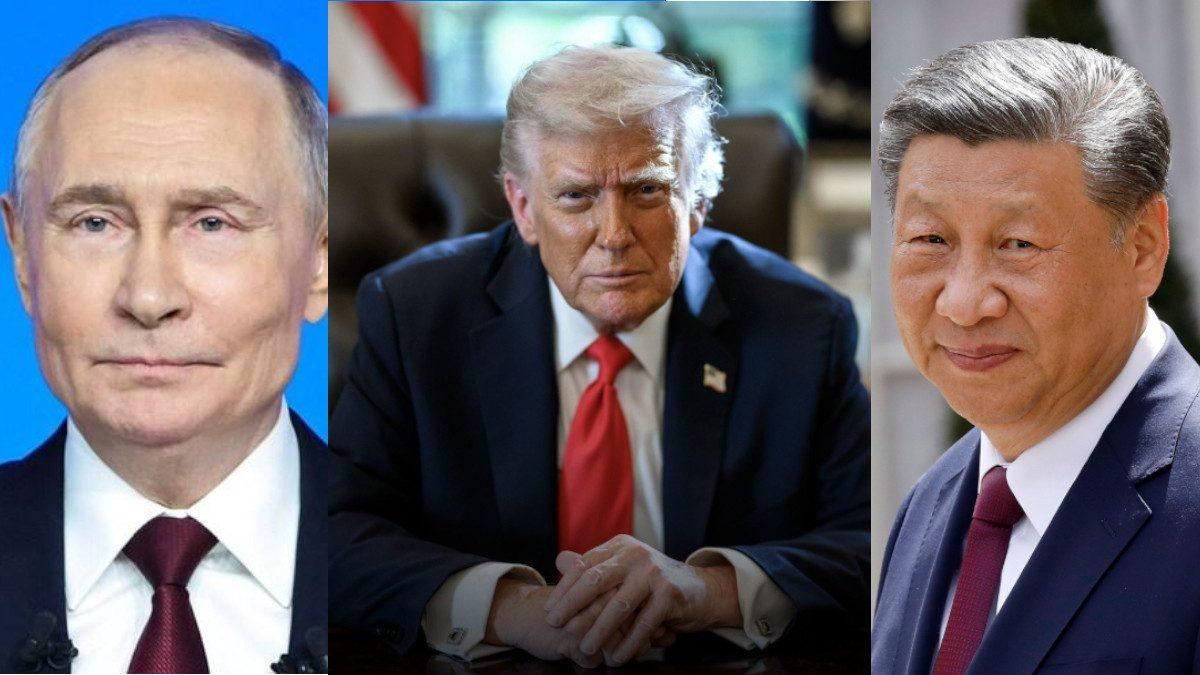
SHENZHEN, China — November 19, 2026 — A black briefcase carried by a Russian naval officer at the Asia-Pacific Economic Cooperation summit has brought nuclear command systems into the spotlight, just as President Donald Trump met Russian President Vladimir Putin and Chinese President Xi Jinping for talks on strategic weapons and global security.
The case appeared in Russian state television footage on November 18, a day before the three leaders' joint meeting in Shenzhen.
When a Russian journalist asked the officer whether he was carrying Putin's nuclear briefcase, the officer confirmed that he was.
The device was identified as Cheget, a portable communications terminal associated with Russia's strategic nuclear command system.
The footage was reported by the South China Morning Post and Al Jazeera.
The case's appearance raised questions about what it contained, why it was visible during the summit and whether Trump had commented on its significance.
The available evidence provides an answer to the central mystery: the case was publicly identified as nuclear command equipment, not a newly revealed weapon.
Trump's documented remarks focused on the broader danger of nuclear weapons and his desire to negotiate reductions.
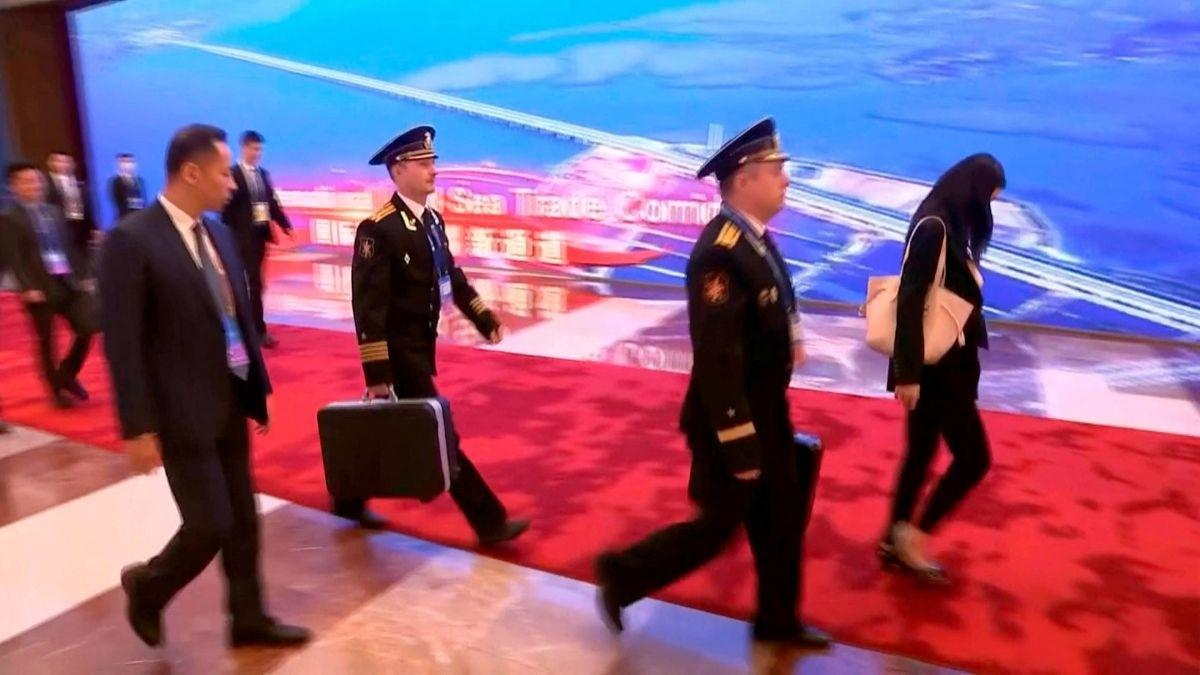
The footage began with Russian journalist Yevgeny Popov near members of Putin's delegation.
A naval officer stood nearby carrying a black case.
Popov drew attention to the object and approached the officer.
He asked whether it was the nuclear briefcase associated with the Russian president.
The officer replied affirmatively.
Popov repeated the question, and the officer confirmed the identification again.
The exchange lasted only a short time.
The case was not opened, and its internal components were not displayed.
Nevertheless, the footage became an international news story because nuclear command equipment is rarely identified so directly in a public setting.
The case was identified as Cheget, a device used in Russia's nuclear command-and-control arrangements.
Its established purpose is to support secure communications involving senior political and military authorities.
It is not generally described as a suitcase containing a nuclear bomb or a newly developed weapon.
The case is associated with systems that allow Russia's leadership to communicate during a strategic military emergency.
Its precise internal components are not publicly established.
That limits what can be concluded from the footage.
The officer's statement supports the identification of the device.
It does not independently verify the equipment's condition, configuration or operational readiness.
The most accurate description is therefore a portable nuclear command communications terminal rather than a secret weapon carried to the summit.
Cheget is often described in international reporting as Russia's nuclear briefcase.
The phrase reflects its association with the country's strategic nuclear forces.
It does not mean that the case physically contains a nuclear warhead.
Nor does it mean that opening the case would automatically launch a missile.
Nuclear command systems involve several layers of authority, communication and security.
The portable terminal is one component of that wider arrangement.
That capability is important because a president may be traveling when an emergency occurs.
A portable system helps ensure that authorized leaders can remain connected to strategic forces.
The case's presence at APEC was therefore consistent with its established function.
The footage appeared just before Trump, Putin and Xi were scheduled to meet.
Their talks included the future of nuclear arms control.
That timing made the briefcase a powerful image.
A device associated with the ability to communicate nuclear orders appeared publicly as leaders prepared to discuss limiting nuclear weapons.
The contrast drew attention to the scale of the security questions facing the three governments.
However, the timing alone does not establish that Putin intended to threaten Trump or Xi.
The footage also does not show the Russian president personally displaying the case.
It shows a member of his entourage carrying it.
The political significance lies in the public visibility of nuclear command equipment during a summit devoted partly to reducing nuclear risks.
Trump's public comments before the summit concerned the difficulty of reaching an agreement to reduce nuclear arsenals.
He said China was expanding its nuclear capabilities and expressed a desire for countries to stop building more weapons.
He also acknowledged that negotiating reductions would require difficult decisions.
In remarks reported by Reuters, Trump referred to the possibility that other countries could demand substantial American reductions in return for their own commitments.
His comments showed that he expected negotiations to involve competing interests.
They did not identify the Cheget case as a newly discovered weapon.
Nor did they establish that he had predicted a hidden device inside it.
Trump's stated concern was the broader accumulation of nuclear weapons and the challenge of reaching an agreement among countries with different arsenals.
The American president has repeatedly argued that nuclear weapons should be a subject of direct talks among major powers.
Before the Shenzhen meeting, his administration identified nuclear arms control as an important objective.
The United States and Russia possess the world's largest nuclear arsenals.
China has a smaller but expanding stockpile.
Trump wanted Beijing involved in a new negotiating framework.
The idea reflects a concern that agreements involving only Washington and Moscow may not address the changing strategic balance.
However, a three-country arrangement would be difficult to negotiate.
The governments differ over arsenal size, verification requirements and national security priorities.
Trump's public position was that dialogue could begin addressing those differences.
That was a policy objective, not a prediction about a mysterious object carried by Putin's security team.
Trump, Putin and Xi met on November 19 at the APEC summit in Shenzhen.
The meeting was unusual because the leaders of three major nuclear powers rarely participate in joint discussions of this kind.
Associated Press reported that nuclear arms control and the wars involving Ukraine and Iran were among the major subjects.
The meeting also took place amid disagreements over trade, technology and regional security.
Trump had promoted the talks as an opportunity to address major international problems.
Putin sought to advance Russian security interests.
Xi emphasized the importance of managing relations among major powers.
The encounter brought competing national priorities into a single diplomatic setting.
One reason the Shenzhen meeting mattered was the expiration of New START in February 2026.
The treaty had placed limits on deployed strategic nuclear weapons held by the United States and Russia.
It also established arrangements for exchanging information and verifying compliance.
Its expiration left the two countries without the same binding treaty framework governing their strategic arsenals.
The loss of those limits created concerns about a possible new arms competition.
Governments now face questions about future deployments, transparency and confidence-building measures.
Trump has argued for a broader agreement involving China.
However, expanding a bilateral framework into a three-country arrangement introduces additional complications.
The appearance of Cheget at APEC highlighted the military capabilities that such negotiations are intended to address.
China has long argued that its nuclear arsenal is much smaller than those of Russia and the United States.
Pentagon estimates cited in reporting before the summit put China's stockpile at more than 600 warheads.
The United States and Russia each possess several thousand nuclear weapons.
That difference shapes Beijing's position.
Chinese officials have questioned why their country should accept comparable restrictions before the larger nuclear powers make deeper reductions.
Washington, meanwhile, is concerned about China's military modernization and future arsenal growth.
Russia has its own strategic calculations.
These competing positions make a comprehensive agreement difficult.
A framework acceptable to one country may be viewed as unfair or strategically dangerous by another.
The challenge is therefore not simply persuading three leaders to sign a document.
It is finding restrictions that all three governments consider compatible with their security interests.
Cheget is associated with Russia's wider strategic command-and-control infrastructure.
The system developed during the Soviet period, when leaders sought reliable communications during a possible nuclear crisis.
Its function is to connect authorized political and military officials through protected channels.
Public descriptions associate the device with Russia's president, defense minister and senior military command.
Those officials have different responsibilities within the command structure.
The system is designed to support communication and authorization procedures rather than operate as an independent weapon.
The distinction is important.
A missile, submarine or bomber is a weapons platform.
Cheget is part of the communications infrastructure associated with decisions involving those forces.
Calling it a weapon can obscure that difference.
The case's strategic significance comes from the authority and communications it supports.
The expression nuclear button is frequently used in political discussions.
It creates the impression that a leader can launch nuclear weapons by pressing a single switch.
Actual command arrangements are more complicated.
They involve authenticated communications, military command structures and procedures intended to prevent unauthorized action.
Public information about Russia's system remains incomplete.
For that reason, the exact process cannot be reconstructed from the Shenzhen footage.
The recording shows no control panel, operational display or launch mechanism.
It also shows no attempt to activate the device.
The officer's confirmation establishes how the case was identified.
The dramatic appearance of the case should therefore be separated from assumptions about its technical operation.
The United States maintains a portable presidential emergency communications system commonly called the nuclear football.
A military aide carries it near the American president.
The system is intended to provide access to emergency procedures and military command communications.
Like Cheget, it is associated with the responsibilities of a nuclear-armed head of state.
The South China Morning Post reported that Trump's nuclear football had not been publicly sighted in Shenzhen when the Russian case attracted attention.
That absence from published footage does not establish that the American system was unavailable.
It means only that comparable images had not emerged in the reporting.
Both countries maintain arrangements intended to preserve command continuity during presidential travel.
The Russian device became the focus of attention because a state television reporter openly questioned the officer carrying it.
A president's responsibility for national security does not stop during international travel.
Leaders attend summits, visit foreign capitals and spend long periods away from their primary command facilities.
Secure communications equipment helps maintain access to authorized military channels.
This explains why Cheget can accompany Putin on foreign trips.
The device has previously appeared during international travel, including Putin's 2023 visit to China.
The Shenzhen sighting was therefore not necessarily evidence of a new military posture.
Its unusual feature was the public confirmation on camera.
The difference between a routine security arrangement and a deliberate political signal can be difficult to establish from images alone.
The broadcast was politically significant because of its timing and presentation.
Russian state television drew attention to equipment associated with the country's strategic nuclear forces.
The footage appeared as three major powers prepared to discuss nuclear arms control.
Those circumstances could invite interpretations about deterrence and national power.
However, interpretation is not the same as evidence of intention.
The Kremlin did not publicly establish that the briefcase was displayed to pressure the American or Chinese presidents.
The officer did not announce a new weapon.
Putin did not open the case or demonstrate its contents.
The confirmed event was a televised identification of Cheget.
Whether the broadcast was intended as strategic messaging remains a separate question.
Nuclear deterrence relies partly on the ability to convince potential adversaries that a country possesses credible military capabilities.
Maintaining command systems is an element of that posture.
However, possessing nuclear command equipment does not mean a government is preparing an immediate attack.
The distinction is especially important during diplomatic meetings.
Nuclear-armed leaders routinely travel with extensive security arrangements.
Their governments maintain strategic forces even while participating in negotiations.
The presence of Cheget therefore fits within the broader reality of nuclear deterrence.
An immediate threat would require additional evidence, such as a specific warning, a military announcement or a documented operational change.
The Shenzhen footage did not establish those developments.
Its importance was symbolic and institutional rather than evidence of an imminent strike.
The public recording did not show a new missile system.
It did not reveal a biological-weapons dossier.
It did not establish the existence of a secret weapon being introduced at APEC.
Nor did it document Trump examining the case or issuing a public prediction about its hidden contents.
Those distinctions matter because the case's appearance can easily be confused with claims about what it might contain.
The strongest evidence concerns its identification as Cheget.
The equipment's precise internal configuration remains outside public view.
That does not make every proposed explanation equally plausible.
The established function of Cheget provides a concrete basis for understanding the object.
Claims about additional secret contents would require separate evidence.
The war in Ukraine remained a major source of disagreement between Washington and Moscow.
Russia's invasion and the continuing conflict have affected European security arrangements and relations between the major powers.
Putin has sought recognition of Russian security demands.
Ukraine has insisted that its sovereignty and territorial integrity must be respected.
European governments have also expressed concern about negotiations that could affect regional security.
The Shenzhen meeting offered an opportunity for the leaders to discuss these issues.
The nuclear arms-control agenda also intersects with the conflict because strategic trust between Washington and Moscow has deteriorated.
That makes verification and compliance arrangements more difficult to negotiate.
The conflict involving Iran was another issue on the summit agenda.
The United States, Russia and China have different relationships with Tehran and different regional interests.
The war has affected energy markets and international diplomacy.
Trump sought to discuss possible ways of ending the conflict.
Moscow and Beijing brought their own positions to the talks.
These disagreements complicated efforts to find common ground on nuclear arms control.
Countries may be reluctant to make strategic concessions when they disagree over other major security questions.
The summit therefore involved several interconnected negotiations.
The briefcase footage captured public attention, but the underlying diplomatic problems extended far beyond one piece of equipment.
Analysts interviewed before the meeting warned against expecting a comprehensive nuclear treaty from a single summit.
Negotiations involving strategic weapons require technical expertise and detailed verification arrangements.
Governments must determine which weapons are covered, how compliance will be measured and how disputes will be handled.
Political leaders can authorize negotiations or establish broad principles.
They cannot easily settle every technical issue in a brief meeting.
The differing sizes of the American, Russian and Chinese arsenals create additional obstacles.
An initial agreement to continue talks would be different from a binding treaty.
Similarly, a general statement supporting peace would not establish new limits on weapons.
The value of the Shenzhen discussions would depend on what diplomatic work followed them.
Trump's public remarks offered insight into his expectations for the negotiations.
He expressed concern about the expansion of nuclear arsenals and said he wanted countries to reduce their weapons.
He also acknowledged the difficulty of persuading governments to accept substantial reductions.
In comments reported by Reuters, Trump discussed the possibility of another country demanding that the United States reduce its arsenal by 2,000 weapons as part of a negotiated arrangement.
The example illustrated the bargaining problem.
Each government wants assurances that reductions will not leave it at a strategic disadvantage.
Trump's comments were therefore about the conditions for nuclear arms control.
They were not a verified prediction about a concealed weapon inside Putin's briefcase.
The most consequential question is whether the three governments can establish a workable process for limiting nuclear weapons.
New START's expiration has removed an important framework governing the American and Russian strategic arsenals.
China's expanding capabilities have increased pressure for broader discussions.
Yet the three countries disagree over the terms of any future agreement.
A new framework would require political commitment, technical negotiations and credible verification.
The public appearance of Cheget did not resolve those problems.
It instead highlighted the nuclear command systems that remain part of the international security environment.
The next stage depends on whether Washington, Moscow and Beijing agree to continue substantive discussions.
Any progress would need to address differences in arsenal size, national security priorities and verification requirements.
The wars in Ukraine and Iran could also influence the diplomatic atmosphere.
A comprehensive agreement would require more than statements of goodwill.
It would need defined obligations and procedures for determining whether those obligations were being met.
The Shenzhen summit brought the leaders together at a time of significant strategic uncertainty.
But the appearance of a nuclear briefcase was not evidence that negotiations had succeeded or failed.
The answer supported by the available evidence is Cheget, Russia's portable nuclear command communications terminal.
A naval officer accompanying Putin confirmed the case's identity on Russian state television.
Its established purpose involves secure communication within Russia's nuclear command system.
Trump's documented comments concerned reducing nuclear arsenals and the difficulty of reaching an agreement among the United States, Russia and China.
Comments (0)
Loading comments...
May You Like

ELON MUSK’S $18 BILLION SPACEX STOCK GIFT FOR EVERY AMERICAN CHILD

AMERICA'S LUCAS DRONE — A POTENTIAL GAME CHANGER IN THE SOUTH CHINA SEA?

AMERICA’S NEW-GENERATION AIRCRAFT CARRIERS — MILITARY MIGHT BUILT AT THE EXPENSE OF THE PEOPLE








Popular Posts





