
Fact-check: Did a lone male juror cause the Lindsay Clancy mistrial — and is he being praised online?
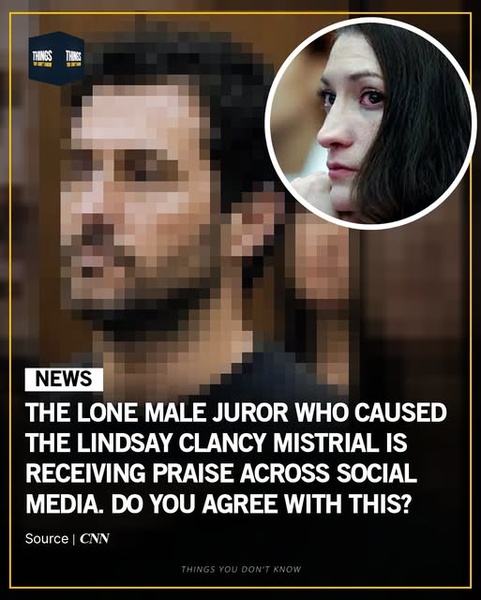
Verdict: Mostly accurate, but the graphic is misleading about the juror being the “lone male juror.”
The graphic is referring to a very real development in the Lindsay Clancy murder trial, which ended in a mistrial on September 4, 2026. The jury was reportedly split 11–1, with one male juror refusing to join the other 11 jurors in finding Clancy not guilty by reason of insanity.
But there is an important distinction: he was the lone male holdout, not the only male juror on the panel.
The jury really did deadlock 11–1
Clancy, a Massachusetts mother charged with killing her three children in January 2023, admitted to the killings but argued that she was not criminally responsible because she was suffering from severe postpartum psychosis and other mental-health problems.
After roughly six weeks of trial testimony, the 12-person jury deliberated for more than 38 hours over seven days.
The foreperson ultimately informed the judge that the panel could not reach a unanimous verdict. Multiple reports put the split at 11 jurors favoring a finding of not guilty by reason of insanity and one holdout. The judge then declared a mistrial.
CNN's reporting likewise described the case as ending in a mistrial because of one holdout juror, with three jurors later telling an NBC Boston affiliate that the panel had been leaning toward acquittal.
But “lone male juror” is technically misleading
The jury was reportedly composed of nine women and three men.
So the person described in the graphic was not the only man on the jury. He was the only male juror who refused to join the majority, making “lone male holdout” the more accurate description.
That's a significant distinction because the graphic's wording could lead viewers to believe there was one man surrounded by 11 women. There were actually two other male jurors.
Why did the holdout refuse to vote for acquittal?
This is where the story becomes considerably more complicated than the social-media graphic suggests.
Several jurors who have spoken publicly after the mistrial said the holdout acknowledged having reasonable doubt, but nevertheless would not vote for a finding that Clancy was not criminally responsible.
Jury foreperson Roni Carlson told reporters that the holdout ultimately said he had reasonable doubt but still would not agree to the insanity verdict. Another juror said he did not provide evidence or testimony that persuaded the others to maintain his position.
Three jurors have also criticized his behavior during deliberations, describing him as unwilling to engage with some of the medical evidence. One account said he asked nurses on the jury about medication and toxicology information but then rejected the answers they provided.
However, those accounts come from jurors who disagreed with him. They should not automatically be treated as an objective determination that he violated the law or acted improperly.
Was he actually “causing” the mistrial?
In practical terms, yes. In legal terms, the situation is more nuanced.
A criminal jury generally has to reach a unanimous verdict. If one juror will not agree with the other 11, the jury can become hung and the judge can declare a mistrial.
That's what happened here.
The defense tried to have the holdout removed shortly before the mistrial, arguing that his conduct showed he was not following the judge's instructions. The request was rejected, including by the Massachusetts Supreme Judicial Court.
The holdout therefore had the same legal right as every other juror to disagree with the majority.
His vote wasn't legally supposed to be determined by what the other 11 jurors thought was correct.
Is he receiving praise on social media?
Yes. There is clear evidence of that.
After the mistrial, posts on X and other social-media platforms began portraying the holdout as a hero who had prevented Clancy from being acquitted.
One viral post described him as a “hero” and said he had stood up for the children. Other posts called him a “legend” and praised him for refusing to join the majority.
The specific wording in the graphic — “receiving praise across social media” — is therefore supported by the online reaction.
But that does not mean social media is united behind him. There are also people strongly criticizing the holdout and arguing that he misunderstood or improperly applied the reasonable-doubt standard. The online reaction is sharply divided.
The case is not over
The mistrial does not mean Clancy was found innocent or guilty.
Her defense has now asked the judge to enter a not-guilty judgment rather than allow a retrial, arguing that the prosecution's evidence was legally insufficient. A hearing on that request is scheduled for September 29. Prosecutors have not yet announced whether they will seek a new trial.
So the legal status remains unresolved.
Bottom line
The graphic is based on a real event, but its wording needs correction.
| Claim | Assessment |
|---|---|
| Lindsay Clancy's trial ended in a mistrial | ✅ True |
| One juror prevented a unanimous verdict | ✅ True |
| The holdout was male | ✅ True |
| He was the “lone male juror” | ⚠️ Misleading — there were three men on the 12-person jury |
| The jury was reportedly 11–1 | ✅ True |
| The holdout's vote resulted in the mistrial | ✅ Fair characterization |
| He is being praised on social media | ✅ True |
| Everyone online supports him | ❌ False |
| Clancy was acquitted | ❌ False — there was no verdict |
Overall verdict: Mostly accurate, but sensationalized. The most important correction is that the man was the lone holdout, not the lone male juror. The social-media praise is real, but it represents one side of a highly polarized reaction to a legally unresolved case.
Comments (0)
Loading comments...
May You Like

FIGHT OVER OBAMA’S IRAN POLICY

Russian Drone Strikes Kyiv Bridge as German Chancellor Arrives in Ukraine

Shocking news from Ohio: an unexpected development ahead of Trump's rally












