A plan to remove Mr. Trump from office? The military taking over power
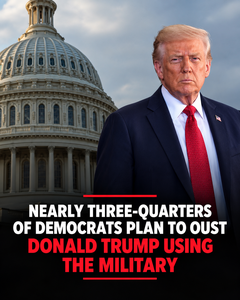
WASHINGTON — A newly released survey of Democratic voters has drawn attention after finding that 59% reacted positively to a hypothetical military takeover removing President Donald Trump from power.


A Controversial Poll
The survey was conducted by the Center for Strategic Politics in partnership with Liberal Currents, which described the project as an effort to measure attitudes among Democratic voters.
Researchers surveyed 683 Democratic voters during September, using SMS-to-web and online panels, and reported a margin of error of approximately 3.75 percentage points.
One question presented respondents with a hypothetical headline saying military leaders had removed Trump from power and assumed control of the United States to “safeguard the Constitution.”
Among respondents, 59% said they would feel very or somewhat positive about that scenario, while 28% said they would react negatively and 13% remained neutral.
Why the “Three-in-Four” Figure Appears
The Daily Caller highlighted a broader figure of 72%, combining respondents who reacted positively with those who expressed neither a positive nor negative opinion about military removal.
That calculation is different from saying that 72% actively supported a military coup, because 13% of respondents in the published breakdown were neutral rather than supportive.
The survey measured emotional reactions to hypothetical news scenarios, rather than directly asking respondents whether they would organize, participate in, authorize or join an actual military coup.
That distinction is significant because a person reporting a positive reaction to a hypothetical event does not necessarily indicate willingness to participate in political violence or unconstitutional action.
Constitutional Removal Received Stronger Support
The same survey found substantially higher positive reactions to constitutional mechanisms for removing Trump, including impeachment followed by congressional conviction and removal from office.
About 86% of respondents said they would feel positively if Trump were impeached, convicted by Congress and removed, according to the published survey results.
Another 84% reported positive feelings toward a hypothetical scenario in which Trump’s Cabinet invoked the 25th Amendment to remove him from office.
Those results indicate that constitutional methods of presidential removal generated considerably stronger positive reactions than the hypothetical military takeover presented in the same survey.
Other Hypothetical Scenarios
Researchers also asked respondents about other hypothetical circumstances under which Trump might leave office, including natural death and assassination while speaking at a political rally.
Fifty-six percent reported a positive reaction to a hypothetical scenario in which Trump died overnight in his sleep, while 31% responded positively to the assassination scenario.
The assassination question was the only one among the five scenarios in which negative reactions exceeded positive reactions, according to the published survey breakdown.
The survey's authors therefore emphasized that the results should be interpreted as measurements of attitudes toward hypothetical scenarios rather than evidence that respondents intend to engage in violence.
A Broader Picture of Democratic Voters
The survey also examined Democratic voters’ attitudes toward prosecutions, institutional reforms, foreign policy and potential presidential candidates for the party’s future nomination.
Seventy-seven percent said a future Democratic administration should pursue criminal prosecutions involving actions by Trump administration officials related to immigration and border enforcement.
Other questions found majority support for potential prosecutions connected with military operations, while 57% supported prosecuting officials from both administrations over actions related to Israel and Gaza.
The survey also found Democratic voters divided among several possible future presidential contenders, with Kamala Harris receiving the largest share at 25% in the poll.
Trump’s Broader Political Standing
The survey comes amid wider evidence of dissatisfaction with Trump nationally, although those measurements involve different populations and should not be directly equated with the Democratic-only survey.
A September Reuters/Ipsos poll found Trump's overall approval rating at 32%, while approval among Republicans stood at 73%, showing that his support remained substantially higher inside his own party.
A separate Pew Research Center survey conducted in July found that 42% of registered voters viewed their midterm vote as being against Trump, compared with 22% who viewed it as a vote for him.
Pew also found that 81% of Democratic and Democratic-leaning voters viewed their congressional vote as a vote against Trump, illustrating the president’s importance to Democratic voters’ electoral calculations.
The Military’s Constitutional Role
The poll arrives amid continuing political debate about the military’s role in American politics, but the U.S. military formally operates under civilian control and constitutional authority.
In August, Gen. Dan Caine, chairman of the Joint Chiefs of Staff, said the military had no plans to deploy federal troops or federalized National Guard personnel to polling places during the 2026 elections.
Caine also said the military had no plans to use personnel to seize ballots, voting machines or other election-related materials, addressing concerns about potential military involvement in elections.
The constitutional process for removing a president remains distinct from military intervention, with impeachment, conviction and the 25th Amendment providing established mechanisms under U.S. law.
What the Poll Does — and Does Not — Show
The survey provides evidence of intense opposition toward Trump among the Democratic voters questioned, particularly regarding possible removal from office and prosecution of administration officials.
However, the results cannot establish that Democrats nationally support military rule, because the sample consisted specifically of Democratic voters and the question described a hypothetical news scenario.
The survey also does not measure whether respondents believe military intervention would actually occur, whether they would support it under real circumstances, or whether they would personally participate.
For context, the poll was produced with a publication that openly focuses on the Democratic electorate, meaning its methodology and framing should be considered when interpreting the findings.
The results nevertheless highlight the depth of political hostility surrounding Trump as the United States approaches the November 2026 midterm elections.
What happens next will depend less on hypothetical reactions and more on how voters respond through constitutional elections and institutions, where competing parties will seek to translate dissatisfaction into actual political support.
Sources: Center for Strategic Politics/Liberal Currents survey, The Daily Caller, Reuters/Ipsos, Pew Research Center and Associated Press.
Comments (0)
Loading comments...
May You Like

South Korea–Ukraine Rift Deepens Over North Korean POW Transfer as PURL Draws New Scrutiny

TRUMP’S OHIO WARNING UNDER THE SPOTLIGHT

South Korea–Ukraine Rift Deepens Over North Korean POW Transfer as PURL Draws New Scrutiny