
Vance Confronts El-Sayed Over Remarks About His Wife
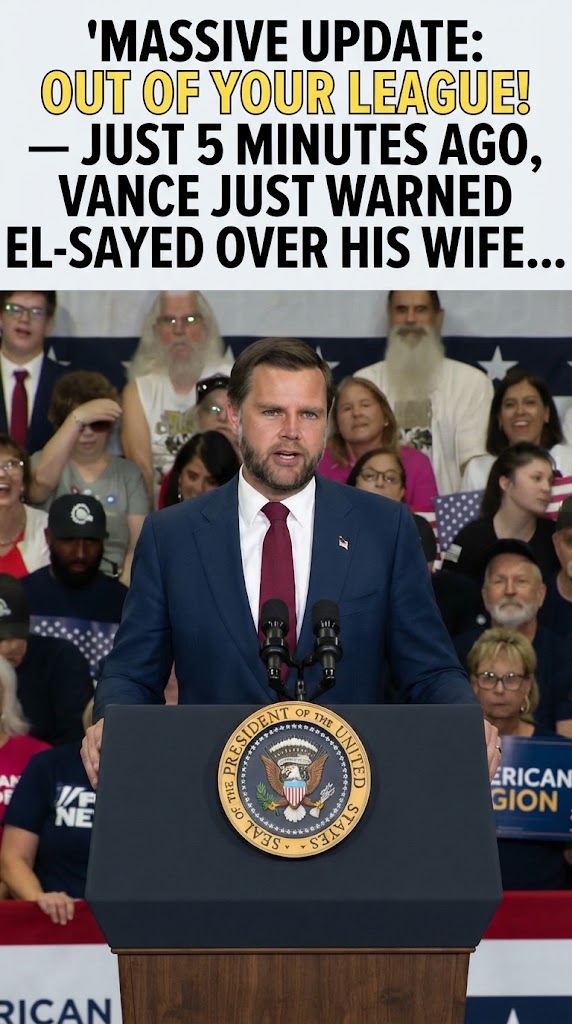
Vice President JD Vance sharply criticized Democratic Michigan Senate candidate Abdul El-Sayed at a Republican campaign rally in Sterling Heights, Michigan, on August 31, 2026, telling him to stop bringing up Second Lady Usha Vance.
“Keep my wife’s name the hell out of your mouth because she’s way out of your league,” Vance said during the event, which was organized by MAGA Inc., a political action committee aligned with President Donald Trump.
The confrontation reflected an increasingly personal Senate campaign in Michigan, where Republican nominee Mike Rogers and El-Sayed are competing for an open seat that could help determine control of the Senate.
Vance argued that voters wanted candidates to discuss public policy rather than make personal remarks about political opponents’ families. He challenged El-Sayed to explain how his proposals would protect Michigan’s manufacturing workers, wages, and employment opportunities.
The dispute unfolded during a campaign season in which national political figures have increasingly intervened in closely contested Senate races.
How the Dispute Began
The disagreement developed after El-Sayed made comments about Usha Vance in connection with her husband’s references to his late grandfather, whom he calls “Papaw.”
Vance had criticized El-Sayed’s positions on Sharia law and suggested that his grandfather would not recognize the Democratic Party represented by the Michigan candidate. The vice president used the disagreement to argue that Democrats had moved away from traditional values.
El-Sayed responded on social media by asking whether Vance would have taken Usha back in time to meet his grandfather. Critics interpreted the remark as raising questions about whether Vance’s white Appalachian family would have accepted his Indian American wife.
El-Sayed defended his broader point as a criticism of the idea that Americans with longer-established family histories have a greater claim to national belonging. He pointed to Usha’s immigrant family background as relevant to the discussion.
The exchange quickly became a personal controversy, moving attention away from the policy questions at the center of Michigan’s Senate campaign. Supporters of Vance accused El-Sayed of disrespecting the vice president’s family, while El-Sayed’s defenders argued that he was challenging Vance’s own rhetoric about American identity.
Vance Turns the Argument Toward Policy
During the rally, Vance said that voters were more interested in substantive policy proposals than comments about another politician’s wife. He argued that El-Sayed should explain how he intended to protect auto workers and Michigan communities dependent on manufacturing.
Vance also criticized El-Sayed’s positions on immigration and labor policy, claiming that some proposals supported by the Democrat would harm American workers. Those assertions formed part of the Republican campaign’s wider effort to portray El-Sayed as too far removed from the economic priorities of Michigan voters.
Michigan’s manufacturing economy and the future of American industrial jobs remain important themes in the state’s Senate contest.
The vice president additionally attacked El-Sayed over his association with controversial online political commentator Hasan Piker. Vance argued that the candidate’s political alliances raised questions about his judgment and his approach to national security.
El-Sayed rejected Vance’s characterization and turned the criticism back on the administration. He argued that policies increasing household costs, reducing access to healthcare, and supporting military conflict abroad were more deserving of condemnation.
The competing arguments illustrated how the campaign had expanded beyond a disagreement about Usha Vance into a broader confrontation over economic policy, national identity, religion, and political conduct.
A High-Stakes Michigan Senate Race
Michigan’s Senate contest is closely watched because the seat is open following Democratic Senator Gary Peters’ decision not to seek reelection. Republican Mike Rogers is seeking to win the seat, while El-Sayed emerged as the Democratic nominee after a competitive primary.
The race has attracted national attention because its outcome could influence which party controls the Senate. Both parties have therefore invested political resources and prominent surrogates in efforts to persuade voters.
Vance’s appearance demonstrated the importance Republicans attach to the contest. By campaigning for Rogers and attacking El-Sayed directly, the vice president sought to connect the Democratic candidate with policies and positions that Republicans believe could alienate moderate voters.
For Democrats, the challenge is to keep the campaign focused on affordability, healthcare, wages, and other concerns that affect Michigan households. Personal disputes may attract national headlines, but voters will ultimately decide which candidate they believe can best represent their interests.
Personal Attacks and the National Political Climate
The confrontation also highlights the increasingly personal tone of American political campaigning. Public figures’ spouses and families have become frequent subjects of political arguments, even when they are not candidates for elected office themselves.
Usha Vance’s background has also become part of wider discussions about immigration, race, religion, and what it means to be American. Such debates can become especially sensitive when political rhetoric is interpreted as questioning whether people from particular backgrounds belong in the country.
At the same time, candidates and elected officials have a legitimate interest in defending their families against personal attacks. The challenge is to distinguish criticism of political arguments from attacks that target people because of their family relationships or identities.
The controversy illustrates how quickly a dispute over a single social media post can become a defining moment in a larger electoral contest. It also shows how political figures use personal exchanges to draw attention to policy disagreements and mobilize their respective supporters.
What Comes Next
Vance’s remarks did not resolve the underlying disagreement, and the broader Senate campaign continued to focus on competing visions for Michigan and the country. Republicans emphasized manufacturing, immigration, and cultural issues, while Democrats highlighted healthcare, living costs, and the effects of the administration’s policies.
The episode may strengthen existing partisan loyalties, but its effect on undecided voters remains uncertain. Some may view Vance’s response as a defense of his family, while others may see the personal confrontation as a distraction from substantive policy debates.
As the November 3 midterm elections approach, both campaigns face the challenge of converting national attention into support at the ballot box. The outcome will depend on voters’ judgments about the candidates’ policies, credibility, and ability to address the state’s economic and social challenges.
Ultimately, the dispute between Vance and El-Sayed reflects a wider struggle over political identity and the boundaries of acceptable campaign rhetoric. Its lasting significance will depend less on the sharpness of the exchange than on whether Michigan voters believe either candidate has offered convincing answers to the issues that matter most to them.
Comments (0)
Loading comments...
May You Like

EAST COAST CATASTROPHE — $20 BILLION AT STAKE, 5 MILLION AT RISK OF LOSING POWER, WATER AND HEAT!

DAVENPORT AIRBNB HORROR — “SHOTS AT THE DOOR” GAME, 1 DEAD, 6 INJURED!










Popular Posts




