"Afraid of Death and Insignificance": Inside Barack Obama's Viral Takedown of Aging Leaders—and the Man He Didn't Name
"Afraid of Death and Insignificance": Inside Barack Obama's Viral Takedown of Aging Leaders—and the Man He Didn't Name
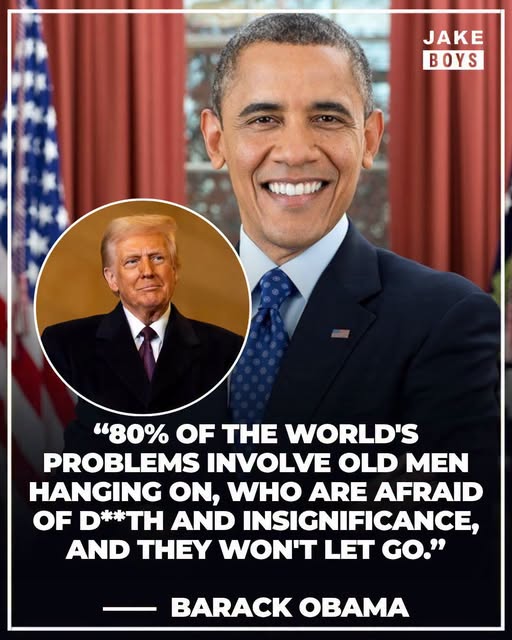
The image is a masterclass in political juxtaposition: a beaming, youthful-looking Barack Obama, paired with a smaller, inset photograph of a stern Donald Trump. The quote below is blunt, almost clinical in its detachment: "80% OF THE WORLD'S PROBLEMS INVOLVE OLD MEN HANGING ON, WHO ARE AFRAID OF DTH AND INSIGNIFICANCE, AND THEY WON'T LET GO."**
The post, shared widely across social media, captures a moment of extraordinary rhetorical precision. It was not a scream. It was not a tweetstorm. It was a quiet, devastating observation, delivered with a smile, that managed to indict an entire generation of leaders—and, without ever saying his name, the man who now sits in the Oval Office.
This is the story behind the quote, the context that made it land with such force, and the uncomfortable questions it raises about power, legacy, and the men who refuse to let go.
The Verdict: A Real Quote, A Devastating Context
Unlike many viral political headlines, this one is grounded in a genuine and significant event. On September 24, 2025, Barack Obama took the stage at London's O2 Arena for "An Evening with President Barack Obama," a conversation with British historian David Olusoga before a crowd of 14,000 people.
The discussion ranged widely, touching on his memoir, the state of democracy, and the rise of authoritarian tendencies. But it was a specific passage on aging world leaders that produced the line that would go viral.
The Full Quote: "They Build Pyramids"
Obama did not just deliver a punchline. He built a case. Here is the full context of what he said:
"It's fair to say that 80% of the world's problems involve old men hanging on who are afraid of death and insignificance, and they won't let go. They build pyramids, and they put their names on everything. They get very anxious about it."
Olusoga's response was immediate and pointed: "History is not short of those figures. Neither is the present."
The imagery was unmistakable. Obama was not simply describing old age. He was describing a psychological state—a fear of mortality, a terror of becoming irrelevant, that drives powerful men to cling to control long past the point when they should have stepped aside. The reference to "pyramids" was particularly cutting: monuments built by rulers obsessed with preserving their names and status long after their lives ended.
The Man Who Wasn't Named
Obama did not mention Donald Trump by name. He did not have to. The implication was clear to everyone in the room and everyone who saw the clip online. Trump was 79 years old at the time of the remarks, a president in his second term, a man who had spent decades putting his name on buildings, casinos, steaks, and now, a "Presidential Walk of Fame" in the White House Rose Garden.
The Daily Beast noted that Obama had "activated troll mode" with the comment, which "could be seen as a pointed dig at 79-year-old President Donald Trump". The Times of India observed that the comment was "widely interpreted as a criticism of powerful older men who struggle to step aside, although Obama did not identify a specific leader".
It was a classic Obama maneuver: the indirect strike, the rhetorical dagger wrapped in a philosophical observation. He had used a similar line before, at a private event in Singapore in 2019, when he said that many of the world's problems stem from "old people, usually old men, not getting out of the way". But this time, the context was different. The old man in question was no longer a hypothetical. He was the sitting president of the United States.
The Broader Warning: "Violence Against the Truth"
The "old men" quote was not the only incendiary moment of the evening. Obama used the O2 Arena stage to deliver a series of sharp critiques of his successor, signaling a new willingness to engage directly in the political fray.
He attacked Trump's attempt to link the use of Tylenol during pregnancy to autism, calling it a dangerous assault on public health. "We have the spectacle of my successor in the Oval Office making broad claims around certain drugs and autism that have been continuously disproved," Obama said. "The degree to which that undermines public health, the degree to which that can do harm to women who are pregnant, the degree to which that creates anxiety for parents who do have children who are autistic... All of that is violence against the truth".
He also warned of "creeping authoritarian tendencies" in the United States, criticizing the belief that "'we the people' is just some people, not all people—and where there are some pretty clear hierarchies in terms of status and who ranks where".
The "old men" quote, therefore, was not an isolated quip. It was part of a broader argument: that the crisis of democracy is, at its root, a crisis of leadership—of men who have grown so accustomed to power that they can no longer imagine a world without themselves at the center of it.
The Reaction: A Viral Moment, Revived and Replayed
The quote first circulated in late September 2025, but it has proven to have a remarkable afterlife. It resurfaced again in March 2026, where a single post on X amassed nearly three million views, and versions on YouTube and Threads drew significant attention. It has been revived once more in the final days of the 2026 midterms, a reminder that its message continues to resonate.
For Democrats, it was a rallying cry. For Republicans, it was an attack from a former president who had promised to stay above the fray. For the broader public, it was a moment of uncomfortable recognition—a description of a political culture that feels increasingly gerontocratic, in which the same faces, the same names, and the same generational conflicts play out year after year.
The Bottom Line
The viral graphic is right about one thing: Barack Obama did say that 80% of the world's problems involve old men hanging on, afraid of death and insignificance. But the story is bigger than a single quote. It is a story about a former president who has found his voice again, a sitting president who embodies the very traits Obama described, and a political system that seems incapable of letting go.
Obama's words were not a policy proposal. They were a diagnosis. And whether one agrees with his 80% figure or not, the underlying observation is difficult to escape: the world is run, to a remarkable degree, by men who have been in power for a very long time, and who seem terrified of what comes next. The question is not whether they will eventually let go. It is what will be left when they do.
📸 Suggested Images
-
The O2 Arena: A wide shot of the 14,000-strong crowd at "An Evening with President Barack Obama," with the quote overlaid on the stage.
The Pyramids: An image of the Egyptian pyramids, symbolizing the monuments Obama referenced and the obsession with legacy he described.
The Contrast: A split image of Obama at the O2 Arena and Trump at a rally, with the caption: "One described the problem. The other embodies it."
The 2019 Precedent: A screenshot of Obama's 2019 remark about "old people, usually old men, not getting out of the way," showing the continuity of his critique.
The Aftermath: A photo of the "Presidential Walk of Fame" in the White House Rose Garden, illustrating the "put their names on everything" line.
Comments (0)
Loading comments...
May You Like