
From Air Force One to Michigan: Nicki Minaj Joins Trump at Midterm Rally, Promises Support “Forever”
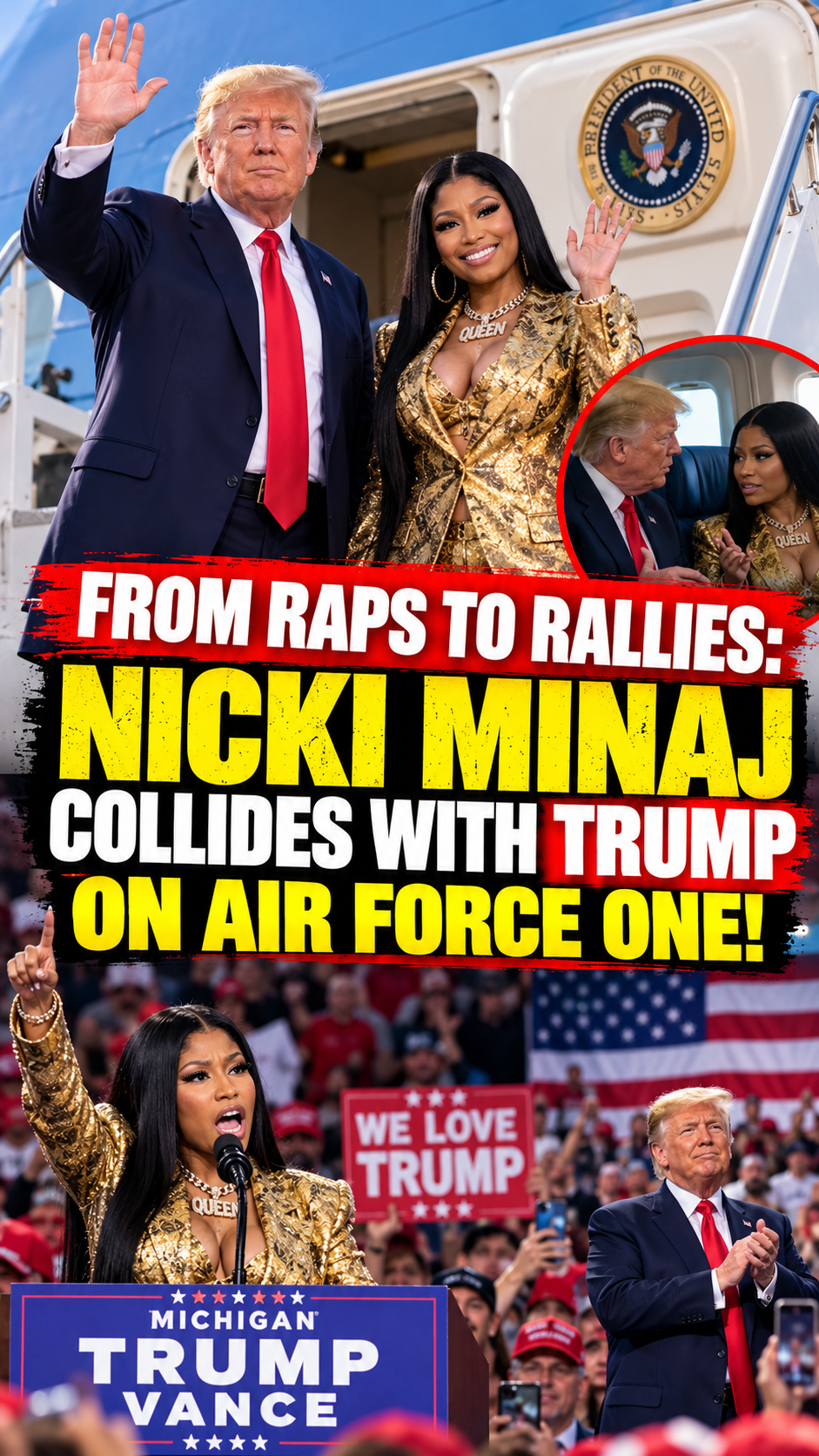
President Donald Trump brought an unexpected celebrity guest into the final stretch of the 2026 midterm elections when rapper Nicki Minaj accompanied him aboard Air Force One and appeared onstage at a Republican campaign rally in Port Huron, Michigan, on Sunday, October 25.
The appearance placed one of hip-hop's most recognizable performers alongside the sitting president at a politically consequential moment, with Republicans seeking to retain control of Congress and Michigan hosting competitive races for the U.S. Senate and governor's office.
Wearing a gold outfit, Minaj took the microphone before thousands of supporters at McMorran Place Arena, led chants of support for Trump and praised his leadership. She also encouraged support for Republican Senate candidate Mike Rogers and gubernatorial nominee John James.
Her remarks culminated in a declaration that quickly attracted attention across entertainment and political media: she would continue supporting Trump indefinitely, even suggesting she would back him if he sought office again.
The appearance was not merely a rumor generated by social media. The rally, Minaj's participation and her travel aboard Air Force One have been documented by local news organizations, national outlets and a published transcript of the event.
Yet the celebrity crossover also raised larger questions about the changing relationship between popular culture and electoral politics, the influence of famous entertainers on political audiences and the limits of what a high-profile endorsement can accomplish.

The event unfolded at McMorran Place Arena, where thousands of Trump supporters gathered nine days before the November 3 midterm elections. According to Michigan news outlet MLive, the venue was filled with attendees as Trump made his case for Republican candidates in one of the country's closely watched electoral battlegrounds.
Minaj's entrance transformed part of the rally into a celebrity appearance. Trump introduced her as the “queen of rap,” praised her longstanding support and invited her to address the crowd.
She began with a call-and-response chant of “We love Trump,” prompting supporters to repeat the president's name. She then praised what she regarded as Trump's resilience and his influence on the country's direction.
Her appearance was relatively brief, lasting approximately two minutes, but it contained several politically significant statements.
Minaj said she was honored to work with Trump and argued that his return to the White House had changed the national mood. She described the administration as offering a more hopeful future for American families.
Those statements represented Minaj's personal political assessment, not an independent measure of public sentiment or economic conditions.
She then shifted her attention to Michigan's Republican candidates, leading chants for Rogers and James and encouraging the audience to support them in the upcoming election.
In the official rally transcript published by Roll Call, Minaj described the election as an important turning point for the country and said Michigan had a role to play in the political movement she supported.

The rapper also addressed gender-related policy, expressing opposition to gender-affirming medical treatment for minors.
Her remarks reflected a position emphasized by Trump and other Republicans, while medical policy involving transgender adolescents remains the subject of disagreement among policymakers, clinicians and advocacy organizations.
Minaj ended by promising continued loyalty to the president.
She told Trump she would support him “forever and ever,” adding that she would support him again if he ran for another term.
That final comment introduced an important constitutional distinction. Under the 22nd Amendment, a person cannot be elected president more than twice. Trump, who won presidential elections in 2016 and 2024, is therefore constitutionally barred from being elected to a third term under the amendment's current provisions.
Minaj's statement was an expression of personal loyalty, not evidence that Trump is legally eligible to seek another presidential term.
Trump responded by praising the rapper and describing her as a special supporter of his political movement.
The exchange attracted additional attention because of comments Trump made earlier in the rally about Minaj's physical appearance.
While discussing his remarks about Ohio Senator Jon Husted's athletic background, Trump turned to Minaj and complimented her backside. The moment was captured in the published transcript and widely reported afterward.
Some coverage focused on the personal nature of the president's remarks, while other reporting emphasized Minaj's endorsement and the candidates she had traveled to Michigan to support.
The rally also drew attention because Minaj had traveled with Trump aboard Air Force One.

The flight itself became part of the story after White House communications director Steven Cheung shared a video showing Minaj participating in a playful exchange about the possibility of becoming White House press secretary.
Cheung suggested that the administration might have found a new candidate for the position, prompting discussion online about whether Minaj could take on an official communications role.
The exchange was presented humorously, and no formal appointment was established by the video.
The episode nevertheless illustrated how the administration has combined political messaging, celebrity appearances and social-media content during the campaign.
An Associated Press examination of Trump's Air Force One travel in October described a broad entourage that included senior advisers, Cabinet officials, political strategists and prominent entertainers or sports figures.
Minaj was among the celebrities who accompanied the president during the month's campaign travel.
The details of any private conversations between Trump and Minaj during the flight have not been independently established. The publicly released video does not demonstrate that they discussed a specific policy agreement, campaign strategy or future government appointment.
That limitation matters because viral images depicting private conversations aboard presidential aircraft can create an impression of access to information that the public record does not support.
The verified story is that Minaj traveled on Air Force One, appeared with Trump at the rally and participated in publicly documented promotional exchanges.

Behind the celebrity headlines, the political purpose of the event was clear.
Michigan is holding an open-seat U.S. Senate election after Democratic Senator Gary Peters decided not to seek reelection.
Republican Mike Rogers, a former congressman, is competing against Democratic nominee Abdul El-Sayed, a physician and former Detroit health official.
The governor's race is also open because Democratic Governor Gretchen Whitmer is completing her second term. Republican John James is competing against Democratic Secretary of State Jocelyn Benson.
Trump's Port Huron appearance was designed to highlight Rogers and James and connect their campaigns with the administration's priorities.
Local 4 Detroit reported that both Republican candidates addressed the crowd and discussed issues including housing affordability, education and employment.
The timing was especially notable because former President Barack Obama had appeared in Detroit the previous day to support El-Sayed and Benson.
The back-to-back appearances underscored the national attention surrounding Michigan's elections.
Obama emphasized the importance of the state's races for Democrats, while Trump defended the Republican ticket and criticized El-Sayed.
But the Republican rally was also marked by a controversy that extended beyond Minaj's endorsement.
According to Associated Press reporting, Trump made attacks on El-Sayed involving his Muslim faith and background, questioned his loyalty and associated him with extremism without substantiating those allegations.
El-Sayed rejected the accusations. Bishara Bahbah, founder of Arab Americans for Trump, also criticized the president's remarks.

The controversy added another dimension to the election in a state with a substantial Arab-American population and politically diverse communities.
Michigan voters are evaluating competing positions on economic policy, healthcare, immigration, education and foreign affairs. The candidates' records and proposals, rather than their religious or ethnic backgrounds, provide the basis for assessing their policy differences.
The juxtaposition of Minaj's endorsement and Trump's remarks about El-Sayed also demonstrated how a single rally can generate several different political stories.
For some observers, the celebrity appearance was the defining moment. For others, the more consequential issue was the president's treatment of a Senate candidate and the potential implications for public debate.
Both developments occurred at the same event, but they raise different questions.
Minaj's political evolution has also become a subject of public interest.
The Trinidadian-born performer, known internationally for songs including Super Bass, Starships and Anaconda, has previously criticized aspects of Trump's policies.
Euronews reported that she had spoken critically about family separations under his first administration, particularly the treatment of migrant children.
Her more recent public support for Trump therefore represents a change from some of her earlier statements, although political views can evolve and an artist's position on one policy does not necessarily determine their position on every other issue.

Her involvement in the 2026 campaign illustrates the growing overlap between entertainment and electoral politics.
Celebrity endorsements can attract media coverage and expose political messages to audiences who might not otherwise follow a particular campaign event.
But visibility is not the same as measurable electoral influence.
A performer may generate substantial online engagement without changing how many people register, participate or vote for a particular candidate.
Likewise, a rally audience's enthusiastic response does not establish how the wider electorate feels about an endorsement.
Determining the electoral effects of Minaj's appearance would require evidence such as reliable voter surveys, campaign participation data or post-election analysis. The event alone does not demonstrate that she has shifted the Senate or gubernatorial races.
The distinction is important because the scale of Minaj's entertainment career makes the political crossover unusually visible.
She has built an international audience over more than a decade, and her public statements can circulate across music, celebrity and political communities.
That reach gives her the ability to draw attention to issues and candidates, but it does not mean her followers share identical political beliefs.
The broader phenomenon is not unique to Republicans.
American political campaigns have long involved musicians, actors and athletes. Some celebrities perform at events, others record endorsements or appear in advertisements, and some use their own platforms to discuss public policy.
These activities can become part of a campaign's communications strategy, but voters remain free to evaluate political candidates independently of the entertainers who support them.

As Michigan approaches Election Day, the substantive contest remains between the candidates on the ballot.
Rogers and El-Sayed are competing for the Senate seat, while James and Benson are seeking the governorship.
The outcome of the Senate race will contribute to the balance of power in Washington. The gubernatorial election will determine the leadership of Michigan's executive branch after Whitmer leaves office.
The campaigns will continue making their arguments about the economy, public services, national security and the role of government.
Minaj's appearance has added an unusual cultural dimension to those contests, but it has not replaced the underlying political choices facing Michigan voters.
For Trump, the rally provided another opportunity to connect his political movement with a high-profile celebrity supporter.
For Minaj, it marked one of her most visible appearances in support of the president, accompanied by a declaration of continued loyalty.
For Michigan's candidates, the immediate consequence was additional national attention in the closing days of the campaign.
And for the public, the event offered a striking example of how presidential politics, popular music and social-media spectacle can converge.
The confirmed facts are already notable: Nicki Minaj boarded Air Force One, traveled with Donald Trump to Michigan, led chants at a Republican rally, supported the party's Senate and gubernatorial nominees, and promised to stand by the president.
What remains unknown is the content of any private discussions during the flight and whether the appearance will have a measurable effect on the November 3 election.
The cultural crossover was real. Its electoral consequences have yet to be established.
Comments (0)
Loading comments...
May You Like

WWE BRONSON REED—STAR COLLAPSES AT COMPANY EVENT, FATAL DRUG REACTION SUSPECTEDs!!

FLORIDA AIRBNB NIGHTMARE — 50 TEENS, 7 SHOOTING VICTIMS LINKED TO “SHOTS AT THE DOOR”!

EAST COAST DISASTER—179 THOUSANDS OF HOMES AT RISK, CAUSING $50 BILLION IN DAMAGE!









Popular Posts




