
Airman’s Death Sparks Pentagon Benefits Controversy — No Payout
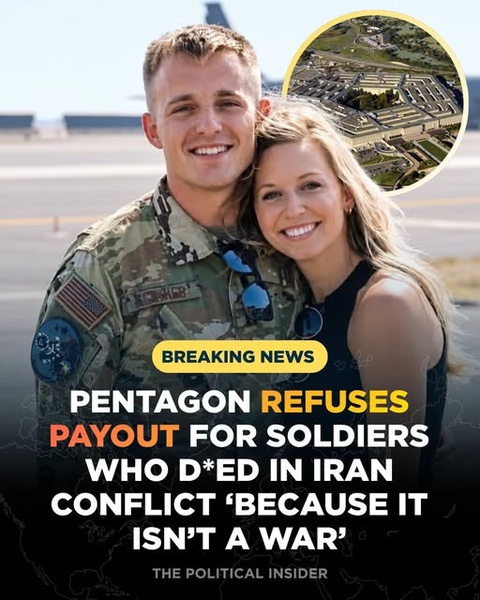
WASHINGTON — The death of a U.S. Air Force officer in a crash during operations supporting the fight against Iran has ignited a political and emotional controversy over how the Trump administration is classifying the conflict — after his widow said she was initially told that certain combat-related benefits were unavailable because the United States was “not at war.”
But the viral claim that the Pentagon refused to pay the family because the conflict was not officially a war is misleading.
The Air Force later acknowledged that the family had initially received inaccurate information and confirmed that the late service member's eligible combat-theater benefits were included in his final pay.
The episode nevertheless exposes a deeper dispute over the administration's refusal to describe the ongoing U.S.-Iran fighting as a war — even as American service members have been killed and wounded in the conflict.
Widow Says She Was Told Her Husband Was Not Eligible
The controversy centers on Maj. Alex Klinner, a 33-year-old Air Force officer who was among six crew members aboard a KC-135 refueling aircraft that crashed in western Iraq in March while supporting U.S. operations against Iran.
Klinner was one of 18 U.S. service members reported killed in the conflict at the time of the latest major reports, with hundreds more wounded.
His widow, Libby Klinner, said she was frustrated after being told by a military official helping her after her husband's death that certain benefits were unavailable because the United States was “not at war.”
For a grieving military family, the distinction was more than semantics.
“My husband lost his life because we're in a war, and then I was told that because it's not technically a war, we lose out on something,” Klinner told The Associated Press.
Her comments went viral, putting renewed attention on the administration's unusual terminology surrounding the conflict.
The Pentagon Did Not Ultimately Deny the Benefits
This is where the viral graphic shown above substantially overstates what happened.
According to the Associated Press, Air Force officials contacted Klinner after her social-media post attracted national attention. The service reviewed her husband's pay and acknowledged that she had initially been given inaccurate information.
The Air Force said that all eligible combat-theater benefits had been included in his compensation.
The issue was apparently related to how the benefits were listed and communicated rather than a final Pentagon decision to permanently deny the family money because Congress had not formally declared war.
That distinction matters.
There is therefore no evidence that the Pentagon ultimately refused to pay Klinner's family simply because the Iran conflict was not legally designated a war.
Instead, the case involved an apparent administrative error that was corrected after the widow raised the issue publicly.
Combat Pay Does Not Simply Depend on a Formal Declaration of War
U.S. military compensation rules also complicate the claim.
The Department of Defense says Hostile Fire Pay and Imminent Danger Pay can be provided to eligible service members under specified conditions. Hostile Fire Pay can apply when a service member is exposed to hostile fire or is killed, injured or wounded by hostile action. Imminent Danger Pay applies to qualifying dangerous locations and circumstances.
Both are currently set at up to $225 per month.
Crucially, the rules do not state that a formal congressional declaration of war is required for these benefits.
That is why the Air Force ultimately clarified that Klinner's eligible combat-related compensation had been included.
Why the “Not a War” Debate Matters
The larger controversy stems from the Trump administration's insistence that the ongoing confrontation with Iran should not be called a war.
Vice President JD Vance recently rejected the term, arguing that there was no sustained active shooting at the moment he spoke, despite U.S. strikes against Iranian targets and Iranian retaliation against American allies.
Trump subsequently backed Vance's characterization, describing the fighting as a “military conflict” and calling it “small potatoes” for the United States.
The administration has also changed how some casualties are categorized.
In late July, the Pentagon created a separate category for casualties associated with renewed U.S.-Iran fighting. Officials said the change followed the end of the earlier operation known as Operation Epic Fury. Since July 7, some U.S. casualties have been listed under the broader category of “Overseas Operations.”
That terminology has generated criticism because it can make an active military confrontation appear administratively different from what the public traditionally understands as a war.
The Conflict Has Already Cost American Lives
Whatever terminology Washington uses, American service members have been killed.
Reuters reported that 18 U.S. military personnel had been killed and more than 750 wounded since the conflict began, after Commerce Secretary Howard Lutnick mistakenly said no Americans had died in the fighting before apologizing.
The fighting has also continued into September.
On Sept. 8, U.S. forces said they had destroyed five Iranian oil carriers following attempted missile attacks on a U.S. Navy warship. Iran subsequently launched ballistic missiles toward a U.S. base in Jordan, while Iranian forces and allied groups continued attacks across the region.
The escalation demonstrates why the language surrounding the conflict has become increasingly politically sensitive.
A Bureaucratic Error Has Become a National Political Story
For Klinner's family, however, the dispute is ultimately about something much more personal than terminology.
Her husband died while carrying out a military mission connected to the Iran conflict. She said families should not have to become experts in government classifications to determine what benefits they are entitled to after losing a loved one.
The Air Force has since assured her that her husband's eligible benefits were included and said it remains committed to providing clearer information to families of fallen service members.
The episode nevertheless raises a legitimate question about how the government communicates with military families when a conflict does not fit neatly into traditional categories.
What the Viral Headline Gets Wrong
The graphic's claim that the “Pentagon refuses payout for soldiers who died in Iran conflict because it isn't a war” is therefore too broad.
What is confirmed:
- Maj. Alex Klinner died in a KC-135 crash in Iraq while supporting U.S. operations against Iran.
- His widow said she was initially told that the family's eligibility for certain benefits was affected because the United States was not officially at war.
- The Air Force later acknowledged that the information she received was inaccurate.
- The service confirmed that all eligible combat-theater benefits were included in her husband's pay.
- The Trump administration continues to avoid formally calling the current Iran operations a “war.”
What is not supported by the evidence:
- That the Pentagon permanently refused the family its legally owed benefits.
- That military combat benefits automatically disappear because Congress has not formally declared war.
The Real Controversy Is Bigger Than One Paycheck
The Klinner case has become a powerful symbol of a much broader debate.
The Trump administration wants to describe the Iran campaign as a limited military conflict rather than a conventional war. Yet American troops have been killed, hundreds have been wounded, U.S. forces are conducting strikes, Iran is retaliating and American military deployments across the Middle East are continuing.
For military families, those distinctions can feel painfully abstract.
In the end, the Pentagon did not leave Klinner's family without its eligible benefits. But the fact that a grieving widow had to go public before receiving clear answers has exposed a serious problem of its own: when the government changes the language used to describe a conflict, military families still need unmistakably clear answers about what that means for the people they have lost.
Comments (0)
Loading comments...
May You Like

gfnhgmnghnmfgnbvvvvvvvvv

OBAMA STUNS ON INSTAGRAM: MESSAGE MARKING 34-YEAR MILESTONE SPARKS A BUZZ













