
Al Sharpton and Hakeem Jeffries Rally for Voting Rights as Democrats Intensify Opposition to Trump
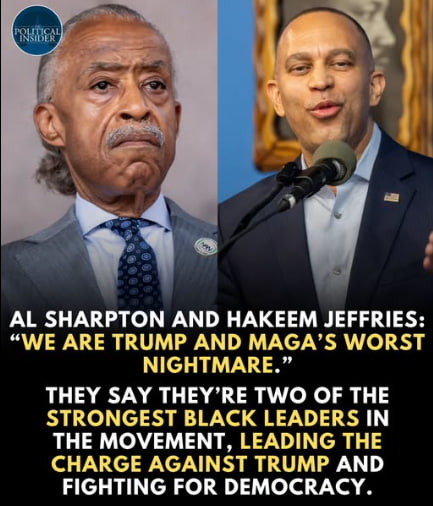
WASHINGTON — Civil rights leader Rev. Al Sharpton and House Democratic Leader Hakeem Jeffries have emerged as prominent voices in the growing Democratic and civil-rights campaign against what they describe as threats to voting rights and political representation under President Donald Trump.
Their alliance was on display at the “Defend the Vote” March on Washington on Aug. 28, where thousands of activists, labor members, students and community leaders gathered at the National Mall to protest changes to voting rules and congressional redistricting. The event was organized by Sharpton’s National Action Network and the Drum Major Institute, alongside more than 90 partner organizations.
The gathering came just weeks before the November 2026 midterm elections and amid a broader political battle over the future of voting rights and Black representation in Congress.
Sharpton and Jeffries Put Voting Rights at the Center of the Fight
Sharpton has spent decades working on civil-rights issues and remains one of the country's most recognizable activists on voting rights, racial justice and police accountability.
In a letter to supporters ahead of the Washington march, Sharpton warned that voting rights were being weakened across the country and argued that the right to vote was fundamental to protecting other civil liberties.
Jeffries, meanwhile, has become one of the Democratic Party's most prominent congressional leaders and is seeking to lead Democrats back to control of the House in the November elections.
Speaking at the march, Jeffries pointed to economic and political disparities affecting Black Americans, including unemployment, homeownership and representation. He also criticized Republican-backed redistricting efforts in the South, describing them as reminiscent of tactics historically used to diminish Black political power.
The two men therefore represent different but overlapping parts of the Democratic coalition: Sharpton brings decades of civil-rights organizing, while Jeffries operates from the center of congressional politics.
Supreme Court Ruling Intensifies Redistricting Battle
The Washington demonstration followed a major Supreme Court decision in the case Louisiana v. Callais, which has become a flashpoint in the national debate over congressional redistricting and the Voting Rights Act.
Civil-rights groups argue that the ruling could make it easier for states to redraw congressional districts in ways that reduce the political influence of Black voters. The decision has also triggered a series of redistricting fights ahead of the midterm elections.
Republicans and conservatives have generally defended state authority over election administration and redistricting, while Democrats and civil-rights organizations have warned that the changes could weaken minority representation.
The dispute is particularly significant because control of Congress could hinge on a relatively small number of competitive House districts.
Jeffries Says Democrats Can Win Back the House
Jeffries has remained optimistic about Democrats' prospects in November despite Republican redistricting efforts.
In an interview with The Associated Press during the Washington march, he said Democrats needed to gain only several seats to take control of the House and predicted victories across the country.
His strategy has increasingly focused on connecting voting-rights concerns with economic issues.
In a separate interview with Sharpton on MS NOW shortly after the march, Jeffries argued that Democrats should emphasize affordability, healthcare and the cost of living while opposing Trump's policies. He also criticized the administration's approach to mail-in voting and said Democrats would continue challenging measures they consider unlawful.
That combination — defending voting rights while campaigning on economic concerns — is central to the Democratic effort to mobilize voters ahead of the midterms.
Sharpton and Jeffries Have a Long Political Relationship
The relationship between Sharpton and Jeffries is not new.
Sharpton has previously described Jeffries as someone who helped translate civil-rights activism into legislative action. Their public appearances together have become increasingly frequent as Democrats prepare for the 2026 elections.
In 2025, for example, the two appeared together on MSNBC's PoliticsNation, where they discussed healthcare, political violence and the treatment of Black communities under the Trump administration.
In 2026, Sharpton has continued to interview Jeffries regularly, with their conversations focusing on Trump's policies, voting rights, healthcare, tariffs and the upcoming elections.
Is “Trump and MAGA's Worst Nightmare” an Actual Quote?
The viral graphic accompanying this story presents Sharpton and Jeffries as saying, “We are Trump and MAGA's worst nightmare.”
However, a review of recent mainstream reporting and publicly available statements did not establish that Sharpton and Jeffries jointly made that exact statement.
The wording appears to be social-media commentary built around their opposition to Trump rather than a verified joint quotation. What is documented is that both have been outspoken critics of the administration and have publicly called for resistance to policies they believe threaten voting rights and democratic institutions.
That distinction matters when turning a political graphic into a conventional news report.
A Broader Democratic Mobilization
The August march was designed to evoke the legacy of the original 1963 March on Washington, when Martin Luther King Jr. delivered his famous “I Have a Dream” speech.
Organizers deliberately returned to the Lincoln Memorial 63 years later, arguing that the unfinished struggle over voting rights required renewed political participation.
The event brought together civil-rights organizations, Democratic politicians, labor groups and progressive activists. Speakers included Jeffries, Sen. Bernie Sanders and Rep. Alexandria Ocasio-Cortez.
For Sharpton, the event represented a continuation of the civil-rights movement. For Democrats, it also served a practical electoral purpose: encouraging voters to participate in an election that could determine control of Congress.
The 2026 Midterms Raise the Stakes
The November elections could determine whether Trump faces a Democratic-controlled House during the remainder of his second term or retains a Republican congressional majority.
Jeffries has made clear that Democrats intend to make voting rights, affordability and healthcare major campaign issues. At the same time, Republican candidates are emphasizing election security, immigration, crime and the Trump administration's broader agenda.
The result is an increasingly polarized political environment in which questions about voting procedures and congressional maps have become central to the struggle for power.
Sharpton's activism and Jeffries' congressional leadership place them at important points in that fight — but the claim that they formally declared themselves “Trump and MAGA's worst nightmare” should be treated as political rhetoric rather than a confirmed quotation.
The Bottom Line
The underlying story in the viral graphic is grounded in a real political development: Al Sharpton and Hakeem Jeffries are prominent allies in the fight over voting rights, Black political representation and opposition to key elements of Trump's agenda.
Both participated in the recent Washington voting-rights mobilization, and both have repeatedly criticized the Trump administration.
But the graphic goes further than the verified record by presenting “We are Trump and MAGA's worst nightmare” as a direct quote. That wording could not be independently confirmed through the reliable sources reviewed for this report.
The more significant story is the political one: with the 2026 midterms approaching, Sharpton's civil-rights movement and Jeffries' congressional leadership are increasingly converging around a campaign to defend voting rights and mobilize voters against Trump's policies.
Comments (0)
Loading comments...
May You Like


gfnhgmnghnmfgnbvvvvvvvvv













