TRUMP’S “AMERICA BELONGS TO THOSE WHO LOVE IT” MESSAGE IGNITES A NEW POLITICAL BATTLE
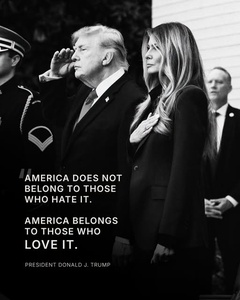
The stark black-and-white image of President Donald Trump standing beside Melania Trump carries a message that is difficult to miss. With Trump saluting and Melania standing with her hand over her heart, the photograph presents an unmistakably patriotic scene. Across the lower portion of the image appears the statement: “AMERICA DOES NOT BELONG TO THOSE WHO HATE IT. AMERICA BELONGS TO THOSE WHO LOVE IT.”
Unlike some political graphics that merely repeat a campaign slogan, this message has a much more confrontational meaning when placed in the context of Trump's recent speeches. The wording is not simply about patriotism. Trump has been using the phrase to draw a sharp political line between what he describes as Americans who love the country and political opponents whom he accuses of hating it.
The quote is authentic. During his speech at the Republican Midterm Convention in Dallas on September 9, Trump said that Democrats who, in his characterization, did not care about problems facing the country were “very, very wrong,” before declaring that America would prove it “does not belong to those who hate it” and instead belongs to those who love it.
The statement quickly became one of the defining lines of Trump's recent political appearances. It was not an isolated remark, either. Trump repeated essentially the same message at later campaign events, including rallies in North Carolina, Alabama and Ohio, tying it directly to the upcoming midterm elections and his effort to help Republicans maintain political strength.
That repetition is significant because the phrase transforms a traditional patriotic sentiment into an explicitly political argument.
For Trump and his supporters, “loving America” is presented as more than simply feeling affection for the country. It is connected to a particular political vision — stronger borders, tougher immigration enforcement, law-and-order policies, military strength, economic nationalism and opposition to what Trump describes as the radical left. His speeches have repeatedly portrayed the 2026 midterm elections as a major struggle over the future direction of the country.
At the Dallas Republican convention, for example, Trump attacked Democrats over immigration, crime and other issues before delivering the “America belongs to those who love it” line. The remark was met with chants of “USA” from the audience, reinforcing the emotional and patriotic character of the moment.
But the statement also raises a much more complicated question.
Who gets to decide whether another American “loves” the country?
That is where Trump's language becomes politically explosive.
America is deeply divided over what patriotism actually means. For Trump's supporters, patriotism may be expressed through supporting strict immigration controls, strengthening the military, protecting traditional institutions and resisting progressive policies they believe are damaging the country.
For many of Trump's critics, however, loving America can mean something very different. They may argue that criticizing the government, protesting presidential policies, supporting immigration reform or demanding greater civil rights is not hatred of the country at all. In their view, disagreement is itself part of the American political tradition.
That fundamental disagreement is what gives the image its power. The photograph does not show a policy document or a complicated legislative proposal. Instead, it presents Trump and Melania in a solemn patriotic setting while placing a simple moral distinction directly beside them: love America — or hate it.
The political message is therefore designed to be understood emotionally before it is analyzed politically.
And Trump has increasingly used that emotional framing as the 2026 midterm campaign intensifies. He has urged voters to treat the election as a referendum on the direction of the country and has repeatedly warned that Democratic victories could move America toward policies he strongly opposes. At the Republican convention, Trump described the coming election in almost existential terms, arguing that Republicans needed to defeat what he called radical elements within the Democratic Party.
Democrats and Trump's critics are likely to interpret the same language very differently. They could argue that describing political opponents as people who “hate” America crosses an important line because it turns a policy disagreement into a question of national loyalty. Once political opponents are characterized as people who hate their own country, compromise can become considerably more difficult.
That tension is hardly new in American politics. Politicians from both parties have frequently accused their opponents of abandoning American values, but Trump's rhetoric has often placed those accusations at the center of his political identity. His speeches regularly connect political disputes with broader questions of national identity, patriotism and the future of the United States.
The timing is also important.
With the 2026 midterms approaching, control of Congress is once again at stake. Trump has made clear that he wants Republican candidates to benefit from his political influence, repeatedly appearing at rallies and encouraging voters to treat the elections as a battle over the country's direction. At an Ohio rally on October 3, he again invoked the same “America belongs to those who love it” message while arguing that Republicans could overcome unfavorable polling if his supporters turned out.
That means the words displayed in this image are not merely a reflection of an earlier speech. They have become part of a broader campaign message that Trump continues to repeat.
There is also an interesting contrast in the photograph itself. Trump is shown saluting while Melania places her hand over her heart. The composition evokes a formal ceremony and emphasizes national symbols rather than the traditional visual language of a campaign rally. Against that background, the words about who America belongs to take on an almost presidential-declaration quality.
But beneath the patriotic imagery is a deeply political argument.
Trump is effectively asking voters to decide what kind of country they want — and, just as importantly, which political movement they believe genuinely represents American interests. His supporters may see the message as a declaration of patriotism and a defense of the country against policies they consider dangerous. His opponents may see it as another example of Trump dividing Americans into competing camps and questioning the patriotism of those who disagree with him.
The debate is unlikely to disappear as the election approaches. If anything, Trump's repeated use of the phrase suggests that it could become one of the central themes of the Republican campaign.
And that leaves a much bigger question hanging over the image:
If America truly belongs to those who love it, who gets to define what “loving America” means — and could that definition become one of the most important political battles of the 2026 elections?
Comments (0)
Loading comments...
May You Like

OBAMA STUNS ON INSTAGRAM: MESSAGE MARKING 34-YEAR MILESTONE SPARKS A BUZZ

TRUMP’S OHIO WARNING UNDER THE SPOTLIGHT