
Trump Declares Himself America’s “Greatest” President as Scholars’ Rankings Place Him Last — New Poll Reveals a Deeply Divided Nation
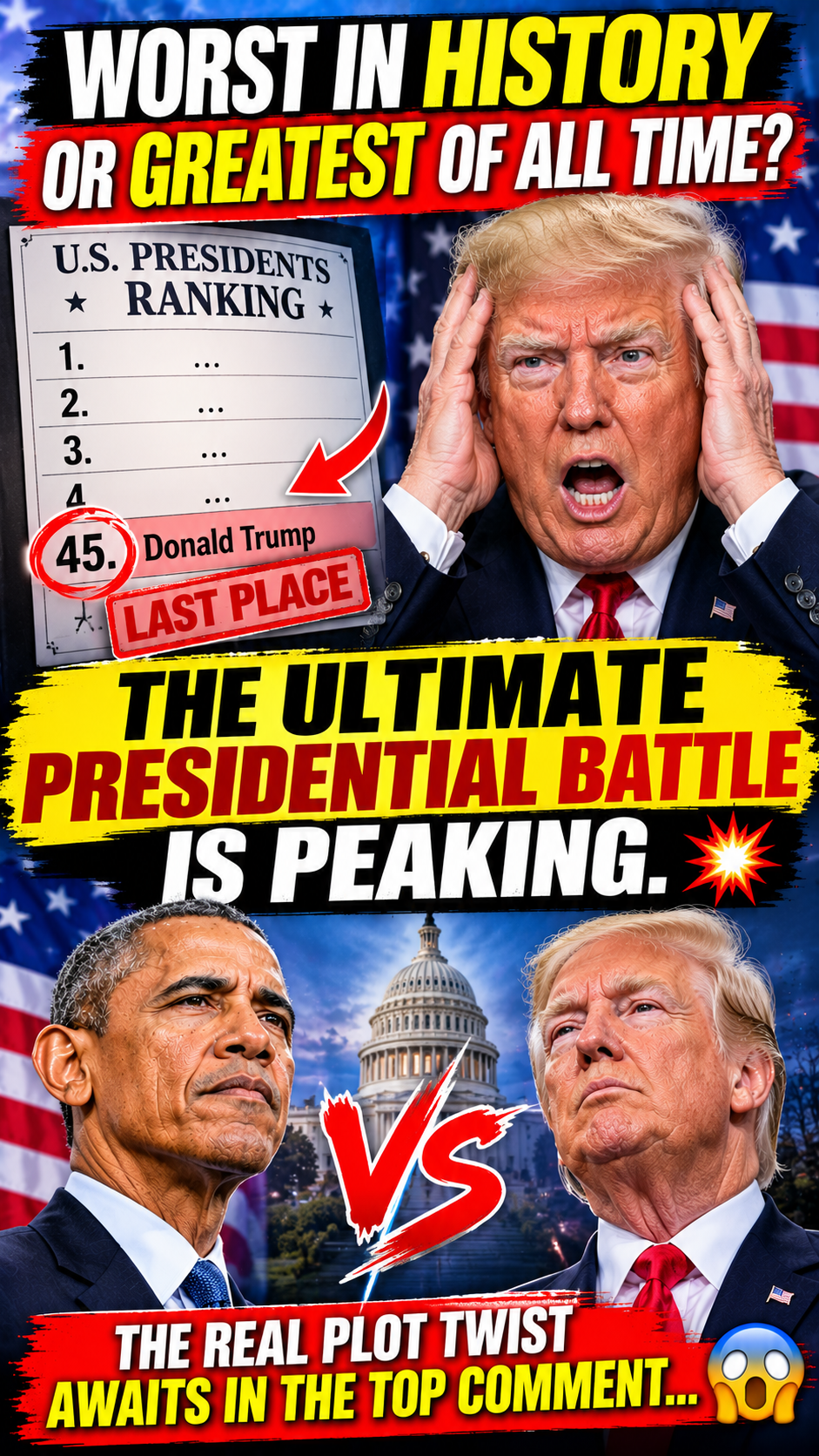
President Donald Trump has placed himself above some of America's most celebrated historical leaders in a social-media ranking of U.S. presidents, reigniting a dispute over presidential legacy at a time when academic researchers and public opinion surveys present sharply different assessments of his record.
The controversy centers on an extraordinary contrast. In an August 27 Truth Social post, Trump shared a graphic identifying himself as the country's greatest president, above Abraham Lincoln, George Washington and Franklin D. Roosevelt. Yet a major survey of presidential scholars placed him 45th out of 45 presidents, while ranking his predecessor Barack Obama seventh.
The competing assessments have attracted renewed attention ahead of the November 3 midterm elections, when voters will determine the balance of power in Congress during Trump's second administration.
But the most revealing development may not be either ranking. A national YouGov survey published October 5 found that Americans themselves hold sharply divided views of Trump: 20% described him as a great president, while 48% called his presidency a failure.
The figures offer a striking illustration of political polarization, although they measure different things. The academic ranking reflects the judgments of participating scholars, while the YouGov findings describe opinions among surveyed U.S. adults.
Neither should be mistaken for a definitive, universally accepted verdict on presidential history.
The story also requires an important clarification: the ranking placing Trump last was originally released in February 2024, not newly compiled in October 2026. Its findings were subsequently examined in a peer-reviewed academic article published in April 2026. Trump's self-ranking, by contrast, was posted in August 2026.
Those different dates matter because the scholarly assessment was conducted before Trump's second term began. It cannot, by itself, evaluate his full record through October 2026.

The academic assessment at the center of the controversy comes from the Presidential Greatness Project, led by political scientists Brandon Rottinghaus of the University of Houston and Justin Vaughn of Coastal Carolina University.
For its 2024 survey, the project invited 525 scholars from relevant academic disciplines to evaluate U.S. presidents. A total of 191 completed the questionnaire between November 15 and December 31, 2023, representing a response rate of approximately 36%.
Participants assigned presidents scores on a scale intended to measure overall historical greatness. The researchers then aggregated the responses into a ranking covering the 45 individuals who had served as president through Joe Biden.
The published results placed Abraham Lincoln first with a score of 93.87 out of 100, followed by Franklin D. Roosevelt at 90.83 and George Washington at 90.32.
Obama appeared seventh with a score of 73.80, while Trump occupied 45th place with 10.92.
What the scholars’ survey actually found
Selected scores from the 2024 Presidential Greatness Project Expert Survey. These are survey results, not an independent judgment by this article.
Source: Presidential Greatness Project, 2024 expert survey. Scores are on a 0–100 scale.
The survey's complete published ordering was as follows. It represents the views of the participating experts rather than an objective historical fact.
|
Rank |
|---|
President
Rank
President
1
Abraham Lincoln
24
William McKinley
2
Franklin D. Roosevelt
25
James K. Polk
3
George Washington
26
Grover Cleveland
4
Theodore Roosevelt
27
Gerald Ford
5
Thomas Jefferson
28
Martin Van Buren
6
Harry S. Truman
29
Rutherford B. Hayes
7
Barack Obama
30
James A. Garfield
8
Dwight D. Eisenhower
31
Benjamin Harrison
9
Lyndon B. Johnson
32
George W. Bush
10
John F. Kennedy
33
Chester A. Arthur
11
James Madison
34
Calvin Coolidge
12
Bill Clinton
35
Richard Nixon
13
John Adams
36
Herbert Hoover
14
Joe Biden
37
John Tyler
15
Woodrow Wilson
38
Zachary Taylor
16
Ronald Reagan
39
Millard Fillmore
17
Ulysses S. Grant
40
Warren G. Harding
18
James Monroe
41
William H. Harrison
19
George H. W. Bush
42
Franklin Pierce
20
John Quincy Adams
43
Andrew Johnson
21
Andrew Jackson
44
James Buchanan
22
Jimmy Carter
45
Donald Trump
23
William H. Taft
One finding attracted particular attention: Obama's position had risen from 16th in the project's 2015 survey to seventh in 2024.
Researchers described the movement as part of the changing historical assessment of presidential administrations, in which scholars revisit policies, institutions, crises and long-term consequences as new evidence and perspectives emerge.
Trump's placement also reflected concerns expressed by participating scholars about his first-term conduct, including his challenges to the 2020 election result and the January 6, 2021, attack on the Capitol. Those were among the issues identified in reporting about the survey and the wider debate over his presidency.

The findings do not mean all historians agree on every president's place in history.
Even within academic research, rankings depend on how presidential performance is defined, the questions asked, the scholars invited and the historical period being assessed.
The Presidential Greatness Project asks respondents for an overall assessment. Other studies divide presidential performance into separate categories such as crisis leadership, economic management, public persuasion, administrative skills and relations with Congress.
The distinction helps explain why different studies produce different results.
In C-SPAN's 2021 Presidential Historians Survey, for example, Trump ranked 41st out of 44 former presidents, not last. Obama ranked 10th.
That survey involved 142 historians and professional observers, who evaluated presidents across ten leadership characteristics.
C-SPAN reported that Trump performed comparatively better in public persuasion and economic management than in moral authority and administrative skills, where respondents placed him last.

In other words, the claim that scholars unanimously consider Trump the worst president in American history would overstate the evidence.
The narrower, supportable conclusion is that Trump placed last in the 2024 Presidential Greatness Project survey and near the bottom in another prominent survey conducted in 2021.
His supporters dispute those assessments, arguing that scholars place insufficient weight on his policy accomplishments and that academic institutions can reflect ideological preferences.
The Presidential Greatness Project researchers examined ideological differences among respondents. Their analysis found that party affiliation affected some presidential evaluations, especially those involving recent political figures, although several broader patterns were consistent across groups.
The project's publicly available partisan breakdown also shows that Democratic-identifying respondents outnumbered Republican-identifying respondents. That is a relevant methodological consideration when interpreting its results.

Trump's own response took a dramatically different form.
On August 27, he posted a presidential ranking on Truth Social that placed him alone in a category labeled “The Greatest.”
Lincoln, Washington and Roosevelt were among the historical presidents placed in lower categories, while Obama and Biden were assigned to a group described as failures.
Mediaite reported that the image appeared to adapt a presidential ranking originally published by LIFE magazine in 1948, with several modern presidents added and Trump's name positioned at the top.
The graphic omitted numerous presidents and was not a newly conducted scholarly survey. It was a political statement shared by Trump, rather than a research-based assessment using an explained methodology.
The president's assertion is consistent with his longstanding tendency to characterize his own administration in historically exceptional terms.
Supporters frequently cite his judicial appointments, tax legislation, immigration policies, trade negotiations and foreign-policy decisions as achievements they believe deserve greater recognition.
Critics point to his conduct surrounding the 2020 election, his two impeachments, the January 6 attack and controversies over executive power, democratic institutions and the rule of law.
Those competing interpretations reflect different priorities and judgments about the presidency. Individual claims about policy outcomes can be evaluated through historical records and measurable results, but broad descriptions of presidential greatness inevitably involve judgments about which outcomes matter most.
A separate question is whether ordinary Americans evaluate presidents the same way scholars do.
The answer, according to recent survey evidence, is more complicated.
What Americans said in the latest public survey
YouGov surveyed 2,175 U.S. adult citizens from September 1 through September 6, 2026, asking respondents to classify presidents using categories ranging from great to failure.
The results, published October 5, showed that Lincoln received the largest share of great ratings, at 57%, followed by Washington at 52% and Kennedy at 37%.
Trump received a great rating from 20% of respondents, while 48% classified his presidency as a failure.
The survey also found that 31% of respondents rated Obama as great.
YouGov reported an overall margin of error of approximately three percentage points.
How U.S. adults rated selected presidents
Share describing each president as “great,” YouGov, September 1–6, 2026
The public survey reveals something important about the relationship between historical reputation and political identity.
Trump attracted both a substantial share of the highest ratings and an unusually large share of the lowest ratings.
YouGov reported that 48% of respondents described Trump as a failure, compared with 35% for Biden and 28% for Richard Nixon.
These findings show that Americans do not necessarily share a common assessment of recent presidents. The differences are particularly pronounced when respondents evaluate political figures who remain active in contemporary public life.
YouGov's survey also illustrates the limits of public familiarity with presidential history.
Many respondents were uncertain how to assess presidents who served in the 18th and 19th centuries, including figures whose administrations receive extensive attention from historians.
Recent presidents, by contrast, are more familiar to voters and are often evaluated through current political loyalties and personal experiences.
That makes comparisons between historical experts and the general public informative but imperfect. The two groups may possess different levels of historical knowledge, use different criteria and interpret the same events through different political perspectives.

The timing of Trump's renewed argument about presidential greatness is also politically significant.
The United States is approaching its November 3 midterm elections, with control of Congress at stake during Trump's second term.
The president's supporters and opponents are debating the administration's economic record, immigration enforcement, foreign policy and use of executive authority.
Those are issues voters can evaluate through current policy proposals, government statistics, legislative records and the positions of candidates on the ballot.
Historical rankings offer a broader perspective, but they are not substitutes for examining present-day policy decisions.
There is also an important limitation in applying the 2024 expert survey to Trump's current administration.
The respondents completed their assessments in late 2023, before Trump returned to the presidency in January 2025.
His second-term decisions, including subsequent executive actions, economic policies and foreign-policy developments, therefore were not part of that original assessment.
Any comprehensive historical evaluation of his two terms would need to account for the second administration and its long-term consequences.
The peer-reviewed article published in April 2026 analyzed the earlier survey. It did not turn those earlier responses into a fresh evaluation of the second term.

The debate also raises a larger historical question: how much weight should be given to presidential achievements compared with institutional conduct, crises, economic performance and long-term consequences?
Lincoln's historical reputation, for example, is closely associated with his leadership during the Civil War and the destruction of slavery.
Franklin Roosevelt's is shaped by the Great Depression, the New Deal and World War II.
Washington's place in American history reflects his leadership in the nation's founding and his role in establishing presidential precedents, including the peaceful transfer of power.
These presidents governed in dramatically different circumstances, which complicates any attempt to compare them using a single numerical scale.
Presidential reputations can also change over time.
The 2024 expert survey documented an improvement in the scholarly standing of Ulysses S. Grant, whose administration has received renewed historical attention for its efforts to defend Reconstruction and civil rights.
Andrew Jackson's position moved downward as historians increasingly examined the consequences of his policies toward Native Americans.
Those changes demonstrate that historical assessment is an evolving field rather than a fixed scoreboard.
The same principle applies to modern presidents.
Obama's place in the academic survey reflects the views of the scholars who participated, but future researchers may place different emphasis on the Affordable Care Act, the financial crisis recovery, foreign policy, executive actions and other aspects of his presidency.
Trump's historical standing may also be reassessed as researchers examine the consequences of both his administrations, including policies whose effects are not yet fully known.
What can be established today is that prominent academic surveys have evaluated Trump unfavorably, Trump has publicly rejected that picture by presenting himself as the greatest president, and public polling reveals sharply divided opinions among Americans.
Those are three distinct findings, not three interchangeable measurements.
The graphic's suggestion that scholars have only just issued a new ranking, followed by an immediate Truth Social counterattack, compresses developments from different dates into one dramatic confrontation.
The original expert ranking was released in 2024. Trump's self-ranking appeared in August 2026. The YouGov public survey was conducted in September and published in October.
Together, they provide a revealing picture of how presidential reputations are contested in modern America.
The larger story is not simply whether one president belongs at the top or bottom of a list. It is how Americans decide what constitutes presidential leadership, which historical evidence they trust and how political identities shape interpretations of the country's past.
As the 2026 midterms approach, those arguments are likely to remain part of the national conversation. But neither a social-media declaration nor a single academic survey can settle the historical record for all Americans.
The available evidence establishes what participating scholars and surveyed citizens have said. The broader historical interpretation will continue to develop.
Comments (0)
Loading comments...
May You Like


WWE BRONSON REED DEAD AT 38, STIMULANTS DETECTED, $10M INSURANCE PAYOUT FROZEN!










Popular Posts



