
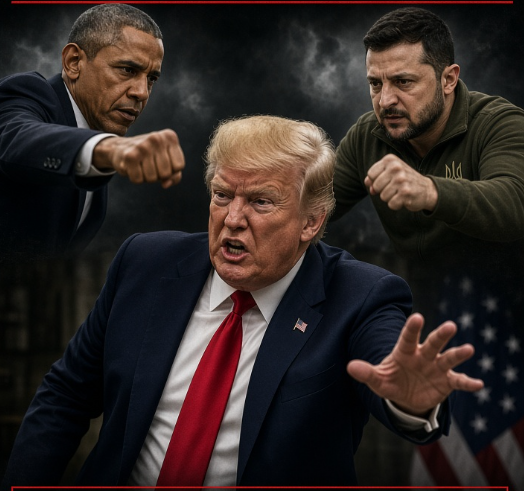
OUTNUMBERED AND CORNERED BY SIMULTANEOUS ATTACKS FROM OBAMA AND ZELENSKY - HOW WILL TRUMP RETALIATE?
## A morning with no good news
In this hypothetical scenario, everything begins with two headlines appearing almost simultaneously. On one side is a large-scale media campaign launched by Barack Obama, aimed directly at Donald Trump’s domestic and foreign credibility. On the other is a carefully prepared speech by Volodymyr Zelensky, in which he questions Washington’s commitment to European security and accuses the White House of hesitating before a conflict that cannot be postponed.
Two strikes. Two fronts. One target: Donald Trump.
In political logic, the danger is not that one opponent speaks out. The danger is that two opponents on two different battle lines speak out at the same time, creating the perception that Trump is surrounded. One is a former U.S. president who still carries enormous influence within the Democratic Party and in the media. The other is the president of a country at war, someone who can turn every hesitation in Washington into a life-or-death issue.
The question now on every mind in Washington is: how will Trump retaliate? And does he have enough time to retaliate before these two attacks merge into a single political storm?
## Strike one: Obama and the strategy of “soft encirclement”
In this hypothetical scenario, Obama does not step forward with a harsh speech. He chooses the more dangerous approach: appearing as a calm political elder, someone who does not need to shout to force his opponent onto the defensive. His campaign is rolled out on three levels.
The first level is media. A series of articles, interviews, and podcasts are staged to revisit the weak points in Trump’s foreign policy. There are no criminal accusations. No inflammatory language. Just questions placed in exactly the right spots: Who is protecting the allies? Who is weakening America’s position? Who is turning foreign policy into a performance?
The second level is partisan. Obama is said to have contacted governors, senators, and major Democratic donors, pushing a unified message: Trump is not only controversial at home, but is also damaging America’s credibility abroad. This message does not need concrete evidence. It only needs to be repeated often enough.
The third level is international. In this scenario, Obama appears at an international forum and remarks that “America should not let domestic politics become a risk to global security.” The sentence does not mention Trump by name, but everyone understands. It is the kind of attack that leaves no fingerprints, yet creates enormous pressure.
For Trump, this is the most uncomfortable kind of opponent. He cannot accuse Obama of being “hostile.” He cannot say Obama is sabotaging America without triggering a backlash. And most importantly: Obama does not need to win. He only needs to make Trump lose his composure.
## Strike two: Zelensky and pressure from the front line
If Obama attacks credibility, Zelensky attacks legitimacy. In this hypothetical scenario, Zelensky speaks before a European security conference with the tone of a man demanding clarity. He does not personally attack Trump. He questions Washington’s commitment. He says that “the hesitation of a superpower can make an entire continent pay the price.” He repeats that Ukraine is fighting not only for Ukraine, but for the international order.
This is an extremely difficult strike to handle. If Trump reacts harshly, he will be accused of abandoning an ally. If Trump stays silent, he will be accused of lacking courage. If Trump increases aid, he will be criticized by the right. If Trump reduces aid, he will be criticized by the left and by European allies.
Zelensky, in this scenario, does not need to beat Trump. He only needs to put Trump in a position where he must choose. And in politics, sometimes being forced to choose is more dangerous than being attacked directly.
## Why are these two strikes so dangerous together?
A single attack can be blocked. Two attacks at the same time create a “two-front” effect. Trump must not only deal with a political opponent at home. He must also deal with an ally applying pressure abroad. Every response he makes on one front creates consequences on the other.
If Trump focuses on responding to Obama, he will be accused of ignoring Zelensky. If Trump focuses on supporting Zelensky, he will be accused of letting Obama drive the domestic narrative. If Trump attacks both, he will be accused of lacking control. If Trump stays silent, he will be accused of lacking strategy.
This is why analysts in this scenario call it a “triangular trap”: Trump, Obama, and Zelensky form the three points of a structure in which any action by Trump can be interpreted unfavorably.
## How will Trump retaliate? Five scenarios
### Scenario 1: A direct media counteroffensive
Trump has an advantage no one denies: his ability to dominate the media. In this scenario, he could hold a major press conference, attack Obama as “a former president interfering in current politics,” and accuse Zelensky of “putting on a show” to extract more aid. This helps him hold attention, but carries a risk: it frames him as the defender in the eyes of some swing voters.
### Scenario 2: Using executive power
Trump could order reviews of aid programs, adjust foreign policy, or change senior personnel to send the message that he is in control. This is an institutional form of retaliation, but it often takes time and is easily criticized as “political revenge.”
### Scenario 3: Pulling Zelensky into a bilateral game
Instead of confronting him publicly, Trump could invite Zelensky to Washington, stage a heavily covered meeting, and turn pressure into a deal. This helps him project leadership, but could be seen as conceding to pressure.
### Scenario 4: Pivoting to economics
Trump could retaliate through economic measures: tariffs, trade adjustments, or pressure on European allies. This is indirect retaliation, but it could escalate tensions beyond control.
### Scenario 5: Reorganizing alliances
Trump could try to split the Obama-Zelensky alignment by convincing part of Europe that Zelensky is asking for too much, or convincing part of the American electorate that Obama is benefiting a foreign adversary. This is the most dangerous form of retaliation, because it turns foreign policy into an internal war.
## The biggest risk: losing control of the narrative
In this hypothetical scenario, Trump’s biggest risk is not Obama or Zelensky. His biggest risk is letting these two opponents define the story. Once the public believes Trump is surrounded, every response he makes can be viewed through that lens. If he is forceful, he is seen as reckless. If he is moderate, he is seen as weak. If he is silent, he is seen as stuck.
The most effective retaliation, therefore, is not to answer every blow. It is to change the playing field. Trump needs to create a new issue that forces Obama and Zelensky to react, instead of letting them lead. He needs a media win big enough to overshadow the two old headlines. He needs a deal clear enough to prove he still controls foreign policy. And he needs a message simple enough for voters to understand that he is not cornered.
## Conclusion: retaliate by refusing to be cornered
In politics, being attacked from two sides does not mean defeat. It only means the game has become harder. Trump, with his instinct for media and his ability to generate attention, can turn pressure into fuel. But he can also turn pressure into a mistake.
The final question is not “who will Trump retaliate against first?” It is “does Trump have enough composure not to turn himself into the victim of a story written by others?”
If the answer is yes, he escapes the triangular trap. If the answer is no, Obama and Zelensky will not need to do anything more. They will simply stand and watch.
Comments (0)
Loading comments...
May You Like

FCC CLEARS SPACEX FOR ONE MILLION AI SATELLITES AS ASTRONOMERS SOUND ALARM

THANKSGIVING NIGHTMARE: OVER 1M BLACKOUTS, NEARLY 2M WATER ALERTS!

TRUMP NAMES PICKAXE TARGET AS NETANYAHU PUSHES FOR MORE IRAN STRIKES
Latest Posts








Popular Posts





