
Bad Bunny Is American—But What About Nicki Minaj? Viral Trump Comparison Sparks Citizenship Debate
Bad Bunny Is American—But What About Nicki Minaj? Viral Trump Comparison Sparks Citizenship Debate
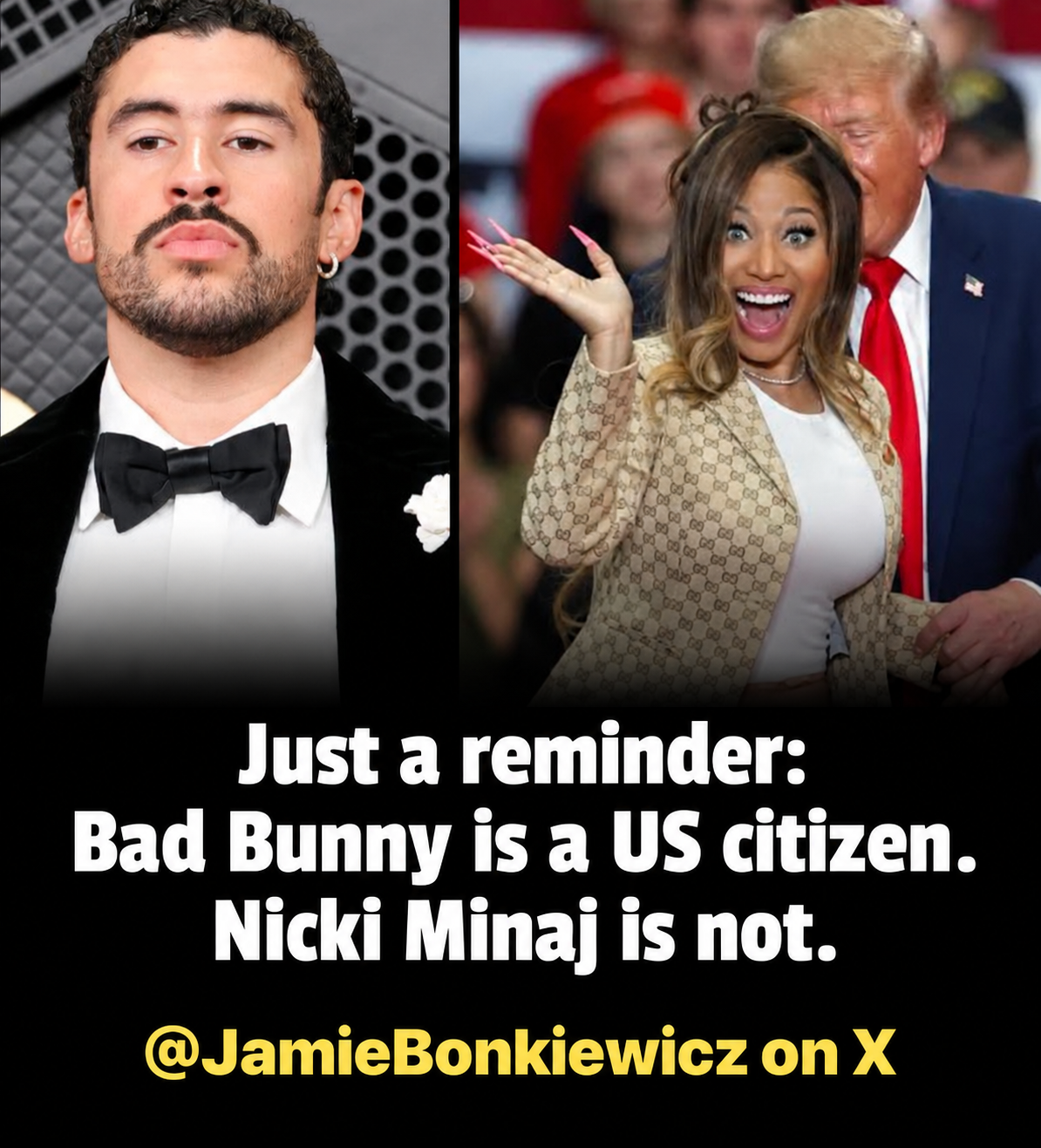
A viral comparison involving Bad Bunny and Nicki Minaj has reignited a surprisingly complicated debate about American citizenship, celebrity politics and President Donald Trump. The graphic circulating online makes a blunt claim: Bad Bunny is a U.S. citizen, while Minaj is not. The first assertion is straightforward; the second requires more care.
Bad Bunny, whose real name is Benito Antonio Martínez Ocasio, was born in Puerto Rico. People born in Puerto Rico are U.S. citizens under federal law, a fact sometimes overlooked when political arguments treat the island as though it were a foreign country.
Puerto Rico is a U.S. territory, not a state. Its residents have American citizenship, although their voting rights in presidential elections differ depending on where they live. A Puerto Rico resident generally cannot vote for president in the general election, while a Puerto Rican citizen living in a U.S. state can.
That distinction matters because online arguments frequently blur citizenship, residence and eligibility to vote. The singer's birthplace does not make him any less American, regardless of how people feel about his music or political opinions.
Minaj's story is different. Born in Trinidad and Tobago, she moved to the United States as a child and built an internationally successful career in hip-hop. She has spoken openly about her immigration experience and her complicated relationship with American politics.
In a 2024 livestream, Minaj said she was not a U.S. citizen, despite living and working in the country for years. Her remark attracted attention because she is such a prominent figure in American popular culture.
But an old public statement does not automatically establish someone's current legal status. In January 2026, Minaj suggested that she was finalizing citizenship paperwork, and later reports noted that she had not publicly confirmed completion of the naturalization process.
That means the most accurate description is narrower than the viral graphic's categorical claim: Bad Bunny's U.S. citizenship is clear, while Minaj's current citizenship status has not been independently established through publicly available confirmation.
The contrast became politically charged as Minaj developed a conspicuous public alliance with Trump. She appeared alongside the president at a January event promoting Trump Accounts, an administration initiative focused on savings for children.
At that event, Minaj described herself as an enthusiastic Trump supporter. Their joint appearance generated widespread coverage, partly because the rapper had previously criticized policies associated with his first administration.
In 2018, Minaj spoke out against family separations at the southern border, describing the distress children might feel when removed from their parents. Her comments drew on her own experience of coming to America at a young age.
Her later support for Trump has therefore prompted debate over whether her political views have changed, whether immigration policy remains a concern for her, and how celebrities reconcile personal histories with political alliances.
In October 2026, Minaj appeared with Trump at a campaign rally in Port Huron, Michigan, reinforcing her role as a high-profile celebrity supporter during the final stretch before the midterm elections.
The rally also brought renewed attention to a basic election-law distinction: a person can advocate for a candidate or party without being eligible to cast a ballot. Voting in federal elections is reserved for U.S. citizens who meet other applicable requirements.
Bad Bunny, meanwhile, has become an important cultural voice in discussions about Puerto Rico, identity and the relationship between the island and the mainland United States. His prominence makes misunderstandings about Puerto Rican citizenship especially visible.
None of these facts determines which artist has a more legitimate political opinion. Citizenship status and freedom to express political views are different questions, and public debate does not belong only to voters.
The viral image also shows how a short slogan can flatten complicated legal realities. Naturalization, permanent residency, birthplace and voting eligibility are not interchangeable concepts, even when social media posts treat them as such.
Minaj's reported citizenship paperwork is a particularly important example. An announcement that paperwork is being finalized is not the same as official confirmation that a person has become a citizen, and public records do not necessarily resolve an individual's immigration status.
For readers following the controversy, the most useful questions are not which musician wins a political argument but which claims can be verified, which remain uncertain, and how immigration terminology is being used.
As the midterm campaign intensifies, the Bad Bunny–Minaj comparison offers another reminder that celebrity endorsements can dominate headlines while the underlying legal facts require more nuance than a viral graphic can provide.
Comments (0)
Loading comments...
May You Like

FCC CLEARS SPACEX FOR ONE MILLION AI SATELLITES AS ASTRONOMERS SOUND ALARM

TRUMP'S BIGGEST THANKSGIVING “PARDON”? WHY IS HE BACKING NVIDIA'S JENSEN HUANG?

BLACK FRIDAY TENSIONS IN NYC — DID PROTESTERS CROSS THE LINE AT A DISNEY STORE?














