
Barack Obama Faces ‘You're Not President Anymore’ Backlash as His Attacks on Trump Reignite Political Firestorm
Barack Obama Faces ‘You're Not President Anymore’ Backlash as His Attacks on Trump Reignite Political Firestorm
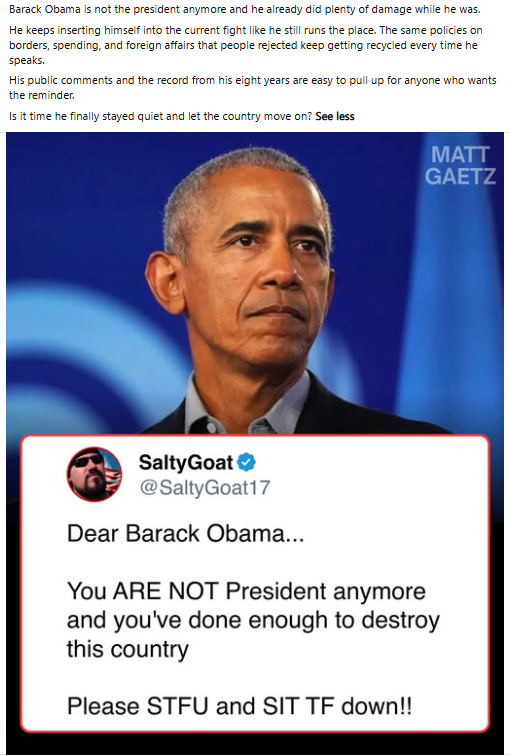
A sharply worded social media post telling former President Barack Obama that he is no longer in office has become a vivid example of the anger surrounding his return to the campaign trail. The message, reproduced in a circulating image, urges Obama to stop commenting on the nation's direction.
The graphic attributes the remark to an account called SaltyGoat. Its language is unmistakably hostile, but the image alone does not establish when the original post was published, how widely it circulated, or whether the account's displayed verification symbol was authentic.
The criticism arrives amid a consequential political moment. With the November 3, 2026, midterm elections approaching, Obama has appeared at Democratic campaign events to argue that voters should check President Donald Trump's power.
Obama served as the 44th president from January 2009 to January 2017. His presidency is over, but former presidents retain the same general rights as other citizens to speak, organize, endorse candidates, and participate in political debates.
For some Trump supporters, Obama's renewed prominence is frustrating. They argue that a former president should allow the current administration to govern without constant intervention from his predecessor.

For Obama's supporters, however, his involvement is ordinary democratic participation. They point out that public figures do not lose their right to challenge government decisions after leaving elected office.
The dispute has intensified because Obama's criticism has been unusually direct. During an October 24 campaign appearance in Cleveland, he blamed decisions by the Trump administration for rising costs and criticized its approach to the war involving Iran.
He also presented the midterms as an opportunity for voters to impose accountability on the administration, linking the outcome of congressional races to the balance of political power in Washington.
Obama appeared in Michigan as well, supporting Democratic Senate candidate Abdul El-Sayed in a competitive contest against Republican Mike Rogers. The campaign appearances underscored how aggressively Democrats are deploying high-profile surrogates.
The former president's attacks have not been limited to policy. He has mocked White House renovations and questioned the priorities of Trump's leadership, provoking counterattacks from the president and his allies.

On October 28, Obama continued the criticism at a rally near Atlanta, campaigning alongside Democrats including Senator Jon Ossoff and gubernatorial candidate Keisha Lance Bottoms.
At that event, he joked about the administration's reaction to his remarks about White House decor, then redirected his comments toward household affordability and what he characterized as conflicts between public duty and private gain.
The viral-style image captures one side of a larger argument: whether Obama's continued political visibility is a useful warning about current policies or an unwelcome attempt to shape the agenda after his own term ended.
It also makes broad accusations about damage allegedly caused during Obama's eight years in office. Those claims are political judgments rather than facts demonstrated by the image, and assessing his record requires examining specific policies and outcomes.
His administration's legacy remains contested across health care, economic recovery, immigration enforcement, foreign policy, and the federal budget. Different voters weigh the achievements and failures of those years very differently.

The image's suggestion that Obama is still somehow running the country is not supported by evidence presented in the post. Trump is the sitting president; Obama holds no presidential authority.
Still, influential former leaders can shape party messaging and mobilize voters. Their public statements can affect campaign attention without giving them the legal powers of office.
The exchange also illustrates how political memes simplify complex disagreements. A few blunt sentences can travel farther than a detailed policy debate, especially when paired with a recognizable face and provocative typography.
As the midterms draw near, Democrats are emphasizing affordability and oversight while Republicans defend the administration and warn against a Democratic congressional majority. The rhetoric from both camps has grown increasingly personal.
Ultimately, the dispute is less about whether Obama is still president—he clearly is not—than about who gets to influence the national conversation. Voters will decide how much weight to give his criticism, Trump's responses, and the competing visions presented before Election Day.
Comments (0)
Loading comments...
May You Like

WWE BRONSON REED DEAD AT 38, STIMULANTS DETECTED, $10M INSURANCE PAYOUT FROZEN!

WWE BRONSON REED—STAR COLLAPSES AT COMPANY EVENT, FATAL DRUG REACTION SUSPECTED!

MINNESOTA NIGHTMARE—UNDERGROUND GAS LEAK, HUNDREDS OF HOMES AT RISK, $300M DAMAGE!










Popular Posts


