
Barack Obama in a Devastating Critique
Barack Obama Says U.S. Is ‘Back Where We Were’ After Trump’s Iran War, in a Devastating Critique
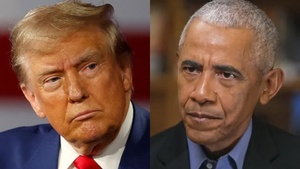
WASHINGTON — Former President Barack Obama has publicly dismantled the rationale and results of President Donald Trump’s war with Iran, saying the United States has spent billions, lost lives, and ended up “back where we were” before the conflict began—or possibly worse.
In a series of interviews aired in mid-June 2026, Obama questioned the entire premise of the military campaign that Trump launched in February, pointing out that the war has produced no outcome superior to the 2015 nuclear agreement he negotiated and Trump abandoned .
The One Sentence That Stung
Obama’s most devastating assessment came during an interview with NBC News’ “Today” show, aired on June 19, as he stood at the opening of his presidential center in Chicago.
“We’ve now fought a war, spent billions of billions of dollars, put enormous strain on our military, a lot of people have died, and it feels like we’re back where we were before we started the war, except maybe a little bit worse,” Obama said .
That single sentence crystallized a critique that had been building for months among critics of the war, but carried unique weight coming from a former commander-in-chief whose own nuclear deal was the very agreement Trump had spent years deriding.
A Deal That Was Working, Until It Wasn’t
Obama’s argument rested on a straightforward chain of events. In 2015, his administration negotiated the Joint Comprehensive Plan of Action (JCPOA), under which Iran agreed to significantly scale back its nuclear program in exchange for sanctions relief .
“That deal worked for a long stretch of time before the United States pulled out of it,” Obama said in an earlier interview with ABC News .
Trump withdrew from the JCPOA in 2018, calling it the “worst deal ever.” Obama noted that the withdrawal led directly to Iran expanding its nuclear capacity .
“This administration, or a prior version of this administration, pulled out of it, which caused then Iran to develop more nuclear capacity,” Obama said .
The ‘Bully or Bomb’ Fallacy
Beyond the specifics of the Iran deal, Obama used the moment to articulate a broader critique of American foreign policy—one that implicitly targeted Trump’s approach.
“You can’t just bully our way or bomb our way to solutions,” Obama said, adding, “You’d think we would have learned that lesson by now” .
He warned that the appeal of military force often obscures the patient work of diplomacy, which can produce agreements that resolve “80 or 90%” of a problem without the catastrophic costs of war .
“It sometimes seems attractive to think we can impose our will by force or by bombing,” Obama said. “But the better path is to take the time to explore diplomatic avenues” .
What the War Actually Produced
Obama’s critique gained additional force from the specifics of what Trump’s war actually achieved. After more than 100 days of fighting, the conflict ended with a memorandum of understanding—not a formal treaty, lacking legal binding force, and merely setting a 60-day window for further negotiations toward a permanent peace agreement .
In other words, the war’s ultimate product was an extension of the diplomatic process that had existed before the bombing began—but with billions of dollars spent, military strain incurred, and lives lost .
Trump had claimed that “annihilating Iran” created “peace in the world,” a statement he repeated in a September 2026 interview with TIME magazine . But Obama’s assessment suggested that the war had produced no enduring strategic gain.
The Netanyahu Connection
Obama also revealed in a separate interview that Israeli Prime Minister Benjamin Netanyahu had used the same arguments to push Trump toward military action that he had once used to try to persuade Obama—arguments that were previously rejected as ineffective .
Obama said he remained skeptical whether Netanyahu had achieved his objectives, and questioned whether the war ultimately served Israeli or American interests .
A Warning About Repetition
Perhaps the most cutting element of Obama’s critique was his framing of the entire episode as a failure to learn from history.
“It is doubtful that any agreement that arises is going to be significantly different or a significant improvement from the deal that we had in the first place,” Obama said in his ABC News interview .
“You’d think we would have learned this lesson by now, but it seems we have to learn it again every so often” .
The implicit message was unmistakable: Trump had spent years attacking Obama’s Iran deal as weak and inadequate, launched a war to get a “better” deal, and ended up right back where he started—except with a higher price tag paid in blood and treasure.
The White House Response
The White House did not immediately respond to Obama’s remarks. But the timing of his critique was notable—coming just as Trump was attempting to frame the ceasefire and memorandum as a foreign policy victory .
Obama acknowledged he was “very happy to see a ceasefire” and hopeful it would hold, but his overall assessment remained withering .
A Legacy Argument
For Obama, the critique was also a defense of his own legacy. Trump had made the JCPOA a central target of his first-term foreign policy, withdrawing from it in 2018 and promising to replace it with something far better .
Obama’s message was that Trump never delivered on that promise—and that the war meant to produce a better deal had instead produced a weaker one.
“We spent billions. People died. And we’re back where we started,” Obama said. “Maybe worse” .
It was, in the end, a devastating indictment delivered in a single sentence—one that no amount of White House spin could easily undo.
Comments (0)
Loading comments...
May You Like

gfnhgmnghnmfgnbvvvvvvvvv
Jack Smith Defends His Integrity as Trump Investigations Face Renewed Political Firestorm
TRUMP HIT WITH 26 ARTICLES OF IMPEACHMENT














