
Barack Obama Leads CNN/SSRS Poll When Americans Are Asked Which U.S. President They Admire Most
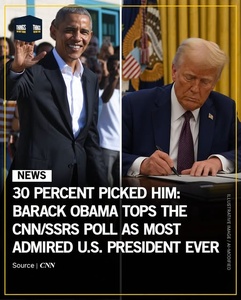
Former President Barack Obama leads a new CNN poll conducted by SSRS when Americans are asked which U.S. president they admire most, with 30% naming Obama in an open-ended question.
President Donald Trump placed second at 19%, while Abraham Lincoln and Ronald Reagan each received 9%. John F. Kennedy followed at 6%, and George Washington was named by 5%.
The survey does not show that 30% of Americans consider Obama the “greatest” president. Instead, respondents were asked which president in U.S. history they personally admired most.

That distinction matters because admiration, favorability, job approval and assessments of presidential performance measure different attitudes. The question was open-ended, meaning respondents were not choosing from a supplied list.
The same CNN/SSRS survey found that 57% of Americans held a favorable view of Obama, making him the most favorably viewed living president measured in the poll.
Trump was viewed favorably by 34% of respondents, while former President Joe Biden received a 30% favorable rating. George W. Bush stood between those figures, with 42% viewing him favorably.
Partisanship strongly shaped the admiration results. Among Democrats, 64% named Obama as the president they admired most, far ahead of Kennedy, Lincoln and Franklin D. Roosevelt.
Among Republicans, 53% selected Trump as the president they admired most. Ronald Reagan followed at 18%, Lincoln at 8%, while Kennedy and Washington each received 5%.
Those figures show different partisan patterns: Obama received 64% among Democrats, while Trump received 53% among Republicans who participated in the nationally conducted CNN/SSRS survey.
Obama also performed more strongly among political independents on favorability. CNN reported that his standing with independents was more than twice as high as the comparable ratings for Trump or Biden.
The poll also captured changing public memories of earlier presidents. More than four in ten adults younger than 30 said they had no opinion of either George W. Bush or Bill Clinton.
CNN noted that many younger adults came of age politically after Obama’s presidency, making recent presidents more familiar than leaders whose administrations ended before they reached adulthood.
Other living former presidents attracted relatively few answers to the most-admired question. Bill Clinton received 2%, while Biden and George W. Bush were each named by 1% of respondents.
Nearly 10% of those surveyed either said they did not admire any president or offered no opinion, another reminder that Obama’s 30% represented a plurality rather than a majority.
The CNN poll was conducted by SSRS from May 7 through May 31, 2026, among 2,480 adults nationwide, using a combination of online interviews and telephone interviews.
SSRS said the sample was assembled from address-based sampling and randomly generated prepaid cellphone numbers. Respondents were contacted through mail, telephone or text before completing the survey.
For the full sample, the reported margin of sampling error was plus or minus 2.7 percentage points, meaning small differences should be interpreted with the survey’s statistical uncertainty in mind.
The poll was released as Obama returned to public attention for the opening of the Obama Presidential Center in Chicago, nearly a decade after he left the White House.
The timing placed renewed attention on Obama’s political legacy, while the survey offered a snapshot of how Americans in 2026 remembered him alongside Trump, Biden and earlier presidents.
The central finding is therefore narrower than some social-media headlines suggest: Obama received the largest share in this particular open-ended admiration question, while substantial partisan divisions remained clearly visible.

Comments (0)
Loading comments...
May You Like

Jack Smith Defends His Integrity as Trump Investigations Face Renewed Political Firestorm

TRUMP’S OHIO WARNING UNDER THE SPOTLIGHT














