
Barack Obama Leads the 2026 Poll on America’s Most Admired President. What Does That Really Mean?
Barack Obama Leads the 2026 Poll on America’s Most Admired President. What Does That Really Mean?
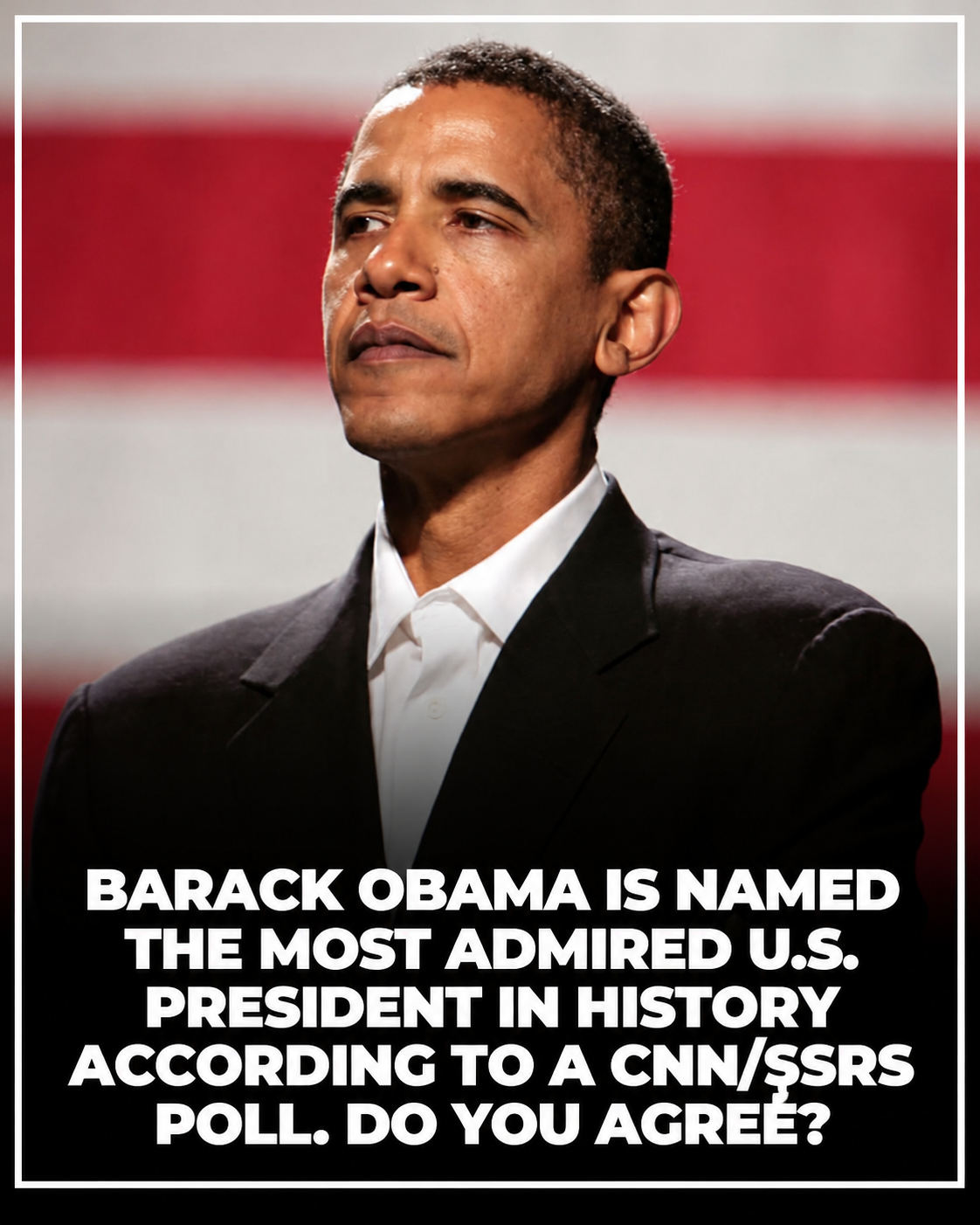
A striking claim is circulating online: Barack Obama has been named the most admired United States president in history. The graphic attributes the conclusion to a CNN/SSRS poll and asks viewers whether they agree. There is a real survey behind the claim, and its findings are notable. But the wording deserves a closer look.
In a CNN poll conducted by SSRS in May 2026, respondents were asked an open-ended question about which president in U.S. history they admired most. Thirty percent named Obama, placing him first among the answers recorded. President Donald Trump followed at 19 percent. Abraham Lincoln and Ronald Reagan each received 9 percent, while John F. Kennedy received 6 percent and George Washington 5 percent.
That is a clear lead in this particular survey. It is not, however, the same thing as a formal declaration that Obama is objectively the greatest president in American history. The poll measured whom respondents said they admired most, not a comprehensive historical judgment based on presidential performance, constitutional impact, crisis leadership, or long-term consequences.
The distinction matters because the phrase ‘most admired’ can sound like a settled national verdict. In reality, the result describes the distribution of answers in one survey at one moment. It captures public sentiment, including the political identities, memories, and current events shaping respondents’ views in the spring of 2026.
The survey was conducted from May 7 through May 31, 2026, among 2,480 adults nationwide. SSRS used a combination of online and telephone interviews, drawing respondents from an address-based sample and a random-digit-dial sample of prepaid cell phone numbers. The reported margin of sampling error for the full sample was plus or minus 2.7 percentage points.
A margin of error is not a guarantee that every subgroup estimate is equally precise, nor does it account for every possible source of survey error. Still, the sample size and published methodology provide a basis for taking the national result seriously while remembering that polls are estimates rather than exact counts of every American’s opinion.
The same CNN/SSRS survey also measured favorability toward recent presidents. Fifty-seven percent of respondents viewed Obama favorably. By comparison, 34 percent viewed Trump favorably and 30 percent viewed former President Joe Biden favorably. Those numbers reinforce the finding that Obama currently enjoys a stronger overall public image than his two most recent successors.

Favorability and admiration are related, but they are not interchangeable. A person can admire a president’s historical significance while disapproving of particular policies. Another respondent may rate a former president favorably without choosing that person as the president they admire most. The poll’s separate questions measure different dimensions of public opinion.
The partisan breakdown reveals how sharply political identity shapes the answers. Among Democrats, 64 percent named Obama as the president they most admired. Among Republicans, Trump led with 53 percent, followed by Ronald Reagan at 18 percent. The national result therefore combines strongly different views across party lines rather than demonstrating a universal consensus.
That divide is one reason the graphic’s sweeping language should be handled carefully. Obama’s first-place finish is meaningful, but it does not mean that most Americans selected him. Thirty percent is a plurality, not a majority. In other words, he received more mentions than any other individual president, while 70 percent did not name him in response to that question.
The open-ended format is important. Respondents were not simply asked to choose from a short list supplied by pollsters. They were invited to name the president they admired most, and the answers were then categorized. This approach allows people to identify historical figures in their own words, but it also means the result can reflect which presidents are most familiar or top-of-mind.
Recent presidents may benefit from greater visibility in contemporary political debate. Obama remains a prominent public figure, and Trump is the sitting president. Their names are frequently present in news coverage and political discussion. Older presidents such as Lincoln and Washington carry immense historical reputations, but respondents may relate to them differently because they lived in very different eras.
Obama’s continued standing also reflects the enduring symbolic importance of his presidency. Elected in 2008 as the first Black president of the United States, he represented a historic milestone. For many supporters, his election embodied a moment of national possibility and change. That symbolism remains part of how his presidency is remembered.
His administration also left a substantial policy legacy. The Affordable Care Act expanded health insurance coverage and reshaped the U.S. health-care debate. The administration oversaw the response to the financial crisis, the operation that killed Osama bin Laden, and major changes in climate and diplomatic policy. Each of those decisions continues to be evaluated differently by supporters and critics.

A balanced account must also acknowledge the controversies of the Obama years. Debates over drone strikes, surveillance, immigration enforcement, the handling of the Syrian war, and the pace of economic recovery remain part of the historical record. The admiration ranking does not settle those arguments, nor does it establish that every major decision made during his presidency was successful.
Comparisons with Trump are especially politically charged. The poll places Obama ahead of Trump on both favorability and the open-ended admiration question, while Trump remains overwhelmingly admired by Republicans. Those contrasting results reveal a polarized electorate in which each leader has a very different relationship with voters across party lines.
The figures also invite a broader question about how Americans judge presidents. Some prioritize economic conditions, others focus on foreign policy, social change, character, or the way a president communicates. A single survey question cannot capture all of those standards. It can, however, show which name rises most readily when Americans are asked whom they admire.
The safest reading of the CNN/SSRS result is therefore straightforward: Obama was the most frequently named president in this poll, with 30 percent, ahead of Trump at 19 percent. The finding is evidence of Obama’s strong current standing in public memory, not proof of an uncontested historical ranking or a majority endorsement of his entire record.
The image’s question—‘Do you agree?’—is ultimately an invitation to debate values as much as facts. Readers may agree that Obama remains the most admired president in the survey while disagreeing about whether admiration is the best measure of presidential greatness. Others may prefer historical rankings, approval ratings, or assessments by scholars and historians.
What the poll does establish is that Obama’s public reputation remains unusually resilient years after he left office. In a divided political environment, he leads the national response to an open-ended question about presidential admiration, even as partisan answers diverge sharply. That is a consequential finding—but the distinction between ‘most named in this poll’ and ‘the greatest president in history’ should remain clear.
Comments (0)
Loading comments...
May You Like

EAST COAST DISASTER—179 THOUSANDS OF HOMES AT RISK, CAUSING $50 BILLION IN DAMAGE!

DAVENPORT AIRBNB HORROR — 40 OF 50 TEENS TEST POSITIVE FOR DRUGS SUPPLIED BY THE HOST'S MOM!










Popular Posts





