Behind Trump's Oval Office 'Golden Portrait' Order: H-1B Fee Struck Down Again as 'No Grace Period' Proposal Emerges
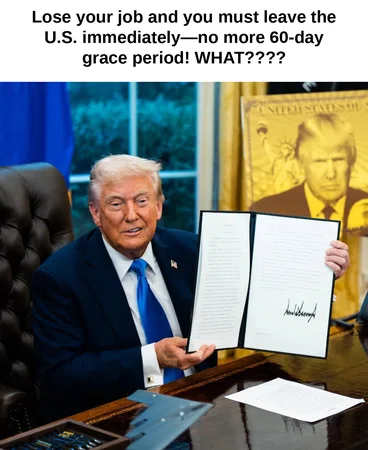
WASHINGTON, D.C. — President Donald Trump was photographed in the Oval Office displaying a freshly signed executive order, with a large golden portrait of himself looming in the background. But as the image circulated, his H-1B visa policies were facing consecutive legal defeats — and an even stricter immigration proposal has just surfaced.
H-1B $100,000 Fee: Court Says 'No' Again
On September 1, 2026, the First Circuit Court of Appeals in Boston again rejected the Trump administration's request to reinstate the $100,000 fee on H-1B visas. The court found that the government had failed to demonstrate the president had legal authority to impose the fee.
The fee was first introduced in September 2025 through a presidential proclamation, applying to foreign skilled workers applying for H-1B visas from abroad. On June 8, 2026, Massachusetts federal judge Leo Sorokin ruled that the fee was effectively a tax — and under the U.S. Constitution, the power to tax belongs exclusively to Congress. "No matter what the payment is called, its substance and application show it is a tax," Sorokin wrote.
The appeals court had already denied a stay request on July 24. The September 1 ruling further solidified the lower court's injunction, meaning USCIS currently cannot collect the $100,000 fee. The case will proceed to a full hearing on the merits.
Court filings reveal the policy has already had a chilling effect: new H-1B applications dropped by 87% after the fee was announced. By mid-February, USCIS had received only a handful of payments under the new policy.
DHS Tries a New Path: $103,265 Fee Proposal
Facing judicial defeat, the Department of Homeland Security (DHS) on August 25, 2026, proposed a new version of the fee through the formal rulemaking process: $103,265, applicable to each of the 85,000 H-1B slots annually.
Unlike the previous presidential proclamation, the new fee attempts to bypass the legal obstacle of whether the president has the power to levy taxes, instead relying on DHS's administrative fee authority. DHS claims the fee is intended to recover the operational costs of the immigration system, generating an estimated $8.8 billion annually.
If the old fee is eventually revived through the courts, employers could face a combined total of up to $203,265 per overseas H-1B worker.
Critics warn the fee would severely damage the H-1B program and suppress the innovative contributions of foreign talent. Amazon had 9,377 H-1B approvals as of June 30, Apple 3,879, Google 3,180, and Meta 2,563 — with tech giants being the largest users.
The Harsher Blow: Eliminating the 60-Day Grace Period
On September 10, DHS published an even more devastating proposal in the Federal Register: abolishing the 60-day grace period for H-1B and other temporary work visa holders after losing their jobs.
Under current rules, since 2017, laid-off H-1B workers have 60 days to remain in the U.S. to find a new employer or handle personal affairs. The new proposal would require visa holders to leave the country immediately upon termination of employment.
The impact extends far beyond H-1B, covering E-1, E-2, L-1, O-1, TN, H-1B1, and E-3 visa categories. DHS acknowledged in the proposal that it would cause "some degree of disruption" to businesses but argued the positions could be "transferred to equally qualified American workers."
Gabriel Chin, a law professor at UC Davis, criticized the move: "Many H-1B workers have lived in the U.S. for years, with families integrated into local communities. I see no justification for forcing them to leave simply because they are in a job transition period."
The proposal will enter a two-month public comment period.
Legal Background: Why Courts Keep Striking It Down
Judge Sorokin's June ruling rested on two core legal arguments: First, the $100,000 fee constitutes a tax in substance, and Article I of the Constitution grants Congress — not the president — the power to levy taxes. Second, the government bypassed the Administrative Procedure Act's notice-and-comment requirements by imposing the fee unilaterally, a procedural violation.
The appeals court's July ruling cited a 1989 Supreme Court precedent emphasizing that the executive branch must demonstrate "clear" congressional authorization when imposing financial burdens, regardless of whether the burden is labeled a "fee" or a "tax."
Currently, both DHS's new fee proposal and the elimination of the grace period are in the public comment stage and have not yet taken effect. The tech industry, universities, and healthcare systems are expected to submit substantial opposition during the comment period, with legal challenges almost inevitable.
| Key Event | Date | Status |
|---|---|---|
| Trump signs proclamation imposing $100,000 H-1B fee | Sept 2025 | Struck down by courts |
| Judge Sorokin rules fee unconstitutional | June 8, 2026 | In effect |
| First Circuit denies stay request | July 24, 2026 | Injunction maintained |
| Appeals court again rejects reinstatement | Sept 1, 2026 | Case continues |
| DHS proposes new $103,265 fee | Aug 25, 2026 | Proposal stage |
| DHS proposes eliminating 60-day grace period | Sept 10, 2026 | Proposal stage |
For the hundreds of thousands of foreign professionals in the U.S. on H-1B visas, a temporary legal reprieve does not mean safety. The Trump administration is repackaging the same policy goals through new regulatory pathways. And if the grace period elimination takes effect, it will mean losing your job means losing your right to stay — no transition, no buffer, no second chance.
This article is based on court rulings, DHS proposals, and publicly available Federal Register documents as of September 14, 2026.
Comments (0)
Loading comments...
May You Like

South Korea–Ukraine Rift Deepens Over North Korean POW Transfer as PURL Draws New Scrutiny