
Benny Johnson Accuses Obama of Orchestrating the “Russia Hoax”: What the Investigations Actually Found
Benny Johnson Accuses Obama of Orchestrating the “Russia Hoax”: What the Investigations Actually Found
An examination of the political accusation, the 2016 Russian interference investigation, and the competing claims over how U.S. intelligence was handled.
1. A Sharp Accusation Against Barack Obama
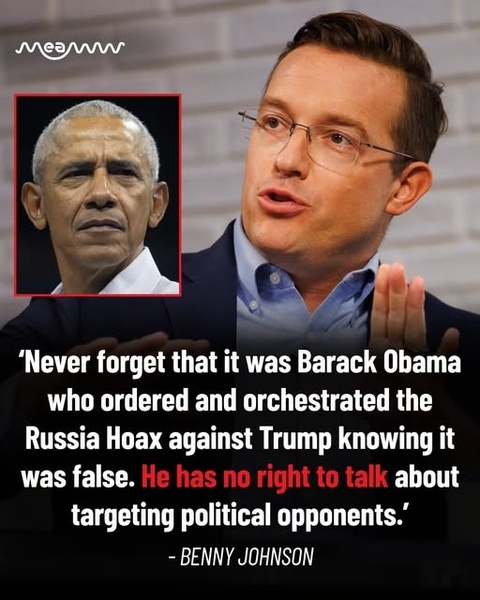
A political graphic circulating online features commentator Benny Johnson alongside former President Barack Obama. It attributes to Johnson a statement accusing Obama of ordering and orchestrating the “Russia hoax” against Donald Trump, allegedly knowing the underlying claims were false.
The graphic concludes that Obama has “no right” to criticize the targeting of political opponents. The wording reflects a broader conservative argument that the investigations into Russian interference were politically motivated. But the central accusation—that Obama knowingly manufactured a false intelligence case against Trump—is disputed and is not established by the public findings of the major bipartisan investigations.
2. What Happened in the 2016 Election?
The controversy traces back to the 2016 presidential election, when U.S. intelligence agencies investigated Russian efforts to influence the campaign. On January 6, 2017, the intelligence community released an assessment concluding that Russian President Vladimir Putin had ordered an influence campaign intended to affect the election.
The assessment described activities including cyber operations, the theft and release of Democratic Party emails, and online influence efforts. It said Moscow sought to damage Hillary Clinton’s prospects and, where possible, improve Trump’s electoral chances. It did not conclude that Russia changed vote totals or determined the election outcome.
3. Obama Did Order an Intelligence Review—but That Is Not Proof of a Conspiracy
One important fact is not in dispute: Obama directed the intelligence community on December 9, 2016, to conduct a comprehensive review of Russian activities and intentions in recent U.S. elections. The resulting assessment was completed and briefed to Obama, President-elect Trump, and congressional leaders.
That presidential tasking is sometimes presented by critics as evidence that Obama personally controlled the conclusions. However, ordering an intelligence review is not, by itself, proof that a president dictated its findings or instructed analysts to fabricate evidence. The distinction is central to evaluating the claim in the graphic.
4. The Bipartisan Senate Investigation Reached a Different Conclusion
The Senate Select Committee on Intelligence conducted an extensive review of the January 2017 assessment. In its 2018 findings, the committee concluded that the assessment was a sound intelligence product and that analysts had not been pressured to reach politically motivated conclusions.
In April 2020, the committee released another installment of its investigation. It said the assessment presented a coherent and well-constructed intelligence basis for concluding that Russia attempted to interfere in the 2016 election. The committee also found that the intelligence supporting the assessment had been properly represented.
5. The 2025 Allegations Revived the Political Battle
The dispute intensified in July 2025, when Director of National Intelligence Tulsi Gabbard released declassified documents and a Republican-led House Intelligence Committee report. Gabbard argued that senior Obama administration officials had manipulated intelligence to create a false narrative about Russian interference and undermine Trump's presidency.
The Office of the Director of National Intelligence used particularly forceful language, describing the alleged conduct as a conspiracy. Those statements represented the administration's interpretation of the released material—not a judicial finding that Obama had committed a crime.
6. Why the Documents Became So Controversial
A central dispute concerns whether earlier intelligence assessments contradicted the January 2017 report. Some earlier documents discussed whether Russia could use cyber operations to manipulate election infrastructure or vote counts. The later assessment addressed a broader range of Russian activity, including hacking, leaking stolen material, and social-media influence operations.
FactCheck.org explained that treating those two questions as identical creates a misleading impression of a sudden reversal. The distinction matters: evidence that Russia did not successfully alter vote totals does not establish that Russia made no effort to influence voters or the campaign.
7. What Independent Reporting and Reviews Have Said
The Associated Press reviewed the declassified material in July 2025 and reported that the documents did not support Gabbard's claim that the Obama administration fabricated intelligence to undermine Trump. The AP also noted that multiple investigations—including Republican-led congressional inquiries—had confirmed Russian interference through hacked Democratic emails and social-media campaigns.
PolitiFact similarly challenged the claim that the documents proved Obama led a coup against Trump. It explained that the evidence cited by Gabbard did not establish that Obama attempted to prevent Trump from taking office or personally directed a criminal effort to fabricate the intelligence assessment.
8. Obama’s Response and the Continuing Political Fallout
Obama's office rejected the allegations in July 2025, calling them “bizarre” and a distraction. Its response maintained that the newly released documents did not overturn the conclusion that Russia worked to influence the 2016 election but did not successfully manipulate votes.
Trump also publicly accused Obama of treason during the dispute. Reuters reported that the accusations were made without evidence establishing that Obama had led a criminal effort to falsely connect Trump to Russia. The Justice Department said it would assess claims concerning alleged weaponization of the intelligence community, but an announced review should not be confused with proof of guilt.
9. The Bottom Line: A Political Claim, Not an Established Finding
Benny Johnson's attributed statement captures a continuing political argument over the origins and credibility of the Russia investigation. Critics of the Obama administration point to the 2017 intelligence review, the role of senior officials, and the documents declassified in 2025 as reasons to question how the assessment was produced.
But the public record also includes bipartisan Senate findings that supported the core assessment of Russian interference and found no evidence that analysts were pressured to reach predetermined conclusions. The 2025 allegations have renewed scrutiny, but the claim that Obama knowingly orchestrated a fabricated investigation has not been established by the evidence cited here.
The distinction is essential: legitimate questions about intelligence procedures and political accountability deserve scrutiny, but accusations of criminal conduct require evidence that goes beyond political statements and social-media graphics.
Comments (0)
Loading comments...
May You Like

I-75 THANKSGIVING NIGHTMARE — MAIL TRUCK CRASH RAISES OVERPASS COLLAPSE FEARS!


FCC CLEARS SPACEX FOR ONE MILLION AI SATELLITES AS ASTRONOMERS SOUND ALARM

Latest Posts








Popular Posts



