
Bernie Sanders Calls Trump’s Administration Deeply Corrupt
Bernie Sanders Calls Trump’s Administration Deeply Corrupt
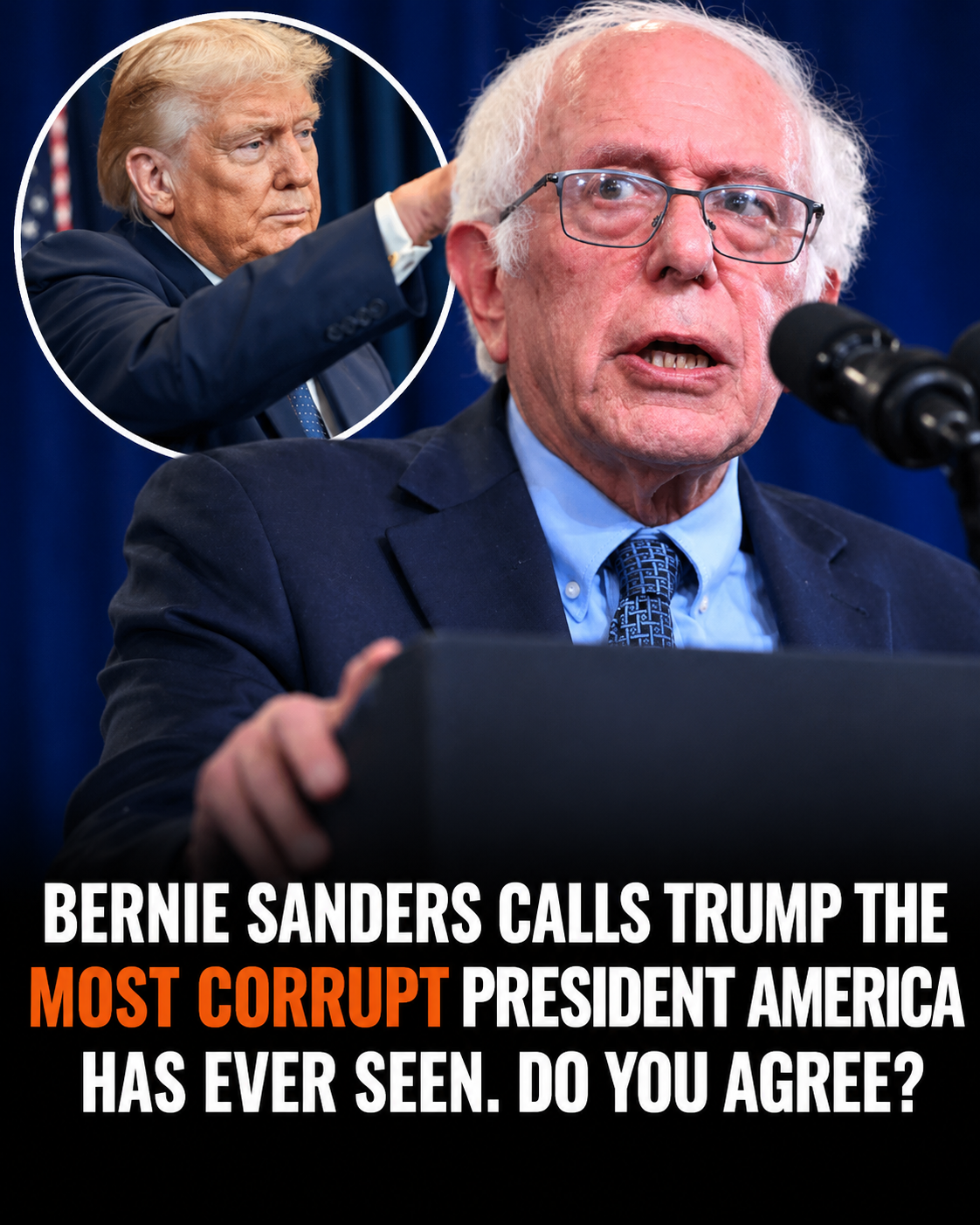
Senator Bernie Sanders has renewed his fierce criticism of President Donald Trump, describing the administration as deeply corrupt and warning that democratic institutions are under strain. A graphic circulating online condenses that message into a question: Is Trump the most corrupt president America has ever seen?
The wording reflects a real theme in Sanders’s recent comments, but precision matters. In an October 25 newsletter, Sanders called Trump the most dangerous president in U.S. history and said he was running “the most corrupt administration in American history.” In other recent remarks, Sanders has also used “most corrupt president” while attacking particular actions by Trump.
Sanders’s criticism is part of a broader campaign ahead of the November 3 midterm elections. The Vermont independent has been traveling to support Democratic candidates and urge voters to end Republican control of Congress, arguing lawmakers must be willing to investigate the administration and check presidential power.
His central allegation is that Trump’s policies and conduct favor wealthy donors and business interests over ordinary Americans. Sanders frequently connects corruption concerns to economic inequality, arguing that billionaires and large corporations have disproportionate influence over public decisions.
In his October 25 newsletter, Sanders wrote that the administration was making the richest Americans richer while increasing pressure on working families. He also pointed to wealth concentration, billionaire influence in politics, health care costs, climate change and artificial intelligence as issues demanding serious public debate.
Those are political arguments, not a judicial finding that the president is the most corrupt in American history. “Most corrupt” is an evaluative judgment, and no official ranking can establish it as objective fact. Assessing the claim requires examining specific conduct, evidence, investigations and legal outcomes rather than treating a campaign slogan as a verdict.
Sanders has made similar arguments about Trump for years. During the first Trump administration, he raised concerns about possible conflicts of interest, obstruction of justice and constitutional limits. The recurrence of these criticisms shows a long-running political dispute rather than a claim that appeared only during the current election cycle.
One area of debate is the relationship between public office and private financial interests. Critics have questioned Trump-linked business ventures, cryptocurrency projects and arrangements involving wealthy individuals or foreign governments. Such issues can raise questions about conflicts of interest and influence, but each allegation needs to be assessed on its own evidence and legal context.
Sanders’s wider argument is that money can distort democratic decision-making even when a transaction does not result in a criminal conviction. He has long criticized campaign finance rules that allow wealthy individuals and organizations to spend heavily to influence elections, contending that ordinary voters struggle to compete with concentrated financial power.
That concern is central to his economic message. Sanders argues that the gains from economic growth have flowed disproportionately to the wealthiest households, while many workers face high housing, health care and everyday living costs. He presents this imbalance as both an economic problem and a threat to political equality.

Supporters see Sanders’s blunt language as a necessary warning. They argue elected officials should scrutinize potential conflicts of interest, defend congressional oversight and insist presidents follow the same laws as everyone else. For them, forceful criticism is part of democratic accountability, not merely partisan theater.
Trump’s supporters are likely to reject Sanders’s description as politically motivated and point to the president’s policy agenda, electoral mandate and claims of progress on the economy or border security. In a polarized environment, the same conduct can be framed as evidence of corruption by one side and legitimate executive action by the other.
The key question is what evidence supports each specific accusation. Investigations, court filings, financial disclosures, ethics reviews and official records can help establish what happened and whether laws or rules were violated. Rhetorical labels alone cannot substitute for that process, regardless of which party uses them.
At the same time, the absence of a criminal conviction does not make every ethical concern irrelevant. Government ethics standards can address appearances of conflicts, transparency and public trust as well as criminal conduct. A careful assessment distinguishes illegal acts, alleged misconduct, potential conflicts and policy choices opponents simply consider harmful.
Sanders’s recent message also reflects the stakes he assigns to the midterm elections. He has argued Congress should not act as a rubber stamp for the White House and that lawmakers need independence to investigate, debate and challenge the administration. His campaign appearances are intended to turn those concerns into voter participation.

The public debate is therefore not only about one president’s character. It is also about the safeguards that prevent private interests from improperly shaping public decisions, and whether those safeguards are applied consistently regardless of party.
The image’s question—whether Trump is the most corrupt president America has ever seen—invites agreement or disagreement, but the historical comparison is difficult to settle definitively. Presidential scandals have varied in nature, scale and consequences, and historians often assess them against different standards rather than produce a single uncontested ranking.
A more useful way to evaluate the issue is to examine verifiable questions: Have officials disclosed relevant financial interests? Are decisions being made for public reasons? Can oversight bodies operate independently? Are allegations investigated fairly? Are court orders and legal procedures respected? Answers are more informative than a superlative on a graphic.
Sanders’s critique is rooted in the view that concentrated wealth and political power reinforce one another. He argues that when wealthy individuals can shape policy, fund campaigns and gain access to officials, the public may reasonably question whose interests government serves. His opponents dispute his diagnosis, but money, access and accountability remain major issues in American politics.
Sanders has clearly called Trump’s administration corrupt and repeatedly accused the president of undermining the rule of law and serving the wealthy. Whether Trump deserves the historical title “most corrupt president” is a political and historical judgment, not a settled fact. The strongest way to assess the charge is to follow the evidence behind individual allegations and judge each on its merits.
Comments (0)
Loading comments...
May You Like

COASTAL DISASTER — 112 KM/H WINDS, SEAWATER FLOODING, 79,000 NEW JERSEY HOMES AT RISK!

WEYMOUTH HORROR—80-MPH WIND GUSTS, FIRE TRUCK FLIPS, 3 FIREFIGHTERS CRITICAL!

DAVENPORT AIRBNB HORROR — 40 OF 50 TEENS TEST POSITIVE FOR DRUGS SUPPLIED BY THE HOST'S MOM!








Popular Posts




