Bernie Sanders Escalates His Attack on Trump: “We Must Take Him On” as He Warns of an Oligarchic America
WASHINGTON — Bernie Sanders is once again putting Donald Trump at the center of his political warning to America, describing the president in extraordinarily stark terms and urging progressives to organize against what he sees as a growing concentration of political and economic power.
In a recent interview with WIRED, Sanders argued that the opposition to Trump cannot be separated from a broader fight over inequality, billionaire influence, artificial intelligence and the future of American democracy.
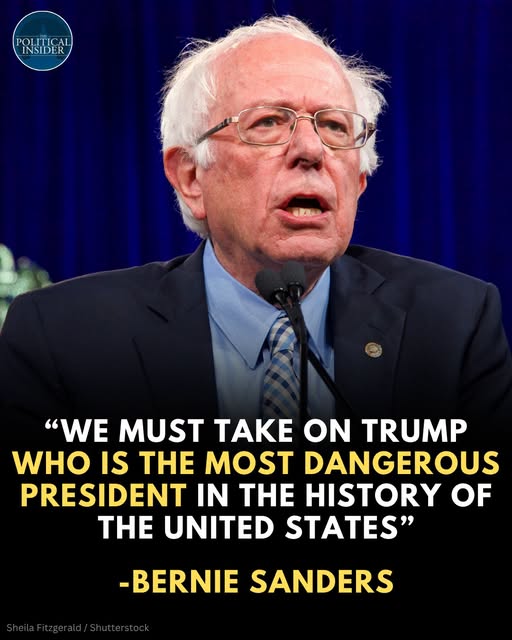
His message was blunt: “We must take on Trump,” whom he described as “the most dangerous president in the history of the United States.”
The statement is not a new description from Sanders. He has repeatedly characterized Trump in similar terms for years. But the timing is significant. With the 2026 midterm elections approaching, Sanders is increasingly framing the political battle not simply as a contest between Democrats and Republicans, but as a struggle over who ultimately controls American government.
And this time, his target extends well beyond the White House.
Sanders Says the Real Battle Is Bigger Than Trump
Sanders' latest comments came during a wide-ranging WIRED interview released June 30, 2026, in which the Vermont senator discussed artificial intelligence, billionaires, campaign financing, inequality and the future of the Democratic Party.
Rather than presenting Trump as an isolated political problem, Sanders connected the president to what he calls an American “oligarchy” — a system in which extremely wealthy individuals exercise disproportionate influence over politics and the economy.
His argument is that political power and economic power have become increasingly intertwined.
Sanders has spent much of his political career attacking that relationship. In May, he joined Republican Sen. Mike Lee in introducing legislation aimed at abolishing Super PACs and preventing billionaires from using enormous political expenditures to influence candidates and elections. Sanders cited Elon Musk's spending during the 2024 election as an example of what he sees as the growing influence of billionaire money.
For Sanders, therefore, defeating Trump is only one part of the equation.
The second is changing the political system that he believes allowed Trump — and wealthy political donors more broadly — to accumulate so much influence.
“They Have the Money. We Have the People.”
Sanders' prescription is not retreat. It is mobilization.
In his WIRED interview, he argued that billionaires possess enormous financial resources, but ordinary Americans have something equally important: numbers.
His strategy is essentially grassroots political organization — encouraging working-class voters, young people and progressives to participate in elections and challenge established political structures.
That message reflects a broader shift in Sanders' political activity.
Rather than launching another presidential campaign, the longtime progressive has increasingly positioned himself as a movement-builder, traveling across the country and supporting candidates who challenge Democratic Party establishments.
He has pointed to recent progressive electoral victories as evidence that the strategy can work. In the WIRED interview, Sanders specifically cited the rise of New York City Mayor Zohran Mamdani and other candidates who defeated established political figures.
The implication is unmistakable:
Sanders believes the Democratic Party cannot defeat Trump simply by becoming a slightly different version of the establishment it is replacing.
The Billionaire Problem
The most consistent theme in Sanders' recent political message is wealth concentration.
In his WIRED interview, Sanders argued that the United States has entered a period in which a small number of extremely wealthy individuals possess extraordinary economic and political power.
He specifically criticized the influence of technology billionaires and argued that the rise of artificial intelligence could make the imbalance even worse.
Sanders warned that AI could eliminate tens of millions of jobs over the next decade while allowing the wealthiest companies to become even more powerful.
That concern has already translated into legislation.
In March, Sanders introduced legislation seeking a national moratorium on the construction of large data centers until Congress establishes safeguards addressing AI's potential consequences. Representative Alexandria Ocasio-Cortez has backed a similar approach in the House.
The legislation is unlikely to become law under the current political environment, but it illustrates Sanders' evolving argument:
AI is not merely a technology issue. It is a question of who owns the future.
Why Sanders Keeps Returning to Trump
Sanders' hostility toward Trump predates the president's second term by many years.
During the 2020 presidential campaign, Sanders repeatedly described Trump as the most dangerous president in American history, warning that his approach to government threatened democratic institutions and the rule of law.
In 2024, Sanders again argued that defeating Trump was essential, describing the election as a potentially historic confrontation over the future of American democracy.
Now, in 2026, the argument has returned with renewed force.
In a February interview with EL PAÍS, Sanders said Trump was “maybe” the most dangerous president in American history and accused him of moving the country toward authoritarianism. He also argued that Trump was concentrating power while wealthy Americans gained greater influence.
His latest WIRED comments therefore represent continuity rather than a sudden political escalation.
But the political environment around those comments has changed dramatically.
Sanders Is Also Attacking His Own Party
Perhaps the most revealing part of Sanders' message is that he does not believe Democrats can simply campaign on being anti-Trump.
He argues that millions of working-class voters who supported Trump were not necessarily enthusiastic about Republican policies. Instead, Sanders says many were frustrated with Democrats because they felt the party had failed to address healthcare costs, wages, housing and economic insecurity.
That creates a difficult problem for Democrats.
If voters believe neither party is improving their daily lives, simply warning them about Trump may not be enough.
Sanders' solution is a fundamental transformation of the Democratic Party into what he describes as a party representing working people and younger Americans rather than wealthy donors and established political interests.
That puts Sanders in an unusual position.
He is one of Trump's most aggressive Democratic critics — but he is simultaneously one of the harshest critics of the Democratic establishment.
The Iran Question Adds Another Dimension
Sanders' criticism of Trump has also increasingly focused on foreign policy.
In the WIRED interview, Sanders criticized Trump's approach to Iran and argued that American presidents and political leaders repeatedly portray foreign conflicts as unavoidable necessities.
He has been especially outspoken about the 2026 war with Iran.
In July, Sanders said Trump had started the conflict without provocation and criticized the resulting deaths and costs to American taxpayers.
His position puts him firmly on the anti-interventionist wing of American politics — a position that has sometimes put him at odds not only with Republicans but also with members of his own party.
For Sanders, however, the issues are connected.
He sees unchecked executive power, military intervention, billionaire influence and weakened congressional authority as symptoms of the same larger problem: too much power concentrated in too few hands.
A Warning That Has Become a Political Strategy
There is another reason Sanders' latest remarks are attracting attention.
His message is no longer simply:
“Trump is dangerous.”
It has evolved into:
“Trump is dangerous — and the system that produced Trump must also change.”
That distinction is important.
Sanders is not presenting himself as someone who believes removing one president will solve America's problems. Instead, he argues that the country must address the economic conditions, political structures and institutional weaknesses that he believes helped create the current political environment.
His proposed answers include stronger labor protections, universal healthcare, restrictions on billionaire political spending, AI regulation and greater public participation in government.
Whether those ideas can attract enough support beyond the progressive movement remains an open question.
The Midterm Test Is Approaching
The 2026 midterm elections will provide an important test of Sanders' theory.
Democrats face the challenge of rebuilding support among voters who have become skeptical of the party, while Republicans continue to defend Trump's political agenda.
Sanders believes progressives can win by combining opposition to Trump with an economic message aimed directly at working-class voters.
But that strategy carries its own risk.
If Democrats focus overwhelmingly on Trump, Sanders argues, they may fail to explain why voters should trust them with power again.
If they move too far left, moderate voters could become alienated.
And if they attempt to preserve the existing party structure, Sanders believes they risk repeating the political failures that helped create Trump's rise in the first place.
“The Most Dangerous President” — and a Much Larger Fight
Sanders' description of Trump as the most dangerous president in American history is, ultimately, a political judgment rather than an objective historical ranking.
There is no official measure that can definitively establish who is the “most dangerous” president in U.S. history.
But the fact that Sanders continues to use the phrase — years after he first adopted it — demonstrates how fundamental his opposition to Trump has become.
And his latest comments reveal something even more consequential.
Sanders is not merely asking Americans to vote against Donald Trump.
He is asking them to decide what kind of political system they want after Trump.
One dominated by billionaires, Super PACs and technology giants?
Or one in which Sanders believes ordinary voters have greater control over economic and political decisions?
That battle is likely to define the progressive movement heading into the 2026 midterms — and potentially shape the Democratic Party long after Donald Trump is gone from the White House.
Comments (0)
Loading comments...
May You Like
Shocking news from Ohio: an unexpected development ahead of Trump's rally
OBAMA STUNS ON INSTAGRAM: MESSAGE MARKING 34-YEAR MILESTONE SPARKS A BUZZ