
Bernie Sanders Proposes 5pct Billionaire Tax to Fund 12,000USD Family Really
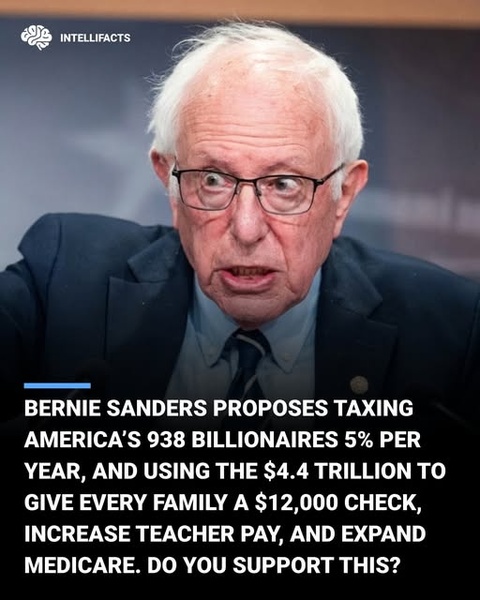
WASHINGTON — Sen. Bernie Sanders and Rep. Ro Khanna have proposed a sweeping federal wealth tax targeting America’s billionaires, promising billions in new investment for working families, health care and housing.


A 5% Tax on Billionaire Wealth
The proposal, formally introduced in March, would impose an annual 5% wealth tax on Americans with net worths exceeding $1 billion, according to Sanders’ office and accompanying legislation.
Sanders and Khanna estimate that 938 billionaires would fall under the proposal, collectively holding approximately $8.2 trillion in wealth under figures cited when the legislation was introduced.
Unlike the federal income tax, the proposal would target accumulated wealth rather than simply taxing wages, salaries or other conventional sources of annual income.
The lawmakers argue that America’s existing tax system allows extremely wealthy individuals to accumulate enormous fortunes while sometimes facing lower effective tax burdens than ordinary workers.
The $12,000 Family Payment
One of the proposal’s most politically striking provisions would provide a $3,000 direct payment to every individual living in qualifying households earning $150,000 or less annually.
For a family of four meeting that income threshold, the payment would amount to $12,000, according to the bill’s official summary and Sanders’ Senate announcement.
The payment would be intended to help households manage expenses including housing, health care, prescription medicines, child care and other basic necessities.
However, the graphic’s wording could create the impression that every American family would automatically receive $12,000, which is not what the proposal says.
The $12,000 figure applies specifically to a family of four in a household earning no more than $150,000 under the legislation’s eligibility rules.


$4.4 Trillion Over a Decade
Sanders and Khanna say their proposed wealth tax could generate approximately $4.4 trillion in federal revenue over 10 years, based on analysis by economists Emmanuel Saez and Gabriel Zucman.
That estimate comes from the bill’s sponsors rather than representing revenue already collected by the federal government or money currently sitting in a government account.
The distinction is important because the proposal remains legislation under consideration, meaning its projected revenue depends on Congress approving the measure and the tax producing the expected results.
The Tax Foundation has separately questioned the revenue potential of wealth-tax proposals, pointing to enforcement difficulties, avoidance and potential economic effects as factors that could reduce collections.
Where the Money Would Go
The legislation outlines a broad spending agenda extending far beyond direct payments, including health care, housing, child care, education and assistance for seniors and people with disabilities.
One major provision would reverse $1.1 trillion in Medicaid and Affordable Care Act reductions that Sanders and Khanna attribute to President Donald Trump’s “Big Beautiful Bill.”
The proposal would also expand Medicare coverage to include dental, vision and hearing services for millions of older Americans, according to the legislation’s summary.
Another provision would seek to build, rehabilitate and preserve more than seven million affordable homes as part of an effort to reduce the national housing shortage.
Teachers Would Also Be Targeted
Education represents another significant component of the plan, with Sanders and Khanna proposing a $60,000 annual minimum salary for every public-school teacher nationwide.
The bill’s summary estimates that establishing that minimum would cost approximately $152 billion over a decade under the proposal’s framework.
The legislation would additionally seek to limit child-care expenses to no more than 7% of household income, addressing one of the largest recurring costs for working parents.
Sanders has repeatedly argued that such investments would strengthen working families while reducing economic inequality between ordinary Americans and the country’s wealthiest households.
Housing and Homelessness
Housing is another major spending priority, with the proposal allocating hundreds of billions of dollars toward affordable housing construction and preservation.
The legislation estimates that eliminating the affordable-housing gap and addressing homelessness through more than seven million homes would require roughly $856 billion over 10 years.
The proposal also includes expanded Medicaid home-health coverage for seniors and people with disabilities, estimated by its sponsors to cost approximately $300 billion over the same period.
Together, those provisions demonstrate that Sanders’ plan is not simply a tax proposal but a much broader redistribution and social-spending package.


Billionaires Would Face Enormous Bills
The legislation would produce particularly large tax obligations for America’s richest individuals because the proposed 5% levy would apply annually to qualifying wealth.
Sanders’ office estimated that Elon Musk, then valued at roughly $833 billion, would owe about $42 billion under a 5% calculation based on his wealth.
Mark Zuckerberg and Jeff Bezos were also listed among billionaires who would face multibillion-dollar annual liabilities under the proposal’s framework.
Those examples illustrate why the legislation has generated intense debate among economists, wealthy individuals and business advocates over how such a tax would affect investment.
Critics Question the Economics
Opponents argue that taxing wealth annually could create significant difficulties because much billionaire wealth consists of stocks, privately held companies, real estate and other assets that fluctuate in value.
The Tax Foundation has warned that wealth taxes can create incentives for avoidance, relocation and changes in investment behavior, potentially reducing the amount of revenue ultimately collected.
Critics also question whether the federal government could reliably value privately held assets every year and enforce payment when fortunes are largely tied to businesses rather than cash.
Those concerns do not prove the Sanders proposal would fail, but they highlight why projected revenue should be treated as an estimate rather than guaranteed federal income.
Supporters See a Different Picture
Supporters argue that America already taxes wages and conventional income while allowing enormous amounts of wealth to accumulate through appreciating assets.
Sanders has framed the proposal as an attempt to make the wealthiest Americans contribute more directly toward the costs of public services and programs benefiting broader society.
The Guardian reported that the proposal forms part of a wider 2026 movement toward wealth taxation, with similar efforts appearing at state and local levels.
That broader movement reflects growing concern among progressive politicians and activists about wealth concentration, particularly as billionaire fortunes have expanded dramatically.
California Adds Another Dimension
The federal proposal is also emerging alongside a separate California initiative seeking to impose a one-time 5% tax on billionaire wealth.
The California measure is designed differently from Sanders’ federal legislation and focuses specifically on billionaires who meet residency and wealth requirements under state law.
That initiative has attracted fierce opposition from Silicon Valley billionaires and business groups, illustrating the political difficulty of imposing wealth taxes even in heavily Democratic jurisdictions.
The California debate could become an important test of whether voters are willing to support direct taxation of billionaire wealth rather than relying primarily on income and capital-gains taxes.
This Is Not a $12,000 Stimulus Check Yet
For American households, perhaps the most important clarification is that the proposed $3,000-per-person payment is not currently an approved federal stimulus program.
The Sanders-Khanna legislation would need to move through Congress, survive committee consideration, pass both chambers and ultimately receive presidential approval before becoming law.
Reporting on similar proposals has emphasized that Americans should not expect checks simply because a bill has been introduced in Congress.
Therefore, the viral graphic accurately identifies the central numbers from the proposal but presents them in a way that can make a legislative proposal appear closer to implementation than it actually is.
The Political Obstacles Are Significant
The legislation faces substantial political obstacles, particularly because Republicans control Congress and the proposal represents a major expansion of federal taxation and social spending.
The Guardian reported when the bill was introduced that it was unlikely to pass under the existing Republican congressional majority, although Sanders and Khanna presented it as a broader argument over economic inequality.
That does not make the proposal politically irrelevant, however, because wealth taxation has become increasingly prominent within Democratic economic debates.
The measure could influence future Democratic campaigns even if it never receives enough congressional support to become federal law.
Sanders' Broader Economic Message
The proposal fits Sanders’ longstanding argument that the United States has allowed wealth and political influence to become excessively concentrated among a small group of billionaires.
His broader political message emphasizes higher taxes on extreme wealth, stronger labor protections, expanded public services and a larger government role in reducing inequality.
The billionaire tax therefore represents a continuation of Sanders’ political agenda rather than an isolated policy initiative.
Khanna, meanwhile, has presented the proposal as a way to address inequality while maintaining America’s capacity for innovation and entrepreneurship.
The Numbers Need Context
The $4.4 trillion figure is a 10-year revenue estimate, not $4.4 trillion sitting in a federal account waiting to be distributed.
Likewise, the 938-billionaire figure reflects the number identified by Sanders and Khanna when introducing the legislation and could change as individual fortunes rise or fall.
The 5% figure refers to an annual wealth tax, meaning it would apply repeatedly rather than being a one-time charge on existing billionaire fortunes.
Those distinctions are essential when evaluating social-media claims about the proposal and its potential financial impact.
A Major Redistribution Proposal
If enacted substantially as written, the bill would represent one of the most aggressive federal efforts in modern American politics to redistribute wealth through direct taxation of net worth.
The proposed spending package would touch nearly every major domestic economic issue, including health care, housing, child care, education and elder care.
Supporters see that breadth as evidence that billionaire wealth could be converted into tangible improvements for millions of households.
Critics see the same breadth as evidence that the proposal combines an ambitious tax experiment with spending commitments whose long-term costs could prove difficult to manage.
What Happens Next
The legislation’s future depends largely on congressional support, making its immediate impact more political than practical.
As introduced, it establishes a clear framework for how Sanders and Khanna believe billionaire wealth could be taxed and redistributed to working families.
The debate is likely to continue as lawmakers, economists, business leaders and progressive activists examine both the projected revenue and the potential economic consequences.
For now, however, no qualifying household is entitled to the proposed $12,000 payment.
The Bottom Line
Bernie Sanders has introduced a real bill proposing a 5% annual wealth tax on Americans with net worths above $1 billion, targeting approximately 938 billionaires.
The proposal estimates $4.4 trillion in revenue over a decade and includes $3,000 payments for individuals in qualifying households, meaning a family of four could receive $12,000 under the income threshold.
It would also expand Medicare benefits, raise the minimum public-school teacher salary to $60,000, subsidize child care, expand Medicaid home care and finance affordable housing.
But the viral post should not be interpreted as announcing a new $12,000 government check that Americans will automatically receive.
The Sanders-Khanna proposal remains a piece of legislation, and its projected $4.4 trillion revenue figure is an estimate that faces major economic, political and implementation questions.
Comments (0)
Loading comments...
May You Like

Jack Smith Defends His Integrity as Trump Investigations Face Renewed Political Firestorm















