
Biden Revives Economic Claim: “I Handed Trump the Strongest Economy in the World”
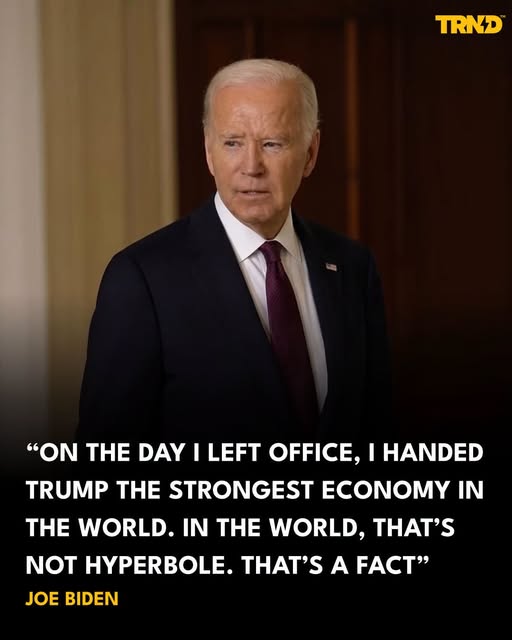
Former President Joe Biden’s claim that he handed Donald Trump “the strongest economy in the world” has resurfaced after Biden repeated the assertion at a February 2026 Democratic event.
Biden made the remark on February 27, 2026, in Columbia, South Carolina, while speaking at an event hosted by the South Carolina Democratic Party commemorating his 2020 primary victory.
His statement referred specifically to conditions when he left office on January 20, 2025, and framed the economy as a strong starting point for Trump’s second presidency.
The claim is partly supported by several favorable economic indicators, although “strongest economy in the world” is not a standard economic measurement with one universally accepted definition.
At the end of Biden’s term, the U.S. labor market remained relatively strong, with unemployment at 4.1 percent in December 2024 according to the Bureau of Labor Statistics.
The same period showed substantial employment gains during Biden’s presidency, with his administration reporting more than 16.6 million jobs created between January 2021 and December 2024.


However, job creation figures alone do not establish that the United States had the world’s strongest economy, because economic strength can also involve inflation, productivity, incomes, investment and growth.
Real U.S. gross domestic product increased 2.8 percent during 2024, while fourth-quarter growth reached a 2.4 percent annual rate in the latest 2024 estimate.
Consumer spending was a major contributor to fourth-quarter growth, according to the Bureau of Economic Analysis, while investment weakened and imports declined during the same period.
Inflation had also fallen substantially from its 2022 peak, but prices remained higher than before the pandemic, creating an important qualification to Biden’s description of economic conditions.
The Consumer Price Index increased 2.9 percent over the twelve months ending December 2024, while core inflation excluding food and energy rose 3.2 percent.
Those figures meant inflation was considerably lower than its 2022 peak, yet the accumulated increase in consumer prices continued affecting household purchasing power and perceptions of economic conditions.


Biden has repeatedly emphasized that his administration inherited severe economic disruption from the COVID-19 pandemic and presided over a recovery featuring strong employment and continued economic expansion.
In a January 2025 statement, Biden said the United States had achieved the strongest growth and employment creation among advanced economies, while acknowledging that more remained to reduce costs.
Independent assessments have also noted that the United States performed strongly relative to other advanced economies, although comparisons depend heavily on the specific indicators and time periods selected.
For example, one 2024 fact-check found that the United States was growing faster than the other G7 economies in 2023 and was projected to maintain comparatively strong growth.
At the same time, critics of Biden’s economic record have focused on the inflation surge that occurred during his presidency, arguing that headline employment gains do not capture affordability pressures.
The Biden administration’s record therefore contains both favorable and unfavorable measures, making the broader description of the economy dependent on which economic outcomes are emphasized.
Trump and his administration have offered a sharply different account, frequently describing the economy inherited from Biden as damaged while highlighting their own subsequent economic policies and performance.
Biden’s February 2026 statement is therefore best understood as a defense of his economic record rather than a settled economic fact: the underlying data show significant strengths alongside measurable challenges.


Sources & References
Comments (0)
Loading comments...
May You Like















