
BRICS Expands Its Global Footprint as Trump Faces a More Assertive Emerging-Power Bloc
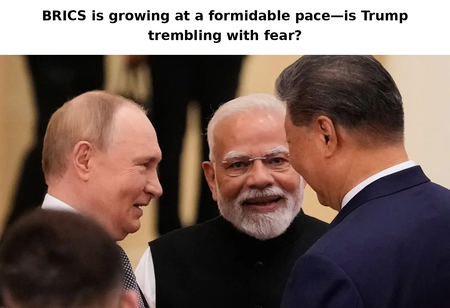
NEW DELHI — September 14, 2026 — The BRICS group is emerging from its latest summit with greater ambitions for economic cooperation and a stronger voice for the Global South, raising fresh questions about how the expanding bloc could affect U.S. influence under President Donald Trump.
The image accompanying this story shows Russian President Vladimir Putin, Indian Prime Minister Narendra Modi and Chinese President Xi Jinping during a trilateral meeting on the sidelines of the 2019 G20 summit in Osaka, Japan. Although the photograph is several years old, the relationship among the three powers has gained renewed significance as BRICS expands and seeks greater independence from Western-led institutions.
The latest BRICS summit, held in New Delhi on September 12–13, 2026, brought together leaders and representatives from an increasingly diverse group of major emerging economies. The meeting produced the New Delhi Declaration, which reaffirmed the bloc's ambition to strengthen cooperation in political, economic, financial and technological areas.
A larger BRICS with growing economic weight
BRICS has changed significantly from the original grouping of Brazil, Russia, India and China. South Africa joined later, followed by Egypt, Ethiopia, Iran and the United Arab Emirates in 2024, with Indonesia joining in 2025. Saudi Arabia has been invited but its membership status remains unresolved, according to Reuters.
India's government says the expanded grouping represents roughly 49.5% of the world's population, 40% of global GDP and 26% of global trade. Those figures help explain why the organization is receiving increasing attention in Washington and other Western capitals.
The bloc's growing importance, however, does not automatically mean that it has become a unified geopolitical alliance.
BRICS members have very different economic systems, strategic interests and relationships with the United States. India maintains close ties with Washington while simultaneously strengthening relations with Russia and China. The UAE has extensive links with the United States, while Iran is one of Washington's most serious geopolitical rivals.
That diversity was clearly visible at this year's summit.
De-dollarization remains a major issue
One of the most closely watched areas is the effort to make cross-border payments less dependent on the U.S. dollar.
Ahead of the summit, India promoted a proposal to improve connections between members' central-bank digital currencies and make international payments faster and more efficient. Reuters reported that the initiative is intended to facilitate trade rather than immediately replace the dollar as the world's dominant reserve currency.
BRICS members also agreed to expand trade and payments using local currencies, representing another step toward reducing dependence on dollar-based transactions.
That development is particularly significant because Trump has repeatedly warned BRICS countries against attempting to undermine the dollar.
In February 2025, Trump threatened BRICS nations with tariffs of at least 100% if they pursued an alternative currency or attempted to weaken the dollar's position in international trade.
The Trump administration has also used tariffs and other trade measures against several BRICS members, increasing the economic pressure surrounding the bloc. The United States, for example, imposed a 25% tariff on certain Brazilian goods in July 2026 following a Section 301 investigation.
Is Trump really "trembling with fear"?
The provocative question in the image — whether Trump is "trembling with fear" — makes for a powerful headline, but the reality is considerably more complicated.
There is no evidence that Trump is literally fearful of BRICS. His administration has instead treated the organization as a potential challenge to U.S. economic and geopolitical influence, particularly when it comes to the dollar, trade and alternative international institutions.
At the same time, analysts caution against portraying BRICS as a unified anti-American alliance.
The bloc itself remains deeply divided. India and China have competing strategic interests, Iran and the UAE have been on opposing sides of the current Middle East conflict, and Brazil and India have not always supported attempts to transform BRICS into an explicitly anti-Western organization.
Those divisions could limit the organization's ability to turn its growing economic weight into coordinated geopolitical power.
Putin, Modi and Xi symbolize the changing balance
The three leaders shown in the photograph — Putin, Modi and Xi — nevertheless represent an important part of the changing global landscape.
Putin has advocated transforming BRICS into a more practical economic platform covering technology, infrastructure, payments and investment. During his latest meeting with Modi in New Delhi, the two leaders also discussed expanding bilateral trade and maintaining energy cooperation despite Western pressure on Russia.
Xi's participation was equally significant. His visit to India marked his first trip there in seven years and came as Beijing and New Delhi sought to stabilize relations after years of border and strategic tensions.
For Modi, the challenge is balancing India's growing relationship with the United States while preserving strategic autonomy and maintaining strong economic and diplomatic ties with Russia and other BRICS members.
BRICS still faces a major test
The New Delhi summit demonstrated both the potential and the limitations of the expanded bloc.
Members were able to adopt a joint declaration calling for restraint in the Middle East and emphasizing international cooperation, trade and supply-chain stability. They also raised concerns about unilateral tariffs and sanctions.
But reaching agreement was difficult because members hold sharply different positions on major conflicts.
That tension is likely to remain the central question for BRICS: Can an organization containing countries with such different interests develop concrete institutions and policies, or will it remain primarily a diplomatic forum?
For Washington, the answer matters.
A more coordinated BRICS could gradually reduce the influence of U.S.-dominated financial systems and give emerging economies greater leverage in global trade and diplomacy. A divided BRICS, by contrast, would struggle to convert its enormous combined population and economic resources into a coherent alternative to the existing international order.
The bottom line
BRICS is undoubtedly larger and more influential than it was a decade ago. Its members account for a substantial share of the world's population and economic activity, while initiatives involving local currencies, digital payments and institutional reform are gaining momentum.
But "Trump trembling with fear" is better understood as political rhetoric than an established fact.
The real story is more consequential: BRICS is attempting to build a more multipolar international system at a time when the Trump administration is aggressively defending U.S. economic interests and the central role of the dollar.
Whether that effort ultimately succeeds may depend less on the bloc's size than on whether its increasingly diverse members can overcome their internal divisions.
Comments (0)
Loading comments...
May You Like

Russian Drone Strikes Kyiv Bridge as German Chancellor Arrives in Ukraine
Jack Smith Defends His Integrity as Trump Investigations Face Renewed Political Firestorm
OBAMA STEPS BACK INTO THE POLITICAL SPOTLIGHT














