
BROOKLYN COLLAPSE: 8 DEAD, 11 MORE BUILDINGS AT RISK—SHARE ONE OWNER!
Brooklyn Collapse Kills Eight as City Expands Inspections to 160 Construction Sites Linked to Project Firms
NEW YORK — November 20, 2026 — New York City inspectors are examining approximately 160 construction projects connected to companies involved in a Brooklyn development after an adjacent apartment building collapsed, killing eight people. The expanding investigation has led to new stop-work orders, renewed scrutiny of engineering reports and urgent questions about the safety of nearby residents.
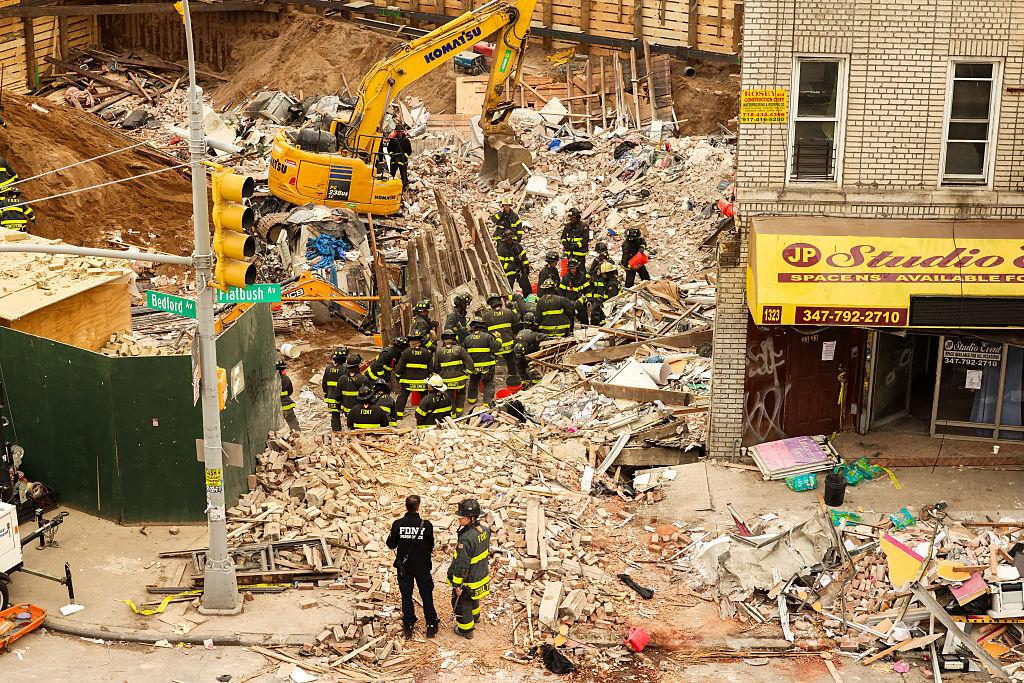
The November 11 collapse at 1321 Flatbush Avenue destroyed a three-story building containing apartments and businesses. It fell into an excavation site at neighboring 2625 Bedford Avenue.
Eight people, including two children and two construction workers, died. At least 18 others were injured.
Mayor Zohran Mamdani ordered a broader safety review of projects connected to six entities involved in the construction operation. The Department of Buildings also hired an independent engineering firm to investigate the disaster.
An examination by Gothamist found that inspectors had visited at least 24 sites associated with two engineers involved in the project and halted work at five.
The collapse occurred shortly after 4 p.m. on November 11.
The building at 1321 Flatbush Avenue fell toward a neighboring excavation pit.
The failure also damaged another apartment building, exposing interior rooms and forcing residents from their homes.
Firefighters arrived within minutes.
Rescue teams searched through unstable rubble, looking for survivors.
The operation continued into the following day.
Six adults and two children were ultimately confirmed dead.
The scale of the destruction immediately raised concerns about the relationship between the existing building and the construction work taking place beside it.
City officials began examining excavation procedures, property maintenance records and earlier safety violations.
Within days, the investigation had expanded beyond the immediate disaster site to construction projects across New York City.
The people killed represented several generations of Brooklyn's residential and working communities.
Two children, ages 9 and 10, died.
Six adults were also killed, including two construction workers.
Some victims were inside the apartment building.
Others were working at the neighboring construction site.
Their deaths demonstrated how a structural failure can endanger both residents and workers.
The disaster also injured at least 18 people, including emergency responders.
Families have been left seeking explanations for how the building failed so suddenly.
Their questions concern not only the immediate cause but also the warnings that may have existed beforehand.
The investigation must determine whether those warnings were recognized and whether appropriate action could have reduced the danger.
The citywide inspection program was launched because several firms and professionals involved in the Flatbush development also worked on other projects.
Mayor Mamdani initially described a review involving approximately 100 sites.
Officials later expanded the scope to about 160 projects connected to six entities.
That does not mean 160 buildings have been declared unsafe.
It means the city identified projects warranting additional examination because of their professional or contractual connections to the development.
The distinction is important.
A construction company or engineer may work on many projects with different conditions, designs and safety requirements.
Inspectors must evaluate each location separately.
The broader review is intended to identify hazards before another incident occurs, not to assume that every connected property presents the same risk.
The headline's reference to 11 additional buildings does not match the confirmed scope of the city's inspection program.
Public reporting identifies approximately 160 projects under review, not 11 properties owned by one developer.
A separate report found that the collapsed building had received 11 housing violations during 2026.
That figure concerns violations at the original property, not 11 additional buildings at risk.
The distinction matters because the broader investigation includes projects connected through engineers, contractors and inspection firms.
Those projects do not necessarily share the same owner.
Gothamist reported that the sites identified in its review did not appear to belong to the same owners as the Flatbush development.
The confirmed issue is a network of professional connections across construction projects, rather than an established portfolio of 11 dangerous buildings.
Gothamist's November 17 investigation found that the Department of Buildings had issued full or partial stop-work orders at at least five sites connected to engineers involved in the Flatbush project.
Inspectors had visited at least 24 jobsites across four boroughs.
The findings show that the safety sweep produced enforcement actions.
However, a stop-work order does not necessarily mean an entire building is structurally unstable.
Such orders can be issued for different violations, including unsafe work practices.
At one Queens project, inspectors halted some interior work after finding a worker on scaffolding without a safety harness.
That violation concerned worker protection.
It was not a finding that the building was about to collapse.
The distinction helps explain why each enforcement action must be evaluated according to its specific circumstances.
Two engineering professionals have attracted particular attention in the expanded investigation.
Jieming Wang, associated with LMW Engineering Group, prepared structural drawings for the development beside the collapsed building.
MD Ariful Islam, associated with RI Consulting Services, was hired for special inspections and monitoring related to excavation and shoring.
Their roles were different.
A design engineer develops plans addressing structural conditions and required safeguards.
A special inspector examines specified construction activities and documents compliance with applicable requirements.
Both functions can be important when excavation takes place beside an occupied building.
Gothamist reported that neither engineer responded to its requests for comment.
The fact that their other projects are being inspected does not establish that either professional falsified documents or caused the collapse.
Those questions require evidence from the ongoing investigation.
The collapsed apartment building and the neighboring development had separate ownership arrangements.
City property records identify Isolag Realty Corporation as the owner of 1321 Flatbush Avenue.
Olufemi Falade was listed as the corporation's registered agent.
The adjoining development site was associated with limited liability companies linked to Robert Fischman and Judy Swimer.
The developer had approval to construct a three-story apartment building.
A separate proposal for a nine-story mixed-use project had not been approved when the collapse occurred.
These distinctions matter because responsibility for maintaining an existing building differs from responsibility for excavation at an adjoining property.
Investigators must examine both sets of obligations.
They must also review the work performed by contractors, engineers and inspectors.
The public records do not establish that one developer owned all the projects included in the citywide inspection sweep.
The neighboring construction site had already been subject to enforcement action.
In March, inspectors found demolition work taking place without adequate overhead protection for adjoining properties.
The Department of Buildings issued a stop-work order.
When inspectors returned in April, they found that demolition had continued despite the restriction.
The city issued another violation.
Officials subsequently determined that the cited problems had been corrected and lifted the stop-work order in May.
Excavation was underway under an active permit when the building collapsed in November.
The earlier violations are relevant to the project's compliance history.
But they do not establish that the same deficiencies caused the later structural failure.
The investigation must determine what safeguards were required during excavation and whether those safeguards were actually in place.
A pre-construction survey filed in March 2026 documented cracks in the building that later collapsed.
The survey examined conditions before work proceeded at the neighboring development.
It rated the building's north facade, facing the construction site, as being in poor condition.
The report described substantial deficiencies in the masonry.
These findings have become important because they establish that visible problems existed months before the disaster.
However, cracks can develop for different reasons.
Some may reflect longstanding deterioration.
Others can indicate movement or structural stress.
Engineers must determine the significance of the documented conditions and whether later excavation affected them.
The existence of the survey also raises questions about who reviewed its findings and whether additional protective measures were necessary.
The available evidence does not establish that inspectors falsified reports.
But it does identify documentation that requires closer examination.
Engineering News-Record reported that the city's online system did not show completed certification for a required special-inspection category involving excavation support.
The publication also found that public records did not establish whether all necessary support components were installed.
Those findings raise questions about compliance and documentation.
They do not prove that an inspection was invented or that an inspector deliberately submitted false information.
An incomplete public record can result from several circumstances, including unfinished work or missing filings.
Investigators must compare official submissions with site records, inspection notes, photographs and actual construction conditions.
Only that examination can determine whether records accurately reflected the work performed.
An allegation of falsified inspections is serious because it implies intentional deception.
Proving such conduct requires more than identifying gaps in paperwork.
Investigators would need evidence that a person knowingly reported work or inspections that did not occur, or deliberately misrepresented conditions.
That evidence might include contradictory photographs, inspection logs, communications or witness testimony.
By contrast, a missing certification could indicate that work had not reached the relevant stage or that required documentation was incomplete.
Those situations can still raise regulatory concerns.
But they are not identical to fraud.
The Brooklyn investigation involves several technical questions about construction practices.
Officials have not announced a finding that the relevant inspection reports were falsified.
The distinction matters for residents seeking accurate information about the safety of their buildings.
Excavation beside an existing structure can require specialized measures to protect neighboring foundations.
These may include shoring, bracing, underpinning and monitoring.
Shoring supports soil or structural elements during construction.
Underpinning strengthens or extends an existing foundation.
Monitoring can help detect movement, cracking or vibration.
The appropriate combination depends on the site and the engineering design.
Gothamist reported that Wang's approved drawings did not call for steel bracing or underpinning beside the collapsed building.
Engineering News-Record separately identified questions about the support system and what was installed.
These findings require careful technical interpretation.
The absence of a particular method from approved plans does not, by itself, prove that the design violated regulations.
Investigators must determine whether the design adequately addressed the site's actual conditions.
The depth and sequence of excavation can affect neighboring structures.
As soil is removed, the forces acting on nearby foundations may change.
The risk depends on soil conditions, foundation design, groundwater and protective supports.
Investigators therefore need to determine how far excavation had progressed on November 11.
They also need to establish whether construction followed approved plans.
A structure with existing cracks may require particular attention during nearby excavation.
However, the presence of cracks does not establish that excavation caused the collapse.
The technical inquiry must reconstruct the sequence of events.
Engineers will examine the remains of the structure, excavation boundaries and construction records.
Those findings are necessary before a definitive cause can be assigned.
Neighbors described vibrations associated with construction before the collapse.
Some residents said they had experienced repeated shaking.
One witness reported seeing bricks fall shortly before the building gave way.
These accounts are relevant because they may help establish the timing of structural movement.
But eyewitness observations alone cannot determine the engineering cause.
Investigators must compare those accounts with photographs, videos and monitoring data.
A former tenant has also filed a lawsuit alleging that he reported cracks to the landlord before the disaster.
The allegations remain subject to legal proceedings.
Together, the accounts raise questions about whether warnings were communicated and how they were handled.
The investigation must distinguish between conditions known before the collapse and findings established afterward.
The collapse damaged more than the building that fell.
An adjoining apartment building lost part of its exterior, exposing rooms and making the structure unsafe.
Residents were forced from their homes.
The city subsequently determined that the badly damaged neighboring building at 1323 Flatbush Avenue would need to be demolished.
For affected households, the immediate concerns include safe accommodation, access to possessions and information about when they can return to the area.
Residents of a building ordered demolished cannot simply move back after emergency crews leave.
Their longer-term housing options may depend on city assistance, insurance, lease arrangements and legal proceedings.
No single relocation outcome applies to every affected household.
The situation remains particularly difficult for families who lost both their homes and personal belongings.
When a residential building becomes unsafe, city agencies can coordinate emergency assistance and temporary shelter.
In New York City, displaced households may receive help through emergency management and housing-support services, depending on eligibility and circumstances.
That assistance is separate from any compensation that might eventually result from litigation.
Residents may also need replacement identification documents, medications, clothing and access to financial accounts.
Some may face lost income because they cannot return to work or retrieve equipment.
The practical effects can continue long after the emergency response ends.
The public reporting reviewed does not establish that residents of 11 additional buildings have been ordered to evacuate.
The documented displacement concerns the collapse site and neighboring properties affected by the structural damage.
A stop-work order restricts specified construction activities.
It does not automatically require residents of nearby occupied buildings to leave.
An evacuation or vacate order is a separate safety action.
Such orders may be issued when officials determine that continued occupancy presents an unacceptable risk.
That distinction is important for people living near projects included in the citywide inspection sweep.
A construction site may receive a stop-work order because of unsafe scaffolding or another worksite violation.
The adjoining residential building may remain safe to occupy.
In other cases, structural concerns could require protective measures or temporary evacuation.
Residents need to rely on the specific orders issued for their property.
The inspection of a nearby project is not, by itself, evidence that their home is unsafe.
The collapsed building had a long history of housing-code violations.
CBS New York reported that city records listed 98 open violations.
They included problems involving leaks, pests, electrical conditions and other maintenance issues.
Engineering News-Record found that 21 were classified as immediately hazardous.
The property also had substantial unpaid Department of Buildings penalties.
However, the publication reported that the recent housing violations did not identify foundation failure or structural instability.
That distinction is significant.
A large number of maintenance violations can indicate persistent problems with property management.
But the violations must be examined individually to determine whether they contributed to a structural failure.
The history adds to questions about oversight without providing a complete explanation of the collapse.
CBS New York+1
The City's Inspection Capacity
The disaster has also raised concerns about the resources available to the Department of Buildings.
Associated Press reported that the agency had a vacancy rate of approximately 9%.
That represented 168 vacant positions out of 1,855 authorized jobs, according to city data cited in the reporting.
City Council Speaker Julie Menin called for the vacancies to be filled.
The staffing issue matters because inspectors oversee a large number of construction projects and occupied properties.
A shortage of personnel can affect how quickly complaints are investigated and how frequently sites are reviewed.
However, staffing levels alone do not establish the cause of the Brooklyn collapse.
The investigation must determine which inspections were required, whether they occurred and whether officials acted appropriately on available information.
A Wider Question About Construction Oversight
The expanded inspection program may reveal problems that extend beyond the Flatbush site.
Different projects may have different violations.
Some could involve worker safety.
Others may involve engineering documentation, excavation procedures or structural support.
The city must evaluate each finding according to its circumstances.
That approach is important because a broad inspection campaign can produce a large number of enforcement actions without establishing a common underlying defect.
The Department of Buildings has declined to release complete details of the ongoing sweep, citing the integrity of the investigation.
As a result, the full list of inspected properties and outcomes is not yet publicly established.
Further disclosures will be needed to determine the program's results.
What Families Want to Know
The families of the eight people killed are seeking answers about the events that led to the collapse.
Their concerns extend beyond the immediate rescue operation.
They want to know whether the building was properly maintained.
They also want to understand the role of construction work next door.
For displaced residents, the questions are practical as well as legal.
They need to know where they can live, what belongings can be recovered and whether compensation may be available.
A lawsuit filed by a former tenant has already raised allegations about warnings given to the landlord.
Additional legal claims may depend on the findings of the engineering investigation.
Responsibility cannot be determined solely from the existence of violations or professional connections.
It must be established through evidence.
The Investigation's Next Steps
The Department of Buildings is working with an independent engineering firm to determine the collapse's cause.
Investigators are reviewing structural plans, excavation records and the condition of the building before it fell.
They are also examining whether construction complied with approved procedures.
The citywide inspection sweep will continue to identify problems at other projects connected to the firms involved.
The Brooklyn district attorney's office is examining possible criminal conduct.
No final engineering finding has been announced.
The investigation may eventually identify failures involving design, construction, maintenance or oversight.
It could also determine that several factors contributed.
Until the evidence is complete, allegations against individual professionals and property owners remain separate from proven findings.
What the Developer Records Actually Establish
The records show that the fatal collapse occurred beside an excavation associated with developers Robert Fischman and Judy Swimer.
The building that fell was owned by Isolag Realty Corporation, with Olufemi Falade listed as its registered agent.
Engineering work connected to the development was performed by professionals whose other projects are now receiving additional scrutiny.
At least five construction sites have received full or partial stop-work orders during the wider review.
But those sites are not established as 11 dangerous buildings owned by a single developer.
Nor has the city announced that inspection reports were falsified.
The documented investigation concerns a larger network of contractors, engineers and construction projects.
The Question Facing New York
Eight people died when a Brooklyn building collapsed into a neighboring excavation.
The disaster exposed questions about construction safety, property maintenance and government oversight.
The city has responded by inspecting approximately 160 projects and issuing new enforcement orders where violations were found.
Residents displaced by the collapse face immediate housing needs, while families of the victims await answers.
The decisive evidence will come from engineering analysis and the examination of construction and inspection records.
The central question is whether the warnings and safeguards already documented before November 11 were sufficient—and whether failures in applying them contributed to a disaster that New York is now trying to prevent from happening again.
Comments (0)
Loading comments...
May You Like

IOWA MILITARY EMERGENCY: 51 TONS OF UNSTABLE SUSPECTED BIOWEAPON WASTE FOUND AFTER 5-TON BLAST!

ELON MUSK’S $18 BILLION SPACEX STOCK GIFT FOR EVERY AMERICAN CHILD

$1 BILLION DISASTER AT BANGCHAK REFINERY, THAILAND—40 BURNED, 8 AMERICANS DEAD!










Popular Posts



