
"BROOKLYN DISASTER: OWNER SAID ""I DON'T KNOW"" AND BLAMED EXCAVATION AFTER 20 DIE! "
Brooklyn Collapse Kills Eight as Landlord Faces Questions Over Cracks, Excavation and Earlier Warnings
NEW YORK — November 20, 2026 — A Brooklyn landlord and the companies involved in a neighboring construction project are facing growing scrutiny after an apartment building collapsed on November 11, killing eight people, including two children. A lawsuit alleges that the landlord dismissed a tenant's warnings about cracks weeks before the disaster.
The three-story building at 1321 Flatbush Avenue collapsed into an excavation site at 2625 Bedford Avenue shortly after 4 p.m., injuring 18 people and damaging an adjoining apartment building.
Investigators are examining whether excavation, pre-existing structural deterioration, inadequate support systems or failures in construction oversight contributed to the collapse.
City records show 98 unresolved housing-code violations at the property. A pre-construction survey had also documented cracks in the building's exterior months before it fell.
The most consequential new development is a lawsuit filed by former tenant Dengane Omari Jack, who says he warned the landlord about visible cracks in October.
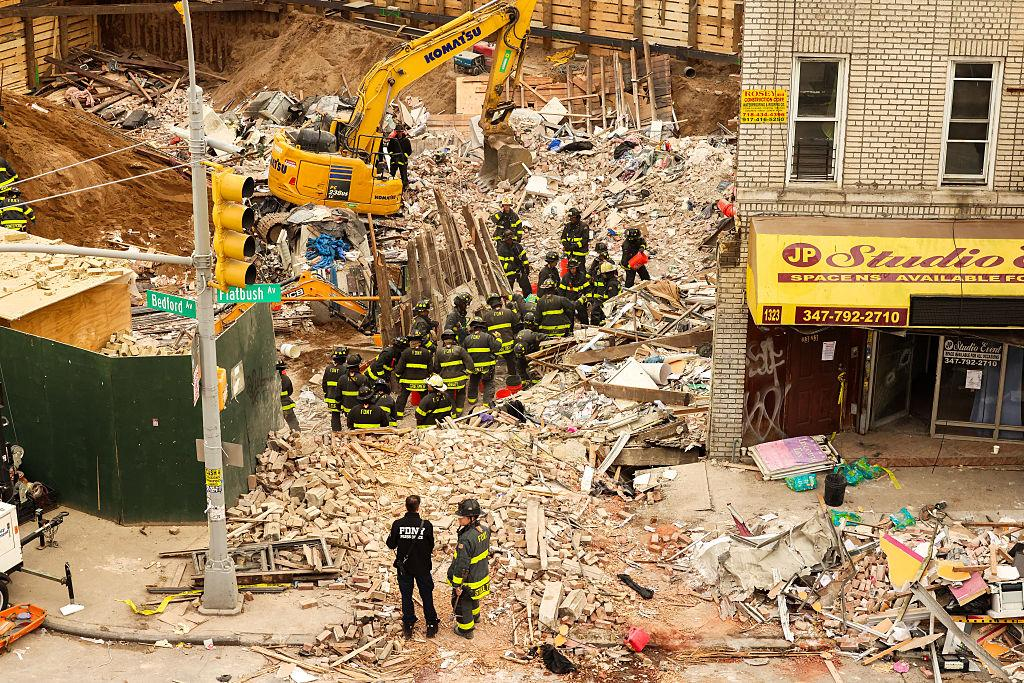
The disaster unfolded on a Wednesday afternoon in Brooklyn's Flatbush neighborhood.
Residents were inside apartments above street-level businesses, while construction workers were excavating a neighboring lot.
Without sufficient warning for those inside, the three-story structure gave way.
Much of the building fell into the excavation pit.
The collapse also tore away part of the adjoining apartment building, exposing bedrooms, furniture and interior walls.
Witnesses described hearing a tremendous crash.
Dust spread across the street as debris fell.
Emergency crews rushed to the scene, beginning a rescue operation that continued through the night.
More than 250 firefighters and emergency personnel participated in the response.
By the following afternoon, officials confirmed that eight people had died and 18 others had been injured.
Six adults and two children died.
The children were identified as Nicole Daniela Salvada Rodriguez, 9, and Kevin Santiago Reyes Gonzalez, 10.
The adult victims were Juan Daniel Salvada Guzman, 31; Ndiaye Mamadou, 31; Barry Mamadou, 23; Gabriel Ariolfo Siguencia Yupa, 22; Edgar Sapon, 26; and Jose Luis Caguana Cosquillo, 26.
Two of the adults were construction workers.
The victims came from different families and communities, reflecting the neighborhood's diverse population.
Six people were pronounced dead at the scene, while two died after being taken to hospitals.
The Fire Department concluded its search after determining that no additional victims remained beneath the debris.
The loss left families confronting both grief and questions about how the building failed.
Firefighters worked among unstable walls, broken masonry and collapsed floors.
Rescue teams used specialized equipment to search for survivors.
The operation required careful removal of debris because portions of the surrounding structures remained dangerous.
Several people were rescued.
Others were taken to hospitals with serious injuries.
Four firefighters were among those hurt, according to the mayor's account.
The search continued into November 12 before authorities declared the rescue operation complete.
At that point, the investigation shifted toward determining what caused the collapse.
The city's Department of Buildings began examining construction records and structural conditions.
Law enforcement authorities also became involved.
Their task was to determine whether the disaster resulted from violations of safety requirements, structural weaknesses or a combination of circumstances.
The collapsed building was owned by Isolag Realty Corporation.
City property records identified Olufemi Falade as the company's registered agent.
That relationship placed the property owner and its management practices under scrutiny.
However, ownership alone does not establish responsibility for a structural collapse.
A landlord has obligations concerning the maintenance and safety of a building.
The developer and contractors working next door may have separate obligations involving excavation and support for adjoining structures.
The investigation must determine whether either set of responsibilities was breached.
Falade's name has appeared in reporting about earlier property-maintenance enforcement.
But historical violations must be distinguished from evidence directly establishing the cause of this particular disaster.
The legal question is not simply who owned the building.
It is whether specific actions or omissions contributed to the fatal collapse.
Dengane Omari Jack lived on the building's top floor for approximately five years.
He worked as a musician and DJ.
In a lawsuit filed in Brooklyn Supreme Court, Jack alleges that he noticed cracks near the entrance in October.
He says he photographed them and reported the condition to the landlord or property management.
According to the complaint, Falade received or responded to the report.
Jack alleges that the problem was dismissed rather than properly investigated.
The complaint states that he was told, in substance, that the condition was not the landlord's fault or could not be repaired.
That allegation is significant because it concerns a warning made shortly before the collapse.
It has not been established as a court finding.
tollbit.gothamist.com+1
The available reporting does not authenticate the precise quotation, “I don't know,” as a statement Falade made about the disaster.
The tenant's lawsuit describes a different response.
According to the complaint, Falade allegedly suggested that the cracks were not the landlord's responsibility or could not be fixed.
That is an allegation made by a plaintiff seeking compensation.
It is not a verified transcript of an interview with the owner.
Gothamist reported that Falade did not immediately respond to a request for comment after the lawsuit was filed.
The distinction matters because an exact quotation attributes specific words to an identifiable person.
Without a recording, direct interview or reliable published quotation, those words cannot be treated as established.
The documented issue is whether the landlord received a warning and responded adequately.
Jack's lawsuit alleges that he photographed visible cracks near the building's entrance weeks before the disaster.
He says he brought the condition to the attention of the landlord or management.
According to the complaint, the defendants failed to arrange a timely structural investigation.
The lawsuit also alleges that necessary repairs or protective measures were not undertaken.
Jack names the landlord and several companies involved in the neighboring construction project.
His claim concerns both the condition of the existing building and the effects of excavation next door.
The defendants have the opportunity to contest the allegations.
The court will need to evaluate the photographs, communications and other evidence.
For investigators, the claim provides a potentially important timeline of reported warning signs.

The October complaint was not the first documented concern about the building's exterior.
A pre-construction survey conducted in March recorded cracks along the north wall of 1321 Flatbush Avenue.
That wall faced the neighboring development site.
The survey rated the facade in poor condition and described major deficiencies.
NBC New York and News 12 reported on the photographs and accompanying inspection documents.
These records demonstrate that visible deterioration existed before the excavation reached its later stages.
However, the photographs do not establish that the cracks caused the collapse.
Engineers must determine whether they reflected longstanding masonry deterioration, foundation movement or other structural problems.
Several cameras captured the building's collapse.
Surveillance recordings showed the structure falling toward the excavation.
Footage from inside nearby apartments recorded walls giving way and residents reacting.
A video from an MTA bus, published on November 19, showed the building collapsing within seconds.
These recordings provide evidence of how rapidly the disaster unfolded.
They may help investigators reconstruct which sections of the structure failed first.
But the publicly reported camera footage does not establish when the exterior cracks originally developed.
That earlier evidence comes primarily from inspection photographs and residents' accounts.
The difference is important.
A video of a collapse documents the final structural failure.
A pre-construction photograph documents conditions at an earlier point in time.
Both may be relevant, but they answer different investigative questions.
City housing records listed 98 open violations at the property before the disaster.
The violations covered several categories of maintenance problems.
They included leaks, electrical hazards and an inadequate water supply for the sprinkler system.
Some were classified as hazardous or immediately hazardous.
The property's enforcement history raised questions about whether maintenance problems had been allowed to persist.
But the number of violations does not establish the collapse's engineering cause.
A plumbing or electrical violation may indicate poor maintenance without directly affecting structural stability.
Investigators must determine whether any recorded conditions involved foundations, load-bearing walls or other structural components.
The violation history is relevant to assessing property management.
News 12 reported that Falade had previously been jailed for 12 days in 2006 over failures to make repairs at properties.
His name had also appeared on the New York City Public Advocate's landlord watchlist.
Those records provide context about earlier enforcement disputes.
They do not establish that Falade caused the November collapse.
A legal finding of responsibility would require evidence showing that the owner breached a duty and that the breach contributed to the harm.
That might involve ignored structural warnings, failure to perform required repairs or other specific conduct.
The pending lawsuit raises such questions.
But the allegations remain subject to judicial review.
Investigators must evaluate the owner's actions alongside the responsibilities of the neighboring developer and construction professionals.
The neighboring development was located at 2625 Bedford Avenue.
Construction crews were excavating the site for a new building.
City officials said an approved plan allowed a three-story development.
The developer had also submitted a proposal for a larger nine-story project, but that plan had not been approved.
Records indicated that excavation work could extend approximately 14 feet below ground level.
Digging beside an existing building can change the support available to its foundation.
That is why excavation plans may require protective measures and structural monitoring.
The city has not established that excavation alone caused the collapse.
However, its proximity to the failed building makes it a central focus of the investigation.
The question is whether the work was designed and performed safely under the conditions present at the site.
The neighboring development was associated with a limited liability company connected to Robert Fischman and other associates.
It was legally separate from Isolag Realty Corporation, which owned the collapsed building.
The construction project involved several contractors and engineering professionals.
Those parties may have held different responsibilities.
The developer controlled the project and its contractual arrangements.
Design professionals prepared engineering plans.
Contractors performed demolition and excavation work.
Special inspectors were responsible for checking specified construction activities.
The investigation must examine what each party was required to do and what actually happened.
The existence of multiple companies complicates the assignment of responsibility.
It also makes detailed records essential.
A single property owner cannot automatically be held responsible for every decision made on the adjoining construction site.
Excavation removes soil that may provide support to nearby structures.
Depending on the foundation and ground conditions, that removal can produce movement.
Engineers use methods such as shoring, bracing and underpinning to control those risks.
Shoring helps support excavated soil or structural elements.
Underpinning can reinforce an existing foundation.
Monitoring equipment may detect movement or vibration during construction.
The appropriate safeguards depend on the site's engineering conditions.
Older buildings can require particular attention because their foundations may differ from modern designs.
But age alone does not establish that a building is unsafe.
The critical question is whether the construction plans adequately addressed the existing structure and whether those plans were followed.
The construction site had already been subject to city enforcement.
On March 20, inspectors found demolition proceeding without adequate overhead protection for neighboring properties.
The Department of Buildings issued a stop-work order.
When inspectors returned in April, they found that demolition had resumed despite the restriction.
That resulted in another violation.
By May 8, the department said the cited safety problems had been corrected and lifted the order.
The excavation underway in November was permitted.
These records show that earlier work had raised compliance concerns.
They do not prove that the later collapse resulted from the same violations.
Investigators must determine whether any relevant protective requirements were violated during the excavation occurring immediately before the disaster.
People living near the construction site described repeated vibrations.
Some said they had noticed cracks in their apartments.
One witness reported seeing bricks fall shortly before the collapse.
Those observations may help investigators establish when the building began to move.
But they do not independently determine the cause.
Vibration can result from different construction activities.
The effect on a nearby building depends on the intensity, duration and structural conditions.
Investigators will need to compare witness accounts with construction logs, engineering records and physical evidence.
The March survey and October lawsuit also create a timeline of concerns predating the disaster.
That timeline may be important in determining whether warnings were communicated to the appropriate people.
The city's investigation includes examination of approved excavation plans.
Officials must determine whether required support systems were installed and whether construction followed the approved sequence.
Engineering reports may also show whether movement or cracking was monitored.
Investigators need to establish the actual depth of excavation at the time of the collapse.
They must determine what structural support remained beneath or beside the building.
The answers may require examination of debris, foundation remnants and construction photographs.
A plan showing protective measures does not establish that those measures were installed.
Conversely, incomplete public records do not automatically prove that required work was omitted.
The investigation must reconcile documents with the physical conditions found at the site.
Responsibility for a structural collapse can involve several different legal duties.
A landlord may be responsible for maintaining an occupied building.
A developer may be responsible for ensuring that adjoining construction does not endanger neighboring properties.
Contractors must follow applicable safety requirements.
Engineers and inspectors have professional responsibilities within their assigned work.
City agencies also have regulatory duties.
Whether any of those parties failed to meet their obligations remains under investigation.
A court could eventually find responsibility involving one party or several.
It could also distinguish between civil liability and criminal wrongdoing.
Those outcomes require different legal standards.
The existence of a tragic result does not establish that every person connected to the property committed misconduct.
Mayor Zohran Mamdani ordered inspections at construction sites associated with companies involved in the Flatbush project.
The review expanded to more than 160 locations connected to six entities.
The city also hired an independent engineering firm to help investigate the collapse.
These steps reflect concerns that safety problems might extend beyond the immediate site.
But the review does not mean every associated project is unsafe.
Each location must be inspected according to its own conditions.
The city is also examining how construction inspections are conducted and documented.
Associated Press reported that the Department of Buildings had a vacancy rate of approximately 9%.
That staffing issue has added to questions about the city's ability to monitor construction activity effectively.
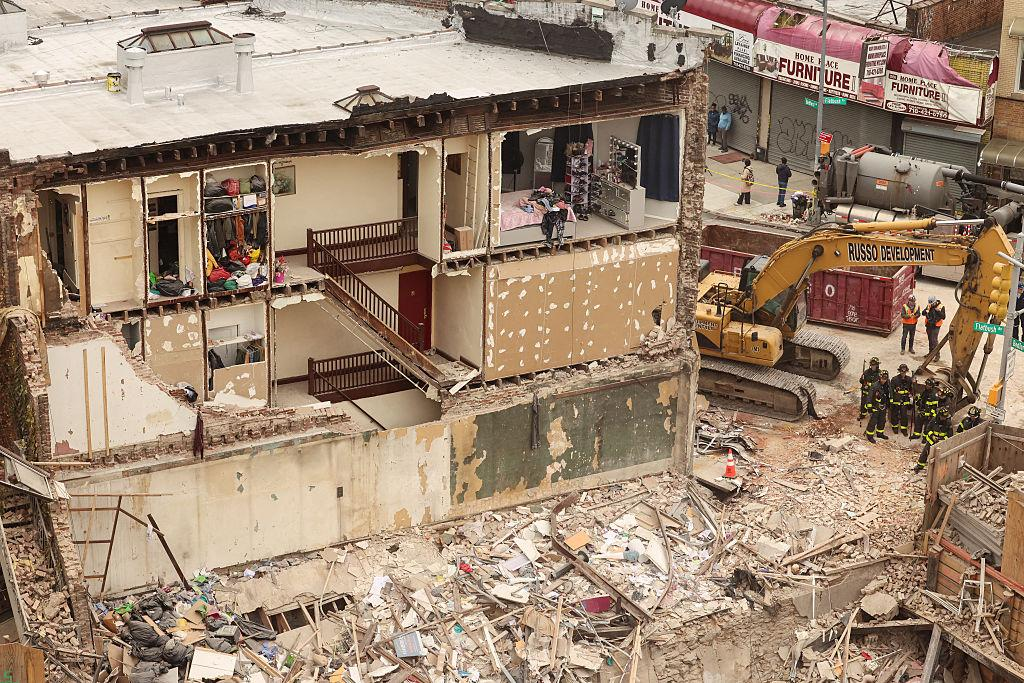
The consequences extend beyond the eight fatalities.
Survivors lost homes, possessions and access to familiar surroundings.
The adjoining building suffered extensive structural damage and was slated for demolition.
Families displaced by the collapse face immediate housing and financial needs.
Some may require medical treatment or long-term support.
Jack, the tenant who filed the lawsuit, was at work when the building collapsed.
He survived but lost his apartment and a substantial collection of vinyl records accumulated over decades.
His complaint seeks compensation for losses associated with the disaster.
Other affected residents may pursue their own claims.
The availability of compensation will depend on legal findings, insurance arrangements and individual circumstances.
Authorities are examining whether the circumstances surrounding the collapse warrant criminal charges.
That inquiry is separate from civil lawsuits seeking compensation.
A criminal investigation must determine whether conduct violated applicable laws and whether prosecutors can prove the required elements of an offense.
Investigators may examine construction records, inspection documents, communications and witness testimony.
They may also review whether any parties knowingly disregarded safety requirements.
The Brooklyn district attorney's office has been involved in examining the disaster.
No final finding of criminal responsibility has been established in the reporting reviewed.
The investigation remains focused on determining the cause and whether identifiable conduct contributed to the deaths.
Mayor Mamdani has said the city intends to hold responsible parties accountable if investigators establish wrongdoing.
The administration has expanded inspections of related construction projects.
It has also sought independent engineering assistance.
Those measures may help determine whether the disaster exposed broader weaknesses in construction oversight.
However, accountability depends on the evidence.
Officials must establish what caused the collapse, what warnings existed and who was required to respond.
The findings could influence enforcement practices and future construction rules.
They may also shape civil and criminal proceedings involving the parties connected to the property.
For the victims' families, the investigation's credibility will depend on whether it produces a clear explanation supported by documented facts.
The evidence currently identifies several parties whose actions are being examined.
Isolag Realty Corporation owned the collapsed building.
Olufemi Falade was associated with its management and received allegations of inadequate maintenance.
The neighboring developer and construction companies were responsible for different aspects of the excavation project.
Engineers and inspectors had defined professional roles.
City authorities oversaw permits and enforcement.
The March survey documented exterior cracks.
A tenant alleges that he reported additional cracks in October.
The construction site had previously received stop-work orders.
These facts create substantial questions about maintenance, excavation and oversight.
But investigators have not yet issued a final determination identifying the cause or assigning legal responsibility.
The November 11 collapse killed eight people, including two children, and injured 18 others.
The landlord's alleged response to a warning about cracks has become part of a civil lawsuit.
Construction activity next door is under technical investigation.
The city's inspection program has expanded to other projects connected to the firms involved.
The evidence points to a building with documented deterioration, an active excavation site and multiple parties whose decisions require examination.
The answer will depend on engineering findings, authenticated records and the outcome of legal proceedings.
Comments (0)
Loading comments...
May You Like

$1 BILLION DISASTER AT BANGCHAK REFINERY, THAILAND—40 BURNED, 8 AMERICANS DEAD!

IOWA MILITARY EMERGENCY: 51 TONS OF UNSTABLE SUSPECTED BIOWEAPON WASTE FOUND AFTER 5-TON BLAST!

PENTAGON'S DECLASSIFIED UFO FILES — THE MYSTERY OF AN UNDERGROUND STORAGE PROJECT!










Popular Posts



