Bush and Blair: The Fateful Alliance That Led to War
The photograph of George W. Bush and Tony Blair standing side by side captures one of the most consequential — and controversial — partnerships in modern history. Their alliance would take the world into a war that would define a generation and reshape the Middle East.
WASHINGTON – The image of President George W. Bush and British Prime Minister Tony Blair, standing shoulder to shoulder at the White House, has become emblematic of the "special relationship" between the United States and the United Kingdom at its most pivotal moment.
The two leaders forged an alliance that would lead to the 2003 invasion of Iraq — a decision that remains one of the most debated foreign policy choices of the 21st century.
The Memo That Revealed Everything
A secret memo from January 31, 2003, revealed the extent of Bush and Blair's coordination. The document, known as the Manning memo, detailed a two-hour meeting between the two leaders at the White House — just two months before the invasion began .
Written by Blair's chief foreign policy adviser, David Manning, the memo showed that the Bush and Blair administrations had already decided the invasion would take place, regardless of whether weapons of mass destruction were found by UN inspectors .
According to the memo, Bush floated the idea of painting a U-2 spy plane in UN colors and flying it low over Iraq to provoke Saddam Hussein into shooting it down — thus providing a pretext for war .
"The start date for the military campaign was now pencilled in for 10 March. This was the bombing would begin," the memo stated .
The Bush Doctrine
The partnership between Bush and Blair was built on a shared worldview that became known as the Bush Doctrine — a set of foreign policy principles that included unilateralism, the option of preemptive war, and the promotion of regime change .
After the September 11 attacks, the doctrine evolved to justify the invasion of Afghanistan in 2001 and later Iraq in 2003. The National Security Strategy of the United States, published in September 2002, codified these principles, stating that the U.S. would "act preemptively" to forestall threats .
A Legacy of Controversy
The Bush-Blair alliance achieved its immediate goal — the removal of Saddam Hussein — but the aftermath was catastrophic. No weapons of mass destruction were ever found, and the war claimed hundreds of thousands of lives .
The 2003 invasion became a defining moment in both leaders' legacies. Bush left office in 2009 with some of the lowest approval ratings in U.S. history, while Blair faced intense criticism at home and abroad .
What the Memo Revealed About the Alliance
| Key Point | Details |
|---|---|
| Meeting Date | January 31, 2003 |
| Location | White House |
| Participants | President Bush, Prime Minister Blair |
| Memo Author | David Manning, Blair's foreign policy adviser |
| Key Revelation | Invasion planned regardless of UN findings |
| War Start Date | March 10, 2003 |
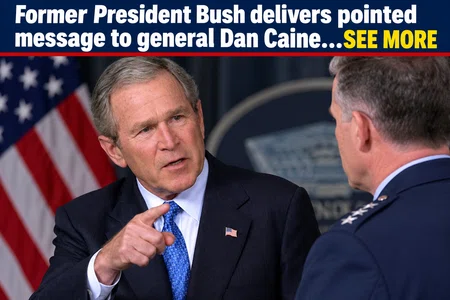
Bush Delivers Pointed Message to General Dan Caine: 'Thank God You're Still in That Position'
DALLAS — Former President George W. Bush delivered a carefully calibrated message to General Dan Caine, the Chairman of the Joint Chiefs of Staff, during an event at the Bush Presidential Center on Wednesday — a remark widely interpreted as a subtle rebuke of President Donald Trump amid the ongoing Iran war.
"Thank God you're still in that position. We're grateful for that," Bush told Caine, who was seated in the audience at Southern Methodist University.
The comment came just five miles away from where Trump and Vice President JD Vance were headlining a Republican midterm convention at the American Airlines Center. Bush did not attend that event.
The Timing and the Target
The remark landed at a highly charged moment. Caine has been a leading voice within the military advocating for restraint in the Iran conflict, while Trump has escalated military operations — striking Iranian oil tankers and publicly declaring the war will end "immediately after" the November midterms.
Bush's words were brief, but the subtext was not lost on observers.
"No one mentioned Trump by name," Raw Story reported. "But the video spread rapidly Thursday morning, with captions explicitly framing Bush as 'taking a swipe at Trump.'"
Why Caine Matters to Bush
Caine's presence at the event carried deep personal significance for the former president.
A trained F-16 pilot, Caine was among the fighter pilots scrambled to patrol Washington, D.C., on September 11, 2001 — one of the darkest days of Bush's presidency.
At the event, Bush and former Secretary of State Condoleezza Rice recalled a previously little-known detail: they had initially believed Flight 93 had been shot down by U.S. forces.
Rice reminded Caine of the moment in the bunker when the president gave the authorization order — that if a plane did not respond to identification signals, it could be shot down. "Yes, I thought that was the same situation," Bush added.
For Bush, Caine is not just a military commander — he is a man who shared in one of the most agonizing decisions of his presidency.
The Iran War Shadow
The "pointed message" interpretation stems from the growing tension between Trump and his military leadership over Iran.
Caine has consistently urged caution, while Trump has pushed for escalation — ordering strikes on Iranian vessels, deploying additional forces to the region, and threatening further action. The president has also publicly predicted the war will end right after the midterms, a claim that has drawn skepticism from military analysts and even some of his own advisers.
Bush, whose own legacy is defined in part by the Iraq War, knows the weight of military decisions. His words to Caine — "Thank God you're still in that position" — read in Washington as both a tribute to a professional soldier and a quiet expression of concern about political interference in military strategy.
A President Who Wasn't There, A Message That Was Heard
Trump did not attend Bush's event. Bush did not attend Trump's rally.
But Bush's single sentence accomplished what it set out to do: less than two months before the midterm elections, it drew attention to the fracture between the White House and the military's top leadership over the Iran war.
And Caine — the pilot who patrolled the skies over Washington on 9/11 — now sat in a room where a former president publicly thanked God he was still there.
In Washington, at this moment, that was a signal all its own.
Comments (0)
Loading comments...
May You Like
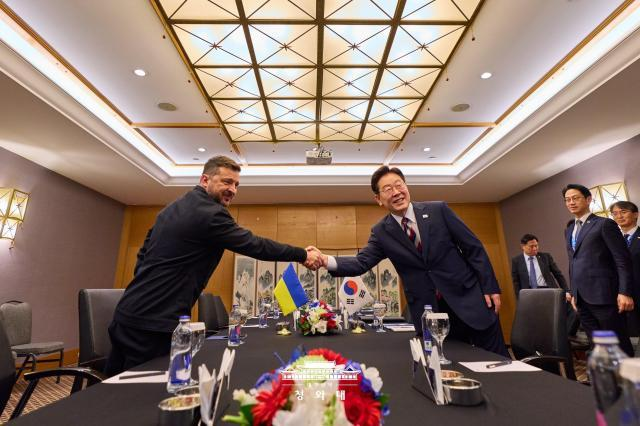
South Korea–Ukraine Rift Deepens Over North Korean POW Transfer as PURL Draws New Scrutiny
gfnhgmnghnmfgnbvvvvvvvvv