
California residents are taxed at a rate of 100 pct. on funds.....
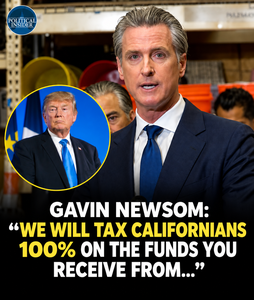
Could California Really Tax Trump’s Fund Payments at 100%?
SACRAMENTO — A striking claim in a viral political graphic suggests Gavin Newsom would tax Californians “100%” if they accept funds from Donald Trump. The reality is narrower, but the underlying policy is real.
A Tax Targeting One Specific Federal Fund
California has enacted a 100% state tax on payments from the federal government’s $1.776 billion Anti-Weaponization Fund, rather than on all federal funding received by Californians.
The measure follows months of confrontation between Newsom and the Trump administration, particularly over federal investigations, election policies, immigration enforcement and disagreements about the use of government funding.


What Newsom Originally Said
In May, Newsom said California wanted to tax 100% of proceeds received by state residents from Trump’s proposed fund, describing the measure as an available state response.
His comments came after the Justice Department announced the creation of the Anti-Weaponization Fund as part of a settlement involving Trump’s lawsuit against the Internal Revenue Service.
The Justice Department said the fund would establish a process for people claiming they had experienced improper political, personal or ideological targeting by government agencies.
According to the department, the fund would receive $1.776 billion from the federal judgment fund and could provide monetary relief to approved claimants.
California Turns the Proposal Into Law
On June 30, Newsom signed Senate Bill 122, formally establishing California’s 100% tax on payments from the Anti-Weaponization Fund.
The legislation applies to qualifying payments from the fund, or certain subsequent arrangements, for California tax years beginning in 2026 and continuing through 2030.
That means the viral graphic’s wording requires an important qualification: California did not impose a 100% tax on every dollar originating from Trump or the federal government.
Instead, the law specifically targets payments connected to the Anti-Weaponization Fund established through the Justice Department’s settlement process.
Why the Fund Became Controversial
The program immediately attracted political and legal controversy because some potential beneficiaries included individuals connected to investigations or prosecutions surrounding the January 6, 2021, Capitol attack.
The Justice Department, however, describes the program differently, saying it is intended to provide a systematic process for people who believe government agencies improperly targeted them.
The department also said the claims process has no partisan requirement and that remaining money would eventually return to the federal government.
Legal Questions Remain
The fund itself encountered significant legal obstacles. In June, a federal judge in Virginia issued a preliminary injunction preventing the Trump administration from creating or operating the program.
That ruling followed conflicting positions from Justice Department officials about whether the fund would proceed, prompting the court to question whether the program had actually been abandoned.
Separately, another federal judge declined to issue similar relief after Acting Attorney General Todd Blanche said the department was not moving forward with the program.
The competing court proceedings meant California’s new tax could become practically significant only if the federal fund ultimately distributes qualifying payments.
Could California Legally Take 100%?
California’s approach is unusual because the state is not directly taxing the federal government. Instead, it is establishing how qualifying payments are treated under California’s own tax system.
University of Southern California tax professor Ariel Jurow Kleiman described the strategy as novel while noting that states generally possess considerable discretion over their tax systems.
Any recipient challenging the tax would likely need to receive a payment first and demonstrate concrete harm from California’s taxation before establishing standing to sue.
Part of a Broader Federal-State Conflict
The tax fight is only one element of a broader dispute between California officials and the Trump administration over federal authority and state policy.
In July, California joined a multistate lawsuit challenging federal conditions attached to public-safety funding, arguing that funding should not depend on states changing election-administration policies.
The dispute illustrates a recurring question in American federalism: how far can Washington condition federal money, and how much authority do states retain over their own programs?
Newsom has also publicly criticized Trump over federal investigations involving him and his wife, while the administration has not adopted Newsom’s characterization of those investigations.
What the Viral Graphic Gets Right — and Wrong
The graphic is broadly correct that Newsom pursued and ultimately signed a 100% California tax connected to Trump’s Anti-Weaponization Fund.
However, its wording can make the policy sound substantially broader than the legislation actually is: the law does not cover ordinary federal grants, salaries, Social Security, disaster assistance or other federal payments generally.
The measure therefore represents a targeted state tax response to one controversial federal fund, rather than a blanket California policy taxing residents who accept money from Trump.
For now, the practical impact remains closely tied to the unresolved legal status of the federal fund itself and whether qualifying payments will ultimately be distributed.
The episode nevertheless highlights how conflicts between California and Washington increasingly extend beyond rhetoric, reaching taxation, federal funding, elections and competing interpretations of governmental authority.
The key distinction is simple: Newsom did sign a 100% tax, but it applies to a specific Trump-linked fund — not to all federal money received by Californians
Comments (0)
Loading comments...
May You Like

gfnhgmnghnmfgnbvvvvvvvvv














