
California Targets 'Addictive' Social Media Apps in Landmark Bill — Protecting Kids or Overreaching Censorship?
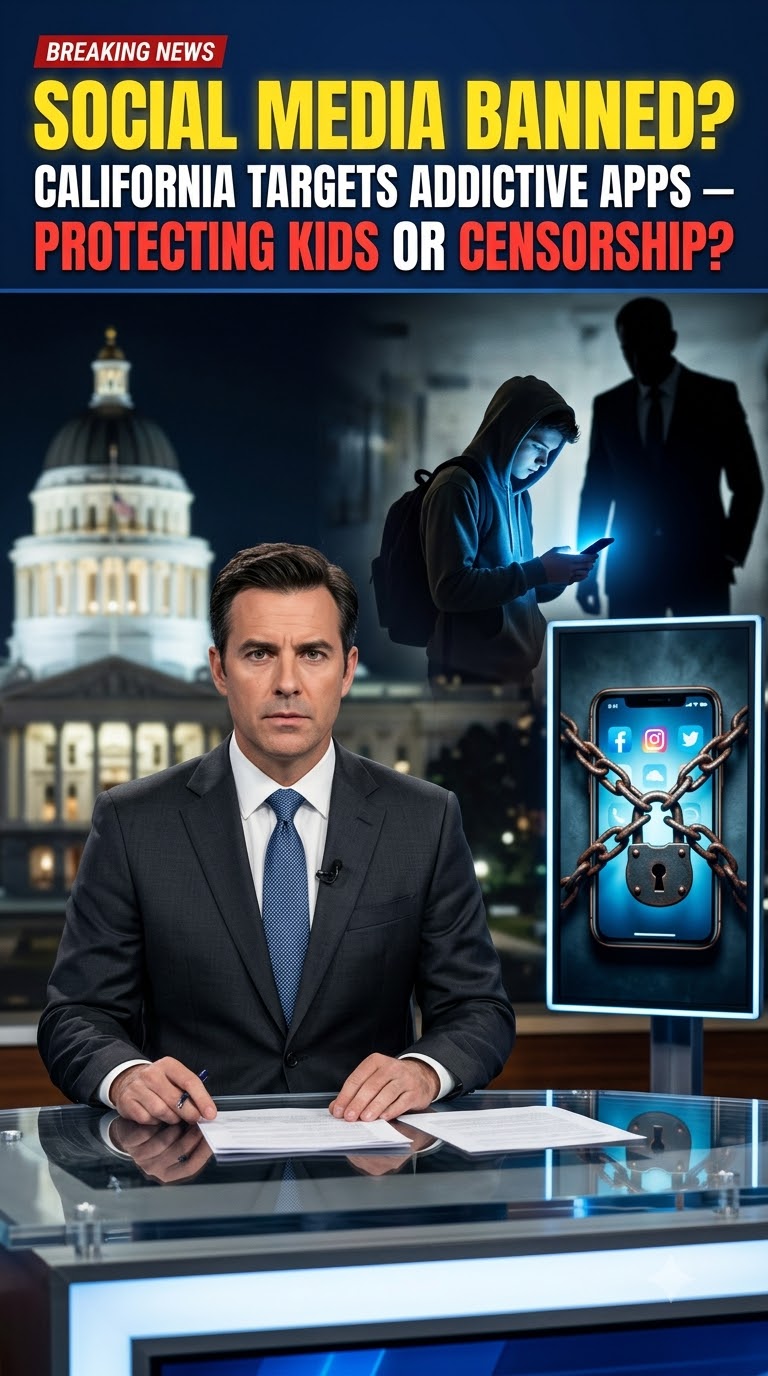
California lawmakers are poised to pass a first-of-its-kind legislation banning social media platforms from providing "addictive" features — including infinite scroll, autoplay, and algorithm-driven feeds — to users under 16. The bill has passed the Assembly with bipartisan support, but legal experts warn of an impending First Amendment showdown with tech giants that could reshape the internet as we know it.
SACRAMENTO – The California Assembly has unanimously passed a bill that would effectively force minors off platforms like TikTok, Instagram, and YouTube unless the companies radically overhaul their core products. The proposal, AB 1709, targets the very features that make social media so profitable and engaging: endless scrolling, algorithmic recommendations, constant notifications, and autoplay .
The legislation, introduced by Assemblymember Josh Lowenthal (D-Long Beach), a self-described "girl dad" of three, would require platforms to verify users' ages and delete accounts belonging to anyone under 16 . Failure to comply could result in significant financial penalties .
"This bill is not about cutting off young people from the internet or denying them access to the community," Lowenthal said during the Assembly floor debate. "Young people deserve the ability to find support and belonging online. But we should reject the false choice that says children must be exposed to addictive and harmful product designs" .
A 'Significant' Bill with Bipartisan Support
The bill passed the Assembly in a 72-0 vote on May 28, 2026, an unusually strong show of bipartisanship in a deeply divided state . Republican Assemblymember Carl DeMaio, who typically opposes new regulations, expressed support, noting the government already restricts items like alcohol, tobacco, and gambling by age .
Assemblymember David Tangipa (R-Clovis), who initially opposed the bill, flipped his position after conversations with Lowenthal. "I look forward to supporting this bill today," he said on the floor . Assemblymember Rebecca Bauer-Kahan (D-Orinda) declared: "California is finally saying enough is enough. There actually is something that brings Republicans and Democrats together today, and it's our kids" .
Gov. Gavin Newsom has signaled support, telling the Washington Post earlier this year that he supports restrictions on social media access for teens under 16 .
What Counts as 'Addictive'?
The legislation specifically targets design features that studies have shown are engineered to maximize engagement at the expense of users' well-being . These include:
| Feature | What It Does |
|---|---|
| Algorithm-driven feeds | Personalized content recommendations based on user history |
| Infinite scroll | Continuous loading of new content without a natural stopping point |
| Autoplay | Automatic playback of videos without user initiation |
| Notifications | Constant alerts designed to pull users back into the app |
| 'Like' counts and feedback | Social validation metrics that create dopamine loops |
The bill would effectively ban minors from using any platform that employs these features, unless companies offer a "kid-friendly" version without them .
The Numbers Behind the Push
The legislation is backed by sobering statistics. The average child in California spends five hours a day on social media, according to Lowenthal . Pew Research Center surveys found most teens use YouTube and TikTok daily, with up to 16% admitting they are online "almost constantly" .
Research has drawn links between excessive social media use and climbing rates of anxiety, depression, and low self-esteem among adolescents . Approximately 95% of 13- to 17-year-olds use at least one social media platform .
The Legal Battle Ahead
The bill has already sparked a fierce legal fight that could ultimately be decided by the Supreme Court. Tech giants including Meta, Google, and TikTok have filed lawsuits challenging the law as a violation of the First Amendment .
The companies argue that their algorithmic feeds are a form of protected editorial expression. As Meta put it in its complaint, the state cannot "dictate how Meta organizes fully protected user-generated speech" any more than it could dictate how a library orders its books .
So far, the courts have sided with the state. Senior U.S. District Judge Edward Davila denied the tech companies' motion for a preliminary injunction, ruling that personalized algorithmic feeds do not convey an expressive message protected by the First Amendment . The U.S. Court of Appeals for the Ninth Circuit largely upheld that decision in September 2025, though it did strike down some provisions as likely unconstitutional, such as the requirement that platforms hide "like" counts from minors .
Judge Davila compared algorithmic feeds to "a mirror that reflects back to users their own perceived interests," rather than the platform's editorial judgment .
Critics of the ruling argue it creates a troubling distinction between content-moderation decisions — which the Supreme Court has held are protected speech — and algorithmic curation, which Davila said is not. The American Enterprise Institute called the ruling "highly problematic," noting it "allows California to enforce a statute that hinders minors' ability to easily receive speech that's fully protected by the First Amendment" .
Protecting Kids or Overreaching Censorship?
The bill has drawn criticism from an unlikely coalition of civil liberties advocates, privacy groups, and LGBTQ+ organizations.
Jaime Huff, head of the Civil Justice Association of California, blasted the plan as unconstitutional overreach. "Protecting kids online is important, but banning minors from broad swaths of the internet is not the answer," she told the New York Post .
Shae Gardner, director of policy at LGBT Tech, warned that the bill could harm the very young people it claims to protect. "For many LGBTQ+ youth, online spaces are where community begins," she wrote in a guest opinion . "They are often where a young person first encounters language for what they are feeling, sees someone like themselves living a full life, finds affirming information that may be unavailable at home or at school" .
Gardner argued the bill takes a "broad and deeply restrictive approach that would do measurable harm" to LGBTQ+ youth, who often rely on online communities for support and mental health resources that may be unavailable in their physical surroundings .
Social media companies have also pushed back, with a Meta spokesperson telling Fox 23 that such bans "remove parental choice altogether and push teens toward less safe, unregulated parts of the internet" .
What's Next
The bill now moves to the state Senate, where it is expected to pass before lawmakers adjourn for the year . Newsom is expected to sign it into law.
If enacted, California would join a growing number of states — including Florida, South Carolina, and Idaho — that have passed similar restrictions, though many have been blocked by courts pending litigation .
California's size and influence could make its law the de facto standard for the rest of the country, according to University of Florida social media expert Andrew Selepak. "California is so big that its law could become the de facto standard for the rest of the country," he said .
But Selepak noted that social media companies are unlikely to abandon their core products. Instead, he predicted they would offer "kid-friendly" versions, like YouTube Kids, "rather than simply ban every young user or fundamentally change their core products" .
The Bottom Line
| Key Detail | Information |
|---|---|
| The Bill | AB 1709 (California) |
| What It Does | Bans minors under 16 from platforms with "addictive features" |
| Status | Passed Assembly 72-0; now in Senate |
| Targeted Features | Algorithmic feeds, infinite scroll, autoplay, notifications |
| Legal Status | Partially upheld by Ninth Circuit; ongoing litigation |
| Key Backers | Gov. Newsom, bipartisan Assembly coalition |
| Key Opponents | Meta, Google, TikTok; LGBTQ+ advocacy groups; civil liberties groups |
The California legislation represents the most aggressive attempt yet to regulate how social media companies design their products for young users. Whether it survives the inevitable legal challenges may determine not just the future of teen social media use in America's most populous state — but whether any state can impose meaningful restrictions on the tech industry's most profitable business model.
For now, the bill is a bipartisan statement that even Silicon Valley's home state is ready to hold tech accountable for the mental health crisis its products have helped create.
Comments (0)
Loading comments...
May You Like

OBAMA STUNS ON INSTAGRAM: MESSAGE MARKING 34-YEAR MILESTONE SPARKS A BUZZ

Russian Drone Strikes Kyiv Bridge as German Chancellor Arrives in Ukraine













