Fact-check: Canada and EU deepen ties as Trump trade war pushes Ottawa to diversify
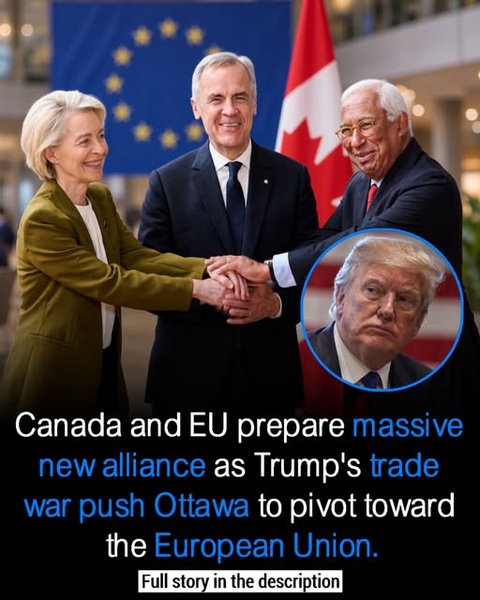
Verdict: Mostly accurate, but “massive new alliance” overstates what has actually been created.
The graphic’s central claim is grounded in a real and significant shift in Canadian policy: Ottawa has been rapidly strengthening its economic, trade and defence relationship with the European Union as its relationship with the Trump administration has deteriorated.
However, Canada and the EU have not announced a new formal “alliance” replacing the United States. What exists is an increasingly comprehensive strategic partnership, built through several agreements and initiatives.
Canada really is pivoting toward Europe
The shift accelerated under Prime Minister Mark Carney.
In June 2025, Canada and the EU announced a New EU-Canada Strategic Partnership of the Future, covering trade, economic security, digital technology, climate, defence and supply chains. Canada and the EU also signed a Security and Defence Partnership.
That relationship has continued to expand.
In March 2026, Canada and the EU formally launched negotiations for a Digital Trade Agreement, while explicitly describing stronger EU-Canada trade as a way to diversify Canada's trade and improve economic security and resilience.
Canada also joined the EU's Security Action for Europe (SAFE) defence initiative. Ottawa says this gives Canadian defence companies access to European procurement opportunities and strengthens Canada-Europe defence-industrial cooperation.
Trump's trade war is an important reason
The graphic is also broadly right that U.S. trade pressure is encouraging Ottawa to diversify.
In August, Carney suspended trade negotiations with Washington after rejecting U.S. terms he described as unfair and economically damaging. He explicitly said Canada needed to “diversify our trading relationships abroad.”
The situation has since worsened. The United States imposed additional measures on Canadian goods, while Canada began retaliatory tariffs on $20 billion of U.S. imports on September 8.
Carney's government has simultaneously emphasized diversification of Canada's trade and defence relationships. The Canadian government said on September 7 that this diversification is continuing despite the trade conflict with Washington.
The economic relationship with Europe is already substantial
This isn't simply a diplomatic gesture.
The EU is Canada's second-largest trading partner, and Canada-EU goods and services trade reached C$178.6 billion in 2025, according to Canada's government.
EU data puts 2025 bilateral goods-and-services trade at about €130 billion, up substantially from the years before CETA.
And Canada's exports to non-U.S. markets are actually increasing. Statistics Canada reported that in July 2026, exports to countries other than the United States reached a record C$25.6 billion, representing 33.7% of Canadian merchandise exports that month.
That said, the United States remains overwhelmingly important. In July, about 66% of Canada's merchandise exports still went to the U.S.
So “pivot” should be understood as diversification, not abandonment of the American market.
Is this really a “massive new alliance”?
That's the biggest exaggeration in the graphic.
Canada and the EU have certainly built a much deeper partnership. Their cooperation now covers:
- trade through CETA;
- negotiations on digital trade;
- critical minerals and supply chains;
- defence procurement;
- military and security cooperation;
- Ukraine;
- energy and climate;
- technology and AI;
- economic security.
The EU and Canada have even described their relationship as a new strategic partnership.
But this is not a military alliance equivalent to NATO, nor is Canada joining the European Union. Canada's government itself describes the EU relationship as a strategic partnership and separately maintains its longstanding relationship with the United States.
The U.S. relationship isn't disappearing
There is an important nuance missing from the graphic.
Even after walking away from the latest negotiations, Carney has repeatedly said Canada remains willing to reach a mutually beneficial trade agreement with the United States. On September 3, he said Canada was still prepared for a deal if Washington adopted a more credible and stable approach.
So Ottawa's strategy is better described as:
reduce dependence on the United States + expand European and other markets + retain access to the U.S. market where possible.
That's considerably different from replacing the United States with Europe.
Bottom line
The graphic is based on a real geopolitical and economic trend, but its language is sensationalized.
Canada really is deepening its relationship with the European Union, and Trump's escalating tariffs and trade confrontation have accelerated Ottawa's determination to diversify. Canada and the EU have created a substantial new framework for cooperation in trade, defence and economic security.
But there is no newly announced “massive alliance” between Canada and the EU, and Canada has not abandoned the United States. The emerging reality is a more diversified Canadian foreign and trade policy in which Europe is becoming considerably more important.
Comments (0)
Loading comments...
May You Like


Russian Drone Strikes Kyiv Bridge as German Chancellor Arrives in Ukraine