Von der Leyen Proposes Canada as EU’s First ‘Associate Member’ in Unprecedented Partnership Plan
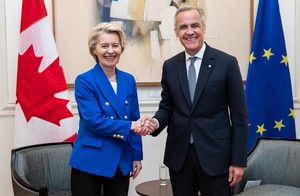
European Commission President Ursula von der Leyen has proposed a historic new relationship with Canada that would deepen cooperation in trade, defence, technology and energy without making Canada a full European Union member.
European Commission President Ursula von der Leyen has proposed making Canada the European Union’s first “associate member,” an unprecedented status intended to deepen ties without turning Canada into a full EU member.
Von der Leyen unveiled the idea during her 2026 State of the Union address in Strasbourg on September 16, with Canadian Prime Minister Mark Carney attending as a special guest.
She said Europe and Canada should move beyond their existing trade relationship toward an “Alliance for the Future,” creating a broader space for economic security, investment, technology and strategic cooperation.
The proposal would expand collaboration in intelligent manufacturing, artificial intelligence, quantum technologies, cybersecurity, energy, critical minerals, batteries and Arctic policy, while also integrating parts of their defence industrial bases.
Von der Leyen described the initiative as a partnership designed to strengthen both sides rather than target another country, emphasizing shared democratic values and a desire for greater strategic resilience.
Her wording was significant but carefully framed: she said she wanted to “work with” Canada on opening the door to associate membership, rather than announcing that a completed legal agreement already exists.
No formal EU category called “associate membership” currently exists in the treaties, so creating such a status would require substantial legal and political work among European institutions and member governments.
Associated Press reported that the concept would likely require treaty changes or a new legal arrangement, meaning von der Leyen’s proposal is an opening initiative rather than an immediately effective membership decision.
Carney welcomed the idea publicly on September 17, telling the European Parliament that Canada wants deeper integration with Europe while preserving its own sovereignty, institutions and independent political identity.
He argued that closer ties could strengthen Canada’s resilience and strategic autonomy, especially in trade, defence, energy, artificial intelligence, financial services and other areas where Ottawa seeks broader international partnerships.
Canada and the EU already have a substantial foundation for closer relations through CETA, their comprehensive trade agreement, which von der Leyen said has helped goods trade grow sharply since implementation.
The two sides have also expanded security cooperation. In June 2026, the EU formally concluded an agreement allowing Canadian companies and products to participate in procurement under the bloc’s SAFE defence instrument.
Canada became the first non-European country to participate in SAFE, reflecting growing cooperation on defence production, procurement and industrial capacity following the Canada-EU Security and Defence Partnership signed in 2025.
Recent Canadian and European discussions have also focused on critical minerals, energy security, advanced technologies, research, development and ways to strengthen supply chains across the Atlantic.
Officials are additionally discussing closer people-to-people links, including expanded opportunities for Canadians and Europeans to travel, study, work and conduct business more easily across the two jurisdictions.
The initiative arrives as Canada seeks to diversify economic relationships and reduce vulnerability to external pressure, while the EU is pursuing stronger partnerships with countries it views as reliable democratic allies.
At the same time, the proposal faces practical uncertainty. EU governments would have to agree on what rights, obligations and institutional access an associate member would receive before any arrangement could take effect.
Questions also remain over whether Canada would gain access to parts of the EU single market, freedom-of-movement arrangements, regulatory systems or additional defence and technology programs under the proposed status.
Canada and the EU are expected to continue discussing the concept ahead of their October 29–30 leaders’ summit in Canada, where officials may begin defining the proposal’s legal and political framework.
The viral graphic therefore captures the central development, but “formally invited” is stronger than the current legal reality: von der Leyen has proposed opening negotiations toward an unprecedented associate relationship with Canada.
Comments (0)
Loading comments...
May You Like

Jack Smith Defends His Integrity as Trump Investigations Face Renewed Political Firestorm
Russian Drone Strikes Kyiv Bridge as German Chancellor Arrives in Ukraine