
CANADA DUMPS MUSK! ★ LOOKING BEYOND STARLINK FOR ITS FUTURE...
CANADA DUMPS MUSK! CARNEY LOOKS BEYOND STARLINK AS OTTAWA PUSHES FOR DIGITAL INDEPENDENCE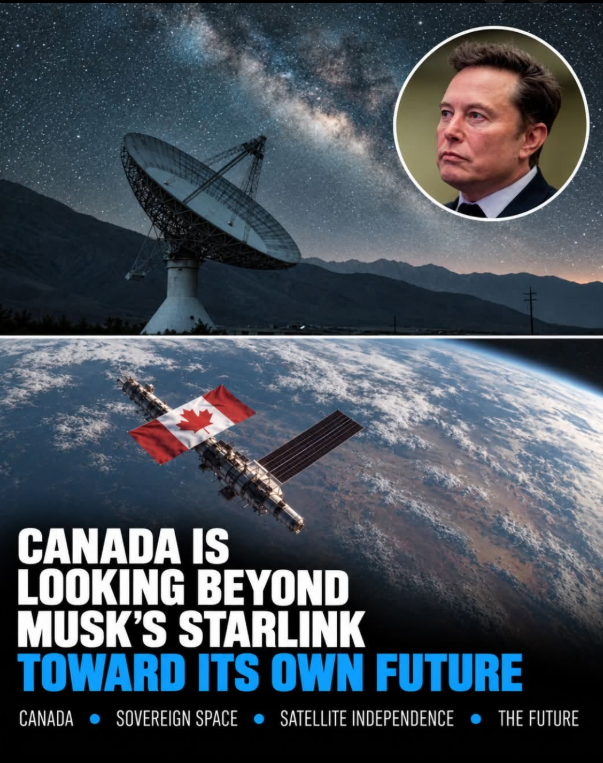
Canada is moving to reduce its dependence on Elon Musk’s Starlink satellite internet network, opening a new chapter in the country’s effort to strengthen technological independence from the United States.
Prime Minister Mark Carney made the government’s position clear in a September 2026 interview, declaring that Canada would diversify away from Starlink as it reassesses its reliance on American technology.
The announcement reflects growing concerns in Ottawa about depending on a privately controlled communications network for services that could become essential to national security, emergency response and remote communities.
Carney’s position also comes amid deteriorating trade and political relations between Canada and the United States under President Donald Trump. Tariffs and disagreements over strategic priorities have encouraged Canadian officials to reconsider long-standing economic dependencies.
Starlink, operated by Musk’s SpaceX, has become an important source of high-speed internet for Canadians living in rural areas, northern communities and locations where conventional broadband infrastructure remains limited.
Its extensive satellite constellation provides connectivity in places where building fibre-optic networks or cellular towers can be prohibitively expensive. That reach has made Starlink difficult to replace quickly, despite growing political pressure to diversify.
Carney’s concern is not simply about internet prices or commercial competition. The prime minister has emphasized the strategic risks of relying on a service controlled by a single individual and company, particularly when communications could affect military operations.
The war in Ukraine has intensified those concerns. Starlink’s role in Ukrainian communications and disputes surrounding access to its services have highlighted how private satellite operators can influence events with significant international security implications.
Canadian officials are therefore exploring alternatives that could give the country greater control over critical communications infrastructure. The goal is to reduce dependence without sacrificing the connectivity that remote communities and essential services currently receive.
One potential partner is Eutelsat, a European satellite operator that runs the OneWeb network. The company has promoted secure satellite communications for defence and government users as Canada considers diversifying its suppliers.
A proposal reported earlier in 2026 would involve approximately C$250 million in potential cooperation for secure satellite broadband coverage supporting military operations in the Arctic. The proposal should not be confused with a finalized nationwide replacement for Starlink.
The Arctic is particularly important to Canada’s strategy. Vast distances, extreme weather and limited terrestrial infrastructure make satellite communications essential for military operations, maritime safety, emergency services and remote settlements.
Canada is also backing Telesat Lightspeed, a planned low-Earth-orbit satellite network developed by Ottawa-based Telesat. The project could eventually provide another option for governments, telecom operators and organizations requiring secure, high-performance connectivity.
However, Lightspeed is still under development, with commercial service expected around 2028. It cannot immediately replace Starlink for households that need reliable satellite internet today.
European cooperation may provide another avenue. Reports in late October indicated that the European Union was considering allowing Canada to participate in its planned IRIS² satellite communications network, designed to support secure government communications and broader connectivity.
No final agreement on Canadian participation in IRIS² had been publicly confirmed as of October 29. Any arrangement would depend on negotiations, security requirements, technical compatibility and the network’s development timetable.
The challenge is especially complicated for ordinary Canadians. Starlink already serves customers across the country, and alternative providers do not yet offer an identical combination of coverage, low latency and direct-to-consumer availability.
Ontario has already taken a separate step away from Musk’s company. The province cancelled a C$100 million Starlink contract in 2025 after Trump’s tariff dispute with Canada escalated, although the decision created challenges for rural broadband expansion.
That experience demonstrates the difficulty of turning political independence into practical infrastructure. Cancelling a contract does not automatically produce a replacement network, and some remote communities may face delays or fewer options.
Starlink also remains commercially significant, including through partnerships that connect compatible mobile phones to satellites. Some services branded by Canadian telecom companies still rely on SpaceX infrastructure, illustrating how difficult it can be to eliminate technological dependence entirely.
Carney’s strategy is therefore better understood as diversification rather than an immediate nationwide shutdown of Starlink. Canada wants more options, stronger domestic capabilities and closer cooperation with trusted international partners.
The broader stakes extend beyond internet access. Satellite communications increasingly influence defence readiness, economic resilience, disaster response and the ability of governments to maintain communications when terrestrial networks fail.
For Musk, Canada’s shift represents a political and strategic challenge, although it does not mean Starlink has already lost all Canadian customers or contracts. For Ottawa, the real test will be whether alternatives can deliver dependable service at competitive prices.
As Canada pursues greater technological sovereignty, the question is no longer whether it wants alternatives to Starlink, but how quickly those alternatives can become practical. The transition could reshape Canada’s satellite communications landscape for years to come.
Comments (0)
Loading comments...
May You Like

WWE BRONSON REED—STAR COLLAPSES AT COMPANY EVENT, FATAL DRUG REACTION SUSPECTED!

WEYMOUTH HORROR—80-MPH WIND GUSTS, FIRE TRUCK FLIPS, 3 FIREFIGHTERS CRITICAL!

EAST COAST CATASTROPHE — $20 BILLION AT STAKE, 5 MILLION AT RISK OF LOSING POWER, WATER AND HEAT!








Popular Posts




