
Viral ‘Canada Is Now Surrounded’ Map Misstates Impact of New U.S.–Greenland Security Deal
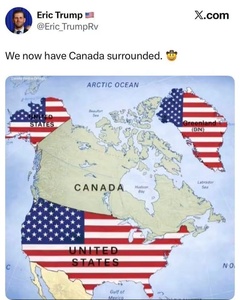
A new U.S. security agreement expanding America’s military role in Greenland has fueled dramatic claims that Canada is now “surrounded,” but Greenland remains under Danish sovereignty and Canada’s borders have not changed.
A viral map showing American flags across Alaska, the continental United States and Greenland is spreading online with the claim that Canada is now effectively “surrounded” by the United States.
The image reflects Canada’s unusual geography, but it presents Greenland as though it had become American territory. No such transfer of sovereignty has occurred under the recently announced security agreement.
Canada already shares the world’s longest international boundary with the United States, running approximately 8,891 kilometers from the Atlantic and Pacific regions to the boundary between Yukon and Alaska.
Alaska has therefore bordered northwestern Canada for generations, while the contiguous United States stretches along Canada’s southern frontier. Neither geographic fact is a consequence of any recent Trump administration policy.
Greenland lies northeast of Canada across narrow Arctic waters, but it remains a self-governing territory within the Kingdom of Denmark rather than an American possession or U.S. state.
Canada and Greenland are actually direct neighbors in one small location. A 2022 agreement divided Tartupaluk, also called Hans Island, establishing a land boundary between Canada and the Kingdom of Denmark.
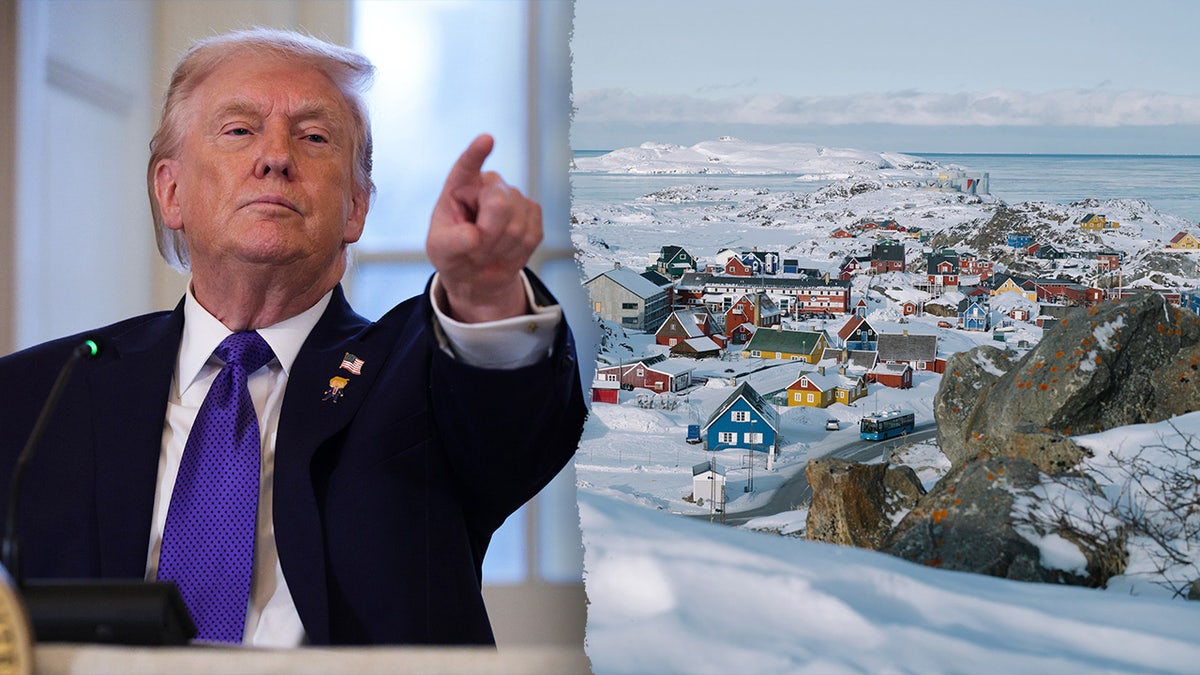
The new controversy follows President Donald Trump’s September 18 announcement of an agreement allowing a substantially expanded and enduring American military presence in Greenland for Arctic and North American security.
Trump characterized the agreement in unusually expansive terms, saying Washington would have permanent control over Greenland’s security needs and the ability to take necessary measures to protect American interests.
Danish and Greenlandic leaders immediately emphasized a different point: the arrangement does not transfer Greenland’s sovereignty, territorial ownership or constitutional status to the United States.
Greenlandic authorities also insist that the island’s right to self-determination remains intact, meaning the new military framework should not be interpreted as Washington acquiring Greenland itself.
The United States already maintains Pituffik Space Base in northwestern Greenland, an important installation supporting missile warning, space surveillance and communications across the increasingly strategic Arctic region.
American military access to Greenland is also decades old. A 1951 defense agreement with Denmark created a framework for U.S. forces long before Trump’s renewed campaign for greater influence there.
The emerging agreement would expand that presence and restrict hostile non-NATO powers from establishing military positions, with Russia and China repeatedly identified as major strategic concerns in the Arctic.
That increased American footprint does place additional U.S. military capability northeast of Canada, but describing Canada as politically or territorially “surrounded” confuses military access with actual ownership of neighboring territory.
Canada, meanwhile, has been strengthening its own Arctic strategy, emphasizing sovereignty, surveillance, diplomacy and deeper relationships with other northern allies as competition in the region intensifies.
Prime Minister Mark Carney recently expanded defence cooperation with Norway, including plans for closer military collaboration and Canada’s selection of the German-Norwegian Type 212CD submarine for its future fleet.
Canada also participates alongside the United States, Denmark, Greenland, Norway and other NATO partners in Arctic security efforts focused on stronger surveillance, military readiness and protection against Russian and Chinese activity.
The Greenland agreement can therefore also be viewed as part of NATO’s wider northern defence posture rather than simply an American attempt to militarily encircle its Canadian neighbor.
Still, the image resonates politically because U.S.-Canada relations have deteriorated sharply under Trump, while Carney has accelerated efforts to reduce Canada’s economic dependence on the United States.
Trump has also previously posted maps depicting Canada and Greenland in American colors, reviving his earlier comments about Canada becoming the 51st state and U.S. control of Greenland.
The most accurate conclusion is that America’s military reach around Canada has increased, particularly in Greenland, but Canada has not been geographically transformed and Greenland has not become U.S. territory.

Comments (0)
Loading comments...
May You Like

Shocking news from Ohio: an unexpected development ahead of Trump's rally

South Korea–Ukraine Rift Deepens Over North Korean POW Transfer as PURL Draws New Scrutiny

Barack Obama Draws Attention With New Literary Podcast












