
Trump Calls Canada the ‘Most Difficult’ Country to Deal With as Trade Rift Deepens
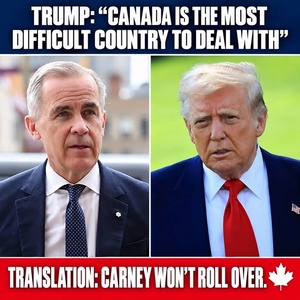
President Donald Trump has intensified his criticism of Canada and its leadership as the two countries remain locked in a tariff dispute, while Prime Minister Mark Carney insists Ottawa will wait for acceptable terms rather than rush into an agreement.

President Donald Trump has again singled out Canada for criticism, describing the longtime U.S. ally as the most difficult country for his administration to negotiate with amid an escalating trade dispute.
Speaking to reporters aboard Air Force One on September 13, Trump said he considered Canada the “worst country to deal with” before clarifying that he meant the country’s political leadership.
Trump separately praised Canadian citizens as “fantastic,” distinguishing them from government officials while repeating his view that Ottawa has been unusually difficult during negotiations over tariffs and market access.
The remarks echoed an August 25 Truth Social post in which Trump said Canada was “easily the most difficult and unreasonable” country among the many governments with which Washington negotiates.
In that post, Trump accused Canada of unfairly protecting domestic industries, imposing steep agricultural tariffs and preventing American companies from competing freely in sectors where Canadian producers hold strong positions.
The dispute escalated dramatically in August after negotiations failed to produce an agreement acceptable to both governments, ending months of talks intended to stabilize their deeply integrated economic relationship.
Carney suspended negotiations on August 21, saying last-minute changes to the American proposal were unfair and economically unacceptable and raised concerns about whether any resulting agreement would remain reliable.
The United States subsequently imposed 50 percent tariffs on roughly C$28 billion of Canadian goods, while Ottawa announced dollar-for-dollar counter-tariffs targeting American products entering the Canadian market.
Carney has consistently framed Canada’s position around securing market access without sacrificing economic independence, saying his government would pursue the best agreement for Canadians rather than accept a deal under pressure.
At the Canada Investment Summit in Toronto on September 15, Carney said Canada and the United States would always remain neighbors despite current disagreements and changes in their economic relationship.
He said future arrangements work best when the two countries operate as genuine partners respecting each other’s sovereignty, while emphasizing that Canada intends to become stronger and more economically independent.
Carney also stressed that Ottawa remains prepared for renewed cooperation when conditions permit, signaling that Canada has not ruled out returning to negotiations despite the increasingly hostile rhetoric.
Meanwhile, Canada is accelerating efforts to diversify trade and investment beyond the United States, seeking deeper economic, defence and technology relationships with Europe and other international partners.
That strategy includes discussions with the European Union over an unprecedented closer relationship, alongside Canada’s participation in European defence procurement and efforts to expand investment in energy and critical minerals.
Trump’s complaints have frequently focused on Canada’s supply-management system, which applies high tariffs to some dairy imports once specified tariff-free quotas have been exceeded.
However, trade statistics provide additional context: the United States maintains a surplus in dairy trade with Canada, while much of America’s broader goods deficit reflects imports of Canadian crude oil.
Despite the political confrontation, the economies remain deeply interconnected. U.S.-Canada freight totaled about $66.1 billion in May alone, highlighting the enormous volume moving through cross-border supply chains.
Small businesses on both sides are already experiencing consequences from retaliatory tariffs, higher transportation expenses and uncertainty, particularly companies whose customers or suppliers are concentrated across the border.
The viral graphic accurately reflects Trump’s description of Canada as exceptionally difficult to negotiate with, but its statement that this means “Carney won’t roll over” is political interpretation rather than Trump’s wording.
For now, both governments continue publicly expressing willingness to reach an eventual agreement, but their positions remain divided over tariffs, sovereignty and the terms governing one of the world’s largest trading relationships.

Comments (0)
Loading comments...
May You Like

South Korea–Ukraine Rift Deepens Over North Korean POW Transfer as PURL Draws New Scrutiny

Shocking news from Ohio: an unexpected development ahead of Trump's rally

Barack Obama Draws Attention With New Literary Podcast












