
Canada Turns Critical Minerals and Energy Into Leverage Against Trump Amid Deepening Trade War
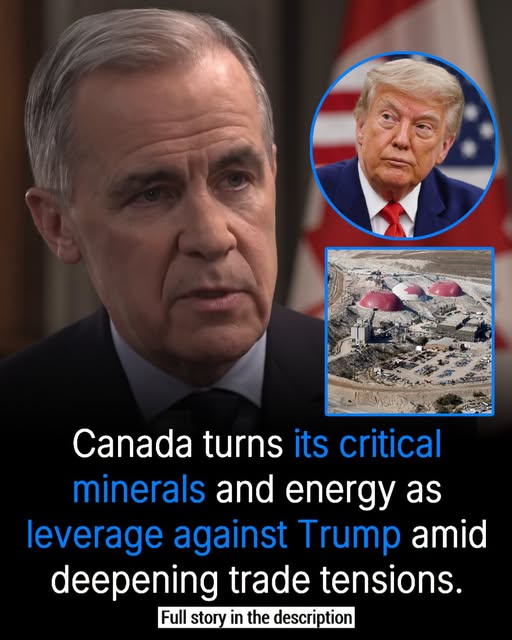
Ottawa is no longer talking about critical minerals as an asset to share with the United States. As the trade war with the Trump administration escalates, Canadian leaders are signaling they will use their vast reserves of nickel, uranium, potash, and electricity as bargaining chips — or even cut them off entirely if Washington continues its economic aggression.
OTTAWA – The image circulating online captures the reality of a rapidly deteriorating relationship between two longtime allies. Canada is actively weaponizing its critical minerals and energy resources in response to President Donald Trump's escalating tariff war .
"I don't get mad, I get even," Energy and Natural Resources Minister Tim Hodgson said Thursday, capping a tour meant to showcase the mines and electricity projects Canada is racing to build in response to Trump's "economic aggression" .
The shift in tone marks a significant departure from earlier cooperation. Under the Biden administration, the U.S. and Canada had a joint action plan on critical minerals collaboration. While that framework technically continues under Trump, Prime Minister Mark Carney has signaled he is losing interest . After walking away from trade negotiations last month, Carney said Ottawa would continue finding deals elsewhere, suggesting Washington had squandered an opportunity to cooperate .
The Minerals at Stake
Canada's critical minerals are not just any resources — they are essential to U.S. defense, quantum computing, artificial intelligence, and virtually every piece of modern technology . The U.S. relies heavily on Canadian supplies, making them a potent political tool:
| Mineral | Why It Matters to the U.S. | Canadian Advantage |
|---|---|---|
| Nickel | Used in stainless steel, EV batteries, military aircraft, and naval vessels | Sudbury Basin is one of the world's largest nickel-producing regions |
| Uranium | Critical for nuclear energy and defense applications | Cameco's Blind River refinery is the world's largest commercial uranium refining facility |
| Potash | Essential for agriculture; U.S. has limited domestic supply | Canada is a dominant global supplier |
| Cobalt, Graphite, Lithium, Copper, Rare Earths | Key to batteries, semiconductors, and advanced manufacturing | Canada holds significant potential in all of these |
Canada supplied more than 80 percent of U.S. electricity imports in 2025, according to the Canada Energy Regulator . U.S. Ambassador to Canada Pete Hoekstra has singled out potash as something America needs, noting that Trump is "very interested" in Canada's energy and critical minerals .
The Carney Doctrine: No Exclusive Access
The prime minister has made it clear: Canada will not be taken for granted.
"That is something that is a missed opportunity as a consequence of what's happened, but we didn't cause it to them," Carney said when asked about the role of critical minerals in the breakdown of trade talks . When pressed whether Ottawa would offer the U.S. exclusive access to its minerals, Carney shot back: "We would never give exclusive access" .
Carney also boasted of 50 deals in the past 12 months, "on the order of C$50 billion worth of transactions," including stockpiling resources and courting alternative buyers . Ahead of this year's G7, Canada extended a behind-the-scenes offer to alliance members for "priority access" to its critical minerals stockpile, according to a letter seen by Politico .
Ford's Threats: Cutting Off the U.S.
Ontario Premier Doug Ford has been the most vocal proponent of using resources as leverage, warning that Canada could cut off electricity and critical minerals to the United States if the trade war continues to escalate .
Ford told the Associated Press: "I'll cut them off. You won't get a grain of sand out of Ontario" . He specifically highlighted high-grade nickel and uranium, questioning what the U.S. would do without Ontario's supplies .
"Without the high-grade nickel we ship to the U.S., what would they do?" Ford said . He noted that Ontario powers 1.5 million American homes and businesses, and said "everything is on the table" in terms of retaliation .
Ford is not alone. British Columbia Premier David Eby noted that Americans need power from his province, while "the president continues to denigrate and insult the massive contribution that British Columbians and Canadians make to American energy security" .
The Risks: A Dangerous Game
Despite the tough rhetoric, experts warn that wielding resources as a weapon carries significant risks for Canada .
Electricity: While Canada supplies most U.S. electricity imports, that amounts to less than two percent of overall U.S. electricity generation. "It's just not a leverage point," said Mark S. Winfield, a professor at York University . Ontario has no long-term supply contracts with the U.S., meaning states could more easily turn to alternatives .
Oil and gas: Alberta Premier Danielle Smith has rejected using oil exports as leverage, saying it would be "extremely harmful to Canadians" and "not a viable option" . With the Trans Mountain pipeline running at full capacity, there is little room to divert those barrels to other markets . Heather Exner-Pirot of the Macdonald-Laurier Institute warned that cutting off oil would "harm us as much as them" and could push the U.S. to reduce its reliance on Canadian crude over the long term .
Critical minerals: Elizabeth Steyn, a University of Calgary law professor, said Canada needs to exercise caution. Potash would be hardest for the U.S. to replace in the short term, but tariffs or export restrictions would also hurt Canadian producers, for whom the U.S. is the largest market . The risks are particularly acute for uranium, given its military applications — "the flak that we would get for ourselves is significant," Steyn warned .
Strategic vulnerability: A research paper by the Transition Security Project raised the specter that the U.S. could coerce Canada into becoming an unwilling supplier of the minerals it needs. "The constant threat of American escalation turns mineral-rich allies like Canada into policy-takers — integrated suppliers whose investment and regulatory space narrows as the U.S. leverages its economic power over their natural resource industries," the paper warned .
The Trade War: Escalating by the Day
The resource standoff comes amid a broader trade war that has intensified dramatically:
| Date | Event |
|---|---|
| August 2026 | Trump imposes 50% tariffs on roughly US$20 billion of Canadian goods, including autos, auto parts, steel, textiles, and toys |
| August 25, 2026 | Trump threatens to double tariffs on Canadian autos and steel to 50% starting January 2027 |
| August 26, 2026 | Canada announces retaliatory tariffs of 15%, 25%, and 50% on more than 700 U.S. products, effective September 8 |
| September 2, 2026 | Trump claims Canada has "ripped off" the U.S. for years, costing Washington $60-100 billion annually |
Carney has pledged "dollar-for-dollar" retaliation and accused Washington of trying to "destroy our major industries" . Finance Minister Francois-Philippe Champagne announced a CA$7.5 billion aid package for affected firms and workers .
The Bigger Picture: A Missed Opportunity
For all the escalating rhetoric, experts say the U.S. and Canada are fundamentally intertwined — and both would suffer from a prolonged trade war.
The U.S. needs Canada to win the critical minerals race against China. Canada's mineral endowment, rule of law, clean power potential, and geographic proximity make it an irreplaceable partner . As The Hill noted, "Canada is not a substitute for U.S. ambition — it is a force multiplier for it" .
"If that trajectory continues, Canada's status as a 'mining nation' might be better understood not as an asset but as a potential liability — a source of resources that a larger, more powerful neighbor can command at will," the Transition Security Project warned .
What the Viral Graphic Gets Right
| What the Image Suggests | What's Actually Happening |
|---|---|
| Canada is turning critical minerals into leverage against Trump | Yes — Energy Minister Hodgson said this explicitly: "That will put cards in our hands" |
| Canada is threatening to cut off energy supplies | Ontario Premier Ford has threatened to cut off electricity exports |
| The trade war is deepening | Yes — both sides have imposed escalating tariffs and more threats are pending |
The Bottom Line
Canada is no longer just responding to Trump's tariffs — it is actively building leverage by controlling access to the critical minerals and energy the U.S. needs. "We develop our own critical minerals and we control our own critical minerals," Hodgson said. "We will develop our critical minerals and we will decide where they go" .
Whether Canada will actually follow through on cutting off the U.S. remains uncertain. The risks are high, and the economic interdependence between the two countries is deep. But for now, Ottawa is sending a clear message: Canada will not be treated as a subordinate.
As Hodgson put it: "Nothing would make me happier than when the United States asks us for more electricity to say, 'You know what, we've got a lot of mines we need to develop in northern British Columbia'" .
The cards are on the table. The question is whether Trump will call — or fold.
Comments (0)
Loading comments...
May You Like
TRUMP HIT WITH 26 ARTICLES OF IMPEACHMENT

Barack Obama Draws Attention With New Literary Podcast














