
Canada Turns Toward Europe as Carney Pursues a “Unique Alliance” With the EU Amid Trump Trade War
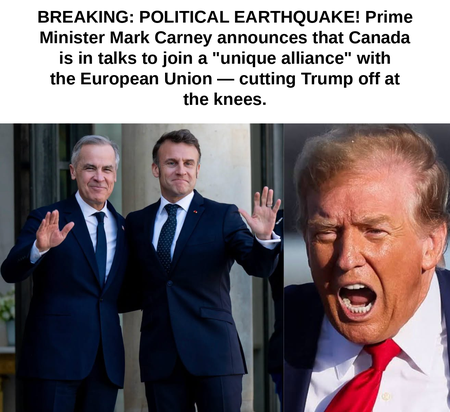
OTTAWA — September 14, 2026 — Canada is moving to deepen its economic, security and strategic relationship with the European Union as Prime Minister Mark Carney seeks to diversify the country’s partnerships amid an escalating trade dispute with the United States.
The development has prompted dramatic headlines suggesting Canada is preparing to “cut Trump off at the knees.” The reality is more measured but potentially significant: Carney has explicitly said Canada is not seeking EU membership, but instead wants to build what he calls a “unique alliance” with the bloc.
Canada and Europe prepare for a deeper partnership
Carney is scheduled to travel to Strasbourg, France, and Liverpool, U.K., from September 15–17. In Strasbourg, he will address the European Parliament and attend European Commission President Ursula von der Leyen’s State of the European Union address.
The Canadian government says the visit is intended to strengthen cooperation with European partners in trade, investment and security, reflecting Ottawa's broader strategy of diversifying its international relationships.
The timing is notable. Canada and the United States are currently locked in a worsening trade dispute, with Washington imposing new restrictions on Canadian products and Ottawa responding with retaliatory measures. The confrontation has encouraged the Canadian government to look beyond its traditional dependence on the U.S. market.
Carney has increasingly presented Europe as a natural partner for Canada in a changing global economy.
What does a “unique alliance” actually mean?
Carney's proposal does not mean Canada is applying to join the European Union.
Asked about reports that Ottawa was exploring an “associate member” arrangement, Carney said Canada instead wants to create a new form of partnership based on shared values, priorities and economic strengths.
The potential areas of cooperation are extensive. Discussions could include:
- Trade and investment
- Energy and critical minerals
- Artificial intelligence and advanced technology
- Defence and security
- Digital infrastructure
- Supply-chain security
- Research and innovation
- Potentially easier movement for people in selected areas
EU officials have also described the concept as something different from the bloc's existing arrangements with countries such as Switzerland, Norway or the United Kingdom.
That makes the initiative more than a symbolic diplomatic gesture. If negotiations eventually produce concrete agreements, Canada could gain additional access to European markets while Europe would gain a closer partner in North America.
Canada has already moved closer to Europe
The latest initiative did not emerge overnight.
At the June 2025 Canada-EU summit, Ottawa and Brussels launched a New EU-Canada Strategic Partnership of the Future and signed a Security and Defence Partnership. Canada subsequently became the first non-European country to participate in the EU's Security Action for Europe (SAFE) initiative.
The relationship has continued to accelerate during 2026.
In May, Carney became the first non-European leader to attend a European Political Community summit. European officials emphasized Canada's growing alignment with Europe on the rules-based international order and multilateralism.
In June, Canada and the EU also discussed expanding cooperation in security, conservation, critical minerals, energy and technology.
Why this matters for Trump
The geopolitical implications are difficult to ignore.
For decades, the United States has been Canada's overwhelmingly dominant economic partner. But the current trade conflict has pushed Ottawa to seek alternatives.
The Trump administration has imposed tariffs and other trade restrictions affecting Canadian goods, while Canada has responded with retaliatory measures. The dispute has created pressure on businesses on both sides of the border and has encouraged Ottawa to pursue new markets.
Carney's European strategy therefore represents a form of economic risk management.
Rather than relying overwhelmingly on the U.S. market, Canada is attempting to build a wider network of relationships spanning Europe and other major economies.
That does not mean Canada is abandoning the United States. The U.S. remains Canada's largest trading partner, and the two economies are deeply integrated.
But Ottawa is increasingly signaling that American market access can no longer be taken for granted.
Europe sees an opportunity too
The European side has its own reasons for strengthening ties with Canada.
European governments are looking for reliable partners in energy, defence, critical minerals, technology and supply chains. Canada possesses substantial natural resources and advanced industrial and technological capabilities while maintaining close cultural and political ties with Europe.
EU officials have openly described the emerging relationship as potentially “unique.”
Canada's participation in European defence initiatives is particularly notable as European countries increase spending on security and seek greater strategic autonomy.
For Brussels, Ottawa offers something unusual: a close partner outside Europe that shares many European political and security interests while also possessing significant energy and mineral resources.
The road ahead will not be easy
Despite the political momentum, a deeper Canada-EU relationship faces obstacles.
The EU is a complicated institutional system involving 27 member states, and major agreements can take years to negotiate and ratify. Even Canada's existing Comprehensive Economic and Trade Agreement has faced ratification delays in some EU countries.
There are also practical questions about how far Europe is prepared to integrate a non-European country into its economic and security structures.
And for Canada, moving closer to Europe cannot completely replace the enormous economic relationship with the United States.
Financial Times reporting indicates that Ottawa is simultaneously exploring closer cooperation with Europe on areas such as Ukraine financing, artificial intelligence and digital trade while still facing the reality that the U.S. remains Canada's most important trading partner.
A strategic shift, not an overnight break
The political image of Canada and Europe joining forces against Trump makes for a powerful headline, but the underlying story is more complicated.
Carney is not announcing Canada's departure from the North American economic system, nor is he seeking EU membership.
Instead, Ottawa is attempting to increase Canada's strategic options.
By strengthening ties with Europe while maintaining relationships across Asia and other regions, Carney's government hopes to make Canada less vulnerable to pressure from any single major power.
That strategy could become increasingly important if the U.S.-Canada trade confrontation continues.
For Trump, the immediate consequence may not be a dramatic economic rupture. But over the longer term, a Canada that develops deeper commercial and security relationships with Europe could have considerably more room to resist American economic pressure.
The real “political earthquake,” therefore, is not that Canada is suddenly leaving the United States behind. It is that Ottawa is actively building alternatives — and Europe appears increasingly willing to build them with Canada.
Comments (0)
Loading comments...
May You Like















