Carney Says Canada Will Remain a U.S. Partner While Defending Sovereignty Amid Trump Trade Dispute

Canadian Prime Minister Mark Carney says the relationship with the United States will endure beyond current political tensions, while insisting that future cooperation must respect Canada’s sovereignty and growing economic independence.
Canadian Prime Minister Mark Carney used a major investment speech in Toronto to argue that Canada can preserve its long-term partnership with the United States while becoming more economically independent.
Speaking at the Canada Investment Summit on September 15, Carney said the two countries would “always be neighbours” and described the United States as Canada’s most important partner in several key areas.
He also made clear that closer cooperation depends on mutual respect, saying bilateral arrangements work best when both countries engage as genuine partners that respect each other’s traditions and sovereignty.
Carney said Canada would be ready to deepen cooperation when better conditions return, adding that the country intends to become stronger, more resilient and more independent in the meantime.
Those remarks came amid a serious trade dispute with President Donald Trump’s administration, which has imposed new tariffs and restrictions while pressing Canadian manufacturers and investment to move south.
Canada suspended trade negotiations in August after Carney said Washington introduced last-minute demands that Ottawa considered unfair, economically damaging and inconsistent with Canadian sovereignty and key domestic industries.
The Canadian government subsequently announced retaliatory measures, while Carney continued to say that Ottawa remains open to a mutually beneficial agreement if Washington returns with acceptable and respectful terms.
Earlier this month, Carney publicly urged the Trump administration to stop “doing memes,” “throwing shade” and “trying to be tough,” saying serious negotiations require a more constructive approach.
Despite the sharper rhetoric, Carney has not argued for ending the relationship with the United States. Instead, his government is trying to reduce Canada’s vulnerability to dependence on a single market.
At the Toronto summit, Carney presented that strategy to global investors, highlighting Canada’s energy resources, critical minerals, technology sector, fiscal position and network of international trade agreements.
He said Canada aims to catalyze one trillion Canadian dollars in investment over five years, while the government announced nearly C$500 billion in investment commitments connected to the summit.
Carney also unveiled tax measures intended to lower the effective tax rate on new business investment, arguing that Canada should compete for capital by offering stability, predictability and faster project approvals.
Another part of the plan involves seeking private investment to operate Canada’s four largest airports through long-term concessions, while the federal government would retain ownership of the underlying assets.
Carney linked those domestic policies to a broader push for strategic autonomy, saying Canada must strengthen its own economy while building deeper partnerships with trusted countries in Europe and Asia.
That strategy has become increasingly visible in Canada’s relationship with the European Union, where officials are discussing expanded cooperation in defence, critical minerals, energy, artificial intelligence and digital trade.
On September 16, European Commission President Ursula von der Leyen proposed exploring an unprecedented associate relationship with Canada, a concept that would require further legal and political negotiations inside the EU.
Carney welcomed deeper European ties while insisting that diversification does not mean abandoning the United States, whose economy remains deeply connected with Canada through trade, energy, manufacturing and shared security interests.
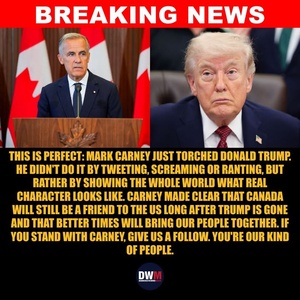
The viral graphic describing Carney as having “torched” Trump therefore mixes factual remarks with political commentary. Carney criticized current U.S. policies, but his speech emphasized future cooperation rather than personal attacks.
It is also misleading to present the line about Canada remaining a friend “long after Trump is gone” as a direct quotation. That wording does not appear in Carney’s official speech.
The more accurate summary is that Carney expects Canada and the United States to remain permanent neighbours and major partners, while insisting that renewed cooperation must respect Canadian sovereignty and independence.

Comments (0)
Loading comments...
May You Like

OBAMA STUNS ON INSTAGRAM: MESSAGE MARKING 34-YEAR MILESTONE SPARKS A BUZZ

South Korea–Ukraine Rift Deepens Over North Korean POW Transfer as PURL Draws New Scrutiny