CANADA'S CARNEY SAYS HE PREPARED FOR US INVASION AMID TRUMP TRADE TENSIONS
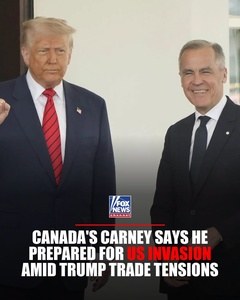
OTTAWA — Canadian Prime Minister Mark Carney says his government examined the remote possibility of U.S. military action against Canada, revealing another dimension of tensions with President Donald Trump.
Carney Addresses an Unlikely Scenario
Carney discussed the possibility in a recent interview with The New York Times, describing a potential U.S. attack as an “extreme tail risk” rather than an expected development.
He said responsible governments must consider even highly unlikely scenarios when their consequences could be severe, while emphasizing that military conflict was not considered Canada’s normal expectation.
“I think you have a responsibility in these roles to look at extreme tail risk,” Carney told the newspaper, adding that it would be irresponsible not to prepare.
Carney did not publicly detail what contingency planning might have involved, and his comments did not indicate that Ottawa believed an American invasion was imminent or likely.
The remarks instead highlighted how dramatically relations between Washington and Ottawa have changed following months of tariff disputes and repeated Trump comments about Canada becoming America’s 51st state.
Trade Tensions Drive the Relationship
The latest dispute intensified after U.S.-Canada trade negotiations collapsed in August, followed by additional tariffs imposed by Washington and retaliatory measures announced by Ottawa.
Canada says the United States imposed a 50% tariff on $27.6 billion of Canadian goods effective August 22, prompting Ottawa to match those measures dollar-for-dollar.
Canadian counter-tariffs took effect September 8 and targeted sectors including steel, dairy, appliances, agricultural equipment, pulp and paper, and electronics.
Carney has argued that Canada cannot accept trade terms that, in his view, would weaken Canadian industries or compromise the country’s ability to make independent economic decisions.
In an August speech, Carney said Canada would continue seeking a mutually beneficial agreement with Washington but would also pursue stronger domestic capacity and broader international trading relationships.
Trump’s “51st State” Rhetoric
Trump has repeatedly spoken about Canada becoming the 51st U.S. state, rhetoric that Canadian officials have rejected while emphasizing the country's sovereignty and independence.
Trump has also used economic pressure as part of his broader argument, while Carney has responded by pursuing policies designed to reduce Canada's dependence on the American economy.
The issue has become particularly sensitive because Canada and the United States maintain one of the world's most integrated economic relationships, with extensive cross-border supply chains.
The automotive industry illustrates that integration particularly clearly, with manufacturing processes and supply networks operating across both countries for decades.
Carney has argued that dismantling those connections could create economic consequences for businesses and consumers on both sides of the border.
Canada Looks Beyond Washington
As tensions have increased, Carney's government has accelerated efforts to diversify Canada's economic relationships rather than relying overwhelmingly on the United States.
Canada's government says it has been pursuing new trade and security agreements across multiple regions while seeking greater access to markets outside North America.
Carney has also discussed reducing Canadian reliance on particular American technologies and suppliers, including satellite services and potentially future defense procurement.
His government is examining alternatives in areas such as space infrastructure and fighter aircraft, reflecting a broader strategy aimed at increasing Canadian strategic autonomy.
At the same time, Carney has stressed that Canada and the United States will remain neighbors and important economic partners regardless of current disagreements.
A Relationship Under Pressure
The dispute has produced increasingly sharp public exchanges, including Carney's September call for Washington to stop “trying to be tough” and return to serious negotiations.
Washington and Ottawa still have substantial incentives to maintain cooperation because businesses, workers, consumers and supply chains on both sides depend heavily on cross-border commerce.
For Canada, however, the current confrontation has become a broader debate about sovereignty, economic resilience and whether longstanding dependence on the United States creates strategic vulnerabilities.
Carney's comments about invasion planning therefore represent one part of a much larger shift in Canada's approach to its southern neighbor.
For now, there is no indication that Canada expects military conflict with the United States. The immediate confrontation remains centered on trade, tariffs, economic diversification and the future of bilateral relations.
What Happens Next?
The central question is whether Washington and Ottawa can eventually return to negotiations or whether the tariff dispute will push Canada further toward Europe, Asia and other international partners.
Carney has said Canada remains open to a future agreement, while simultaneously preparing the economy to operate with less dependence on the United States.
The developments illustrate how a relationship once defined primarily by economic integration is now being reshaped by tariffs, sovereignty concerns and competing visions for North America's future.
Comments (0)
Loading comments...
May You Like
South Korea–Ukraine Rift Deepens Over North Korean POW Transfer as PURL Draws New Scrutiny
Obama Steps Back Into the Political Spotlight as Democrats Target Trump’s Senate Majority