
Canada’s Growing Backlash Against Trump Is Reshaping Cross-Border Politics
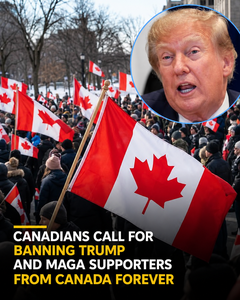
OTTAWA — Anger toward Donald Trump has intensified across Canada as the two countries remain locked in a widening trade dispute, fueling calls for stronger political distance from Washington.
A Viral Claim Meets a More Complicated Reality
A social-media graphic claims Canadians want Trump and his MAGA supporters permanently banned from Canada, but available evidence does not establish a nationwide campaign to exclude people based solely on political affiliation.
What is documented is growing Canadian opposition to Trump personally and to several policies associated with his administration, particularly tariffs and repeated suggestions that Canada could become the 51st U.S. state.
An Angus Reid Institute survey conducted in July and early August found that 79% of Canadians held an unfavorable view of Trump, including 69% who viewed him very unfavorably.
A separate September survey found the sentiment remained strong, with only 10% of Canadians expressing a positive impression of Trump while 82% reported a negative impression.
The Trade War Is Driving Tensions
The deterioration in public sentiment has unfolded alongside a major trade dispute between Ottawa and Washington, with both governments imposing tariffs while negotiations over a broader agreement have struggled.
Trump has repeatedly criticized Canada’s trade policies and has continued referring to the possibility of Canadian statehood, rhetoric that Canadian officials have rejected as incompatible with national sovereignty.
Canada has responded with tariffs and other measures while Prime Minister Mark Carney’s government has emphasized protecting Canadian economic interests during negotiations with Washington.
Recent polling suggests many Canadians currently support maintaining a tougher negotiating position, with 73% in one September survey saying Canada should refuse difficult concessions even if relations deteriorate further.
Canadians Are Also Changing Their Behavior
The political dispute has extended beyond government policy, with some Canadians reducing travel to the United States and deliberately choosing Canadian-made products as a form of economic protest.
Statistics Canada data cited by The Washington Post showed Canadian residents made 25% fewer return border crossings in 2025 and spent about $2.4 billion less on U.S. travel.
The decline has affected communities along the border, where businesses traditionally depend heavily on shoppers, tourists and families moving between Canada and the United States.
Even in communities with longstanding personal relationships across the border, residents have described growing frustration with Trump’s rhetoric while continuing to distinguish American people from political disagreements.
What About MAGA Supporters?
The available polling also complicates the idea that Canadians broadly want to exclude Trump supporters themselves. Angus Reid found Canadians generally distinguish between Trump and ordinary Americans, including those who support him.
The same survey found self-described MAGA Republicans in the United States were actually more likely to hold favorable views of Canadians, with 69% expressing a positive view compared with 17% unfavorable.
Canada does have immigration rules allowing authorities to refuse entry to foreign nationals considered inadmissible for security, criminality, human-rights violations, organized crime or other specified grounds.
Those rules do not establish a general prohibition on entering Canada because someone supports a particular American political movement, and Canadian immigration decisions are generally assessed according to individual circumstances.
Political Protest Is Becoming More Visible
There have nevertheless been organized efforts targeting representatives of the Trump administration. One Canadian parliamentary petition seeking the removal of U.S. Ambassador Pete Hoekstra gathered more than 170,000 signatures.
The petition accused Hoekstra of making statements that undermined Canada-U.S. relations and requested that Parliament examine concerns about American diplomatic involvement in Canadian domestic affairs.
However, parliamentary petitions are non-binding. Reaching the required threshold means the issue must receive a government response, but it does not automatically produce the requested policy change.
The broader political climate remains fluid, with Canadians expressing strong concerns about Washington while governments and businesses on both sides continue dealing with the economic consequences of the trade dispute.
What Happens Next?
For now, the evidence points to a significant deterioration in Canadian public attitudes toward Trump rather than a confirmed nationwide policy to permanently ban MAGA supporters from entering Canada.
The distinction matters because public anger, online campaigns and political petitions can demonstrate sentiment without representing official Canadian immigration policy or a binding decision by the federal government.
As trade tensions continue, the relationship between the two neighbors is likely to remain a major political issue, while Canadians and Americans navigate the economic and social effects of the dispute.
Key takeaway: The image reflects genuine Canadian frustration toward Trump, but the specific claim that Canada is seeking to permanently ban Trump and all MAGA supporters is not supported by the evidence reviewed. Current Canadian rules focus on legally defined grounds for inadmissibility, not political affiliation.
Comments (0)
Loading comments...
May You Like

Shocking news from Ohio: an unexpected development ahead of Trump's rally

OBAMA STUNS ON INSTAGRAM: MESSAGE MARKING 34-YEAR MILESTONE SPARKS A BUZZ

South Korea–Ukraine Rift Deepens Over North Korean POW Transfer as PURL Draws New Scrutiny












