
Canadians Want Trump and MAGA Supporters Banned? What the Viral Graphic Leaves Out
Canadians Want Trump and MAGA Supporters Banned? What the Viral Graphic Leaves Out
A viral headline turns a documented petition targeting one political figure into a much broader claim about an entire country. Here is what the public record actually shows.
News analysis · Updated October 29, 2026
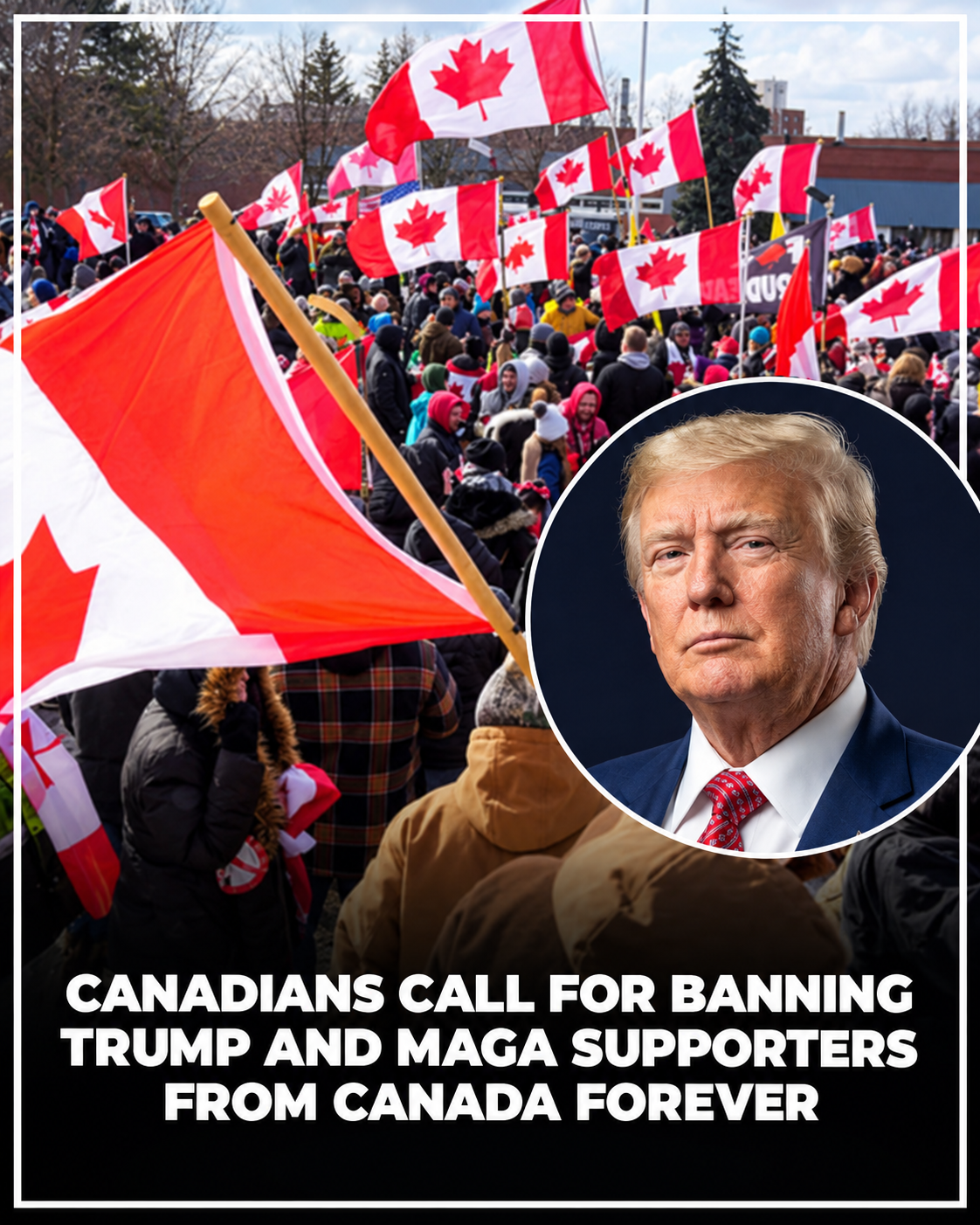
An image circulating online declares that “Canadians call for banning Trump and MAGA supporters from Canada forever.” With Canadian flags filling the background and Donald Trump pictured in a circular inset, the graphic presents a sweeping national demand as though it were an established political position. The public record tells a more specific story.
The central distinction is between people calling for a restriction and the Canadian government adopting one. Petitions and online campaigns have called for Donald Trump himself to be denied entry to Canada. Those efforts are evidence of real opposition among some Canadians, but they do not establish that Canadians collectively want every supporter of the MAGA movement barred.
One documented example is House of Commons e-petition e-5345, initiated by Alberta resident Gerard Aldridge in February 2025. It asked the federal government to refuse Trump entry until he stopped making threats or taking actions that the petition described as contrary to Canadians’ monetary and sovereign security. The petition closed on March 22, 2025, with 66,562 validated signatures listed on Parliament’s website. Source: House of Commons petition record.
That is a substantial number of signatories, and it indicates that the proposal resonated with many people who signed. But a petition is not a representative public-opinion poll. Signatures show support among participants, not the views of all Canadians, and they do not prove that the country as a whole supports a permanent entry ban.
The petition also focused on Trump, not on every American who voted for him or identifies with MAGA. The graphic expands the scope from one named political figure to a broad category of people. That is a consequential change: a request to restrict one person’s entry is not equivalent to a demand to exclude millions of people because of their political beliefs.
Canada’s immigration system does allow authorities to refuse entry to some foreign nationals. The federal government says inadmissibility can arise for reasons including criminality, security concerns, human-rights violations, organized crime, health, finances, or misrepresentation. Decisions are made under immigration law and assessed by immigration or border officials. Source: Government of Canada.
Those rules are not the same as a blanket prohibition based on political affiliation. The government’s published guidance describes legal grounds for inadmissibility; it does not describe a general rule excluding visitors because they support Trump, the Republican Party, or the MAGA movement. A political slogan or petition cannot itself change border policy.

The legal question surrounding Trump personally has been debated because Canadian law can treat certain foreign criminal convictions as grounds for inadmissibility. But the analysis is not as simple as assuming that any conviction abroad automatically settles entry eligibility. Canadian authorities assess the offence under Canadian law and consider the applicable circumstances and exceptions. Source: Immigration, Refugees and Citizenship Canada.
Political leaders and public figures can also disagree about whether a visiting head of government should be welcomed, particularly amid disputes over tariffs, sovereignty, and Trump’s past comments about Canada becoming the “51st state.” Such arguments are part of democratic debate. They do not, by themselves, establish a formal ban or a consensus among the public.

The word “forever” in the graphic is especially emphatic. It suggests a permanent policy with no qualification, yet the image provides no government announcement, legal text, polling data, or named organization to substantiate that claim. Without that evidence, the word functions as persuasive rhetoric rather than a verified description of Canadian policy.
It is also important to distinguish opposition to a political movement from a lawful basis to deny an individual entry. Canadians are free to criticize Trump and MAGA politics, advocate for different border rules, or organize petitions. Whether any specific traveller is admissible is a separate question governed by Canadian law and individual circumstances.
Petitions can still matter even when they do not directly change policy. They may draw media attention, give elected representatives a measure of constituent concern, or frame an issue for debate. In the case of e-5345, the official record documents the request and its signatories; it should not be mistaken for proof that Parliament enacted the requested restriction.
Nor does the petition’s signature count answer how Canadians feel about every MAGA supporter. People may oppose Trump’s policies while distinguishing between a president, his administration, party members, voters, and ordinary visitors. A broad label can obscure those differences and make a political debate appear more unanimous than the evidence supports.
For readers evaluating viral political images, a useful first step is to identify the original source and date. Then look for the underlying petition, government announcement, bill, court decision, or reputable polling. Headlines that make claims about what an entire country wants should be checked against representative evidence rather than inferred from a photograph of a crowd.
Another useful question is whether the image quietly changes the claim. Here, the documented petition called for refusing entry to Trump under specified conditions; the graphic says Canadians want both Trump and MAGA supporters banned forever. The latter is broader, more absolute, and unsupported by the petition record cited above.
At the time of writing, the sources reviewed for this article document petitions seeking to bar Trump personally and a Canadian immigration framework that evaluates admissibility under established legal criteria. They do not establish a nationwide government policy to permanently ban Trump supporters as a class. That conclusion should be updated if an official policy or new reliable evidence emerges.
The most accurate takeaway is therefore narrower than the headline: some Canadians have organized and signed petitions opposing Trump’s entry, reflecting genuine political anger and concern about Canada–U.S. relations. But the viral image overstates what those petitions demonstrate when it presents a broad, permanent ban on Trump and all MAGA supporters as the will of Canadians.
Canada–U.S. relations are shaped by more than personal approval or disapproval of a president. Trade, security cooperation, cross-border families, tourism, and shared communities all create practical reasons for policy debates to be handled through formal institutions. That context is lost when a graphic turns a complex dispute into a single all-or-nothing slogan.
Until an official decision says otherwise, travellers should rely on current Canadian government guidance rather than viral posts when assessing entry requirements. The rules may change, and individual cases can differ; the public record cited here supports neither a permanent blanket ban on MAGA supporters nor the claim that all Canadians endorse one.
Strong political imagery can capture a mood, but it cannot substitute for evidence. Until the claim is backed by representative polling or an official policy announcement, the statement that Canadians broadly demand a permanent ban on Trump and MAGA supporters should be treated as an unverified generalization—not a confirmed description of Canada’s law or public opinion.
Comments (0)
Loading comments...
May You Like

WEYMOUTH HORROR—80-MPH WIND GUSTS, FIRE TRUCK FLIPS, 3 FIREFIGHTERS CRITICAL!

WWE BRONSON REED—INSPIRED—SUDDEN COLLAPSE, MYSTERIOUS STIMULANTS, DEAD AT 38!

EAST COAST DISASTER—179 THOUSANDS OF HOMES AT RISK, CAUSING $50 BILLION IN DAMAGE!










Popular Posts




