
Fact-check: Carney invokes McKinley tariff history in response to Trump
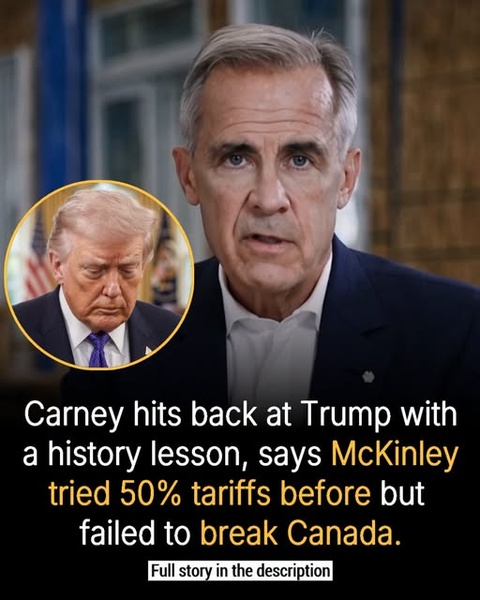
Verdict: Mostly accurate, with an important historical qualification.
The graphic is based on a real statement by Canadian Prime Minister Mark Carney. In a national video address on September 8, 2026, Carney invoked the 1890 McKinley Tariff while defending Canada's decision to retaliate against the latest Trump tariffs. He argued that the earlier American tariff strategy was intended to make Canada more dependent on the United States, but instead encouraged Canada to diversify its trade.
The graphic's wording — that McKinley “tried 50% tariffs” and “failed to break Canada” — is therefore a fair summary of Carney's argument, but it simplifies what the 1890 tariff actually did and why it was enacted.
What Carney actually said
In his September 8 address, Carney said William McKinley, then an Ohio congressman, championed the Tariff Act of 1890.
He described it as imposing 50% tariffs on Canadian imports into the United States and argued:
- the policy was intended to pressure Canada toward dependence and eventually annexation;
- it had the opposite effect;
- Canada diversified its trading relationships;
- Canada emerged stronger rather than weaker.
Carney was making the historical comparison explicitly because Canada had just begun imposing new retaliatory tariffs against the United States.
The 50% figure is broadly grounded in history — but needs context
The McKinley Tariff became law in October 1890 during Benjamin Harrison's presidency. William McKinley was chairman of the House Ways and Means Committee and a leading architect of the legislation.
The U.S. House historian says the law raised protective tariff rates to nearly 50% on average for many American products. It did not impose a uniform 50% tariff on every Canadian product. Some goods were subject to much higher or lower rates, while certain products were placed on the free list.
So the graphic's phrase “50% tariffs” is directionally correct but can give the impression that every Canadian export faced exactly a 50% duty. That is not accurate.
The tariff did substantially affect Canadian exports, particularly agricultural and manufactured goods. Historical research records a decline in Canadian exports to the United States after the tariff while exports to Britain increased.
Did the tariff “fail to break Canada”?
In the broad political sense, yes.
The tariff did not cause Canada to seek annexation by the United States. Instead, the episode helped strengthen Canadian nationalism and encouraged greater economic ties with Britain.
Canadian Prime Minister John A. Macdonald responded forcefully, while Canadian policymakers promoted retaliation and diversification. Historical accounts describe Canadian trade shifting toward Britain after the tariff, rather than Canada being absorbed into the United States.
That makes Carney's broader analogy legitimate: American tariff pressure did not produce the political outcome that some U.S. expansionists wanted.
But there's an important caveat.
Was the McKinley Tariff itself designed specifically to annex Canada?
That's more complicated.
The 1890 tariff was fundamentally a protectionist economic law designed to protect American industries. The U.S. House's historical account describes its purpose primarily in those terms.
At the same time, prominent American officials — particularly Secretary of State James G. Blaine — saw economic pressure and the absence of favorable trade arrangements with Canada as potentially encouraging Canada toward political union with the United States. Contemporary and later historians have documented that connection.
So saying “the tariff was meant to pressure Canada toward eventual annexation” is defensible when referring to the broader strategy of some U.S. policymakers, but it is too simplistic to describe the entire McKinley Tariff as an explicit annexation bill.
Indeed, historical scholarship notes that McKinley himself opposed commercial union with Canada.
The historical parallel to Trump is striking
There is nevertheless a remarkable similarity to the present dispute.
In July 2026, Trump imposed additional 50% tariffs on a significant range of Canadian products under Section 338 of the Tariff Act of 1930. The White House says the tariffs cover products including wine, hockey sticks and cement.
By August, the U.S. was preparing 50% tariffs covering about $27.6 billion of Canadian goods. Canada subsequently announced matching counter-tariffs, which took effect September 8.
Trump's trade policy has also been accompanied by repeated rhetoric about Canada becoming part of the United States, making Carney's reference to the 1890s especially pointed.
And Canada really is pursuing diversification
This is perhaps the strongest part of Carney's comparison.
Carney has explicitly made trade diversification a central part of his government's response to Washington. In August he said Canada was building strength at home while diversifying partnerships abroad.
The Canadian government says it has been developing new economic and security partnerships and expanding access to markets outside the United States.
That echoes what happened after the McKinley Tariff, although today's global economy is obviously very different from the 1890s.
One claim in Carney's history needs caution
Carney also said that after the McKinley Tariff, inflation rose in the United States, followed by a financial crisis and a four-year economic depression.
Those events did occur, but it would be misleading to imply that the McKinley Tariff caused the entire economic crisis.
The Panic of 1893 had multiple causes, including financial instability, railroad problems and monetary issues. The tariff was an important political and economic factor, but historians do not generally treat it as the sole cause of the depression.
Bottom line
The graphic is substantially based on a genuine Carney statement, rather than a fabricated quote.
Accurate:
- Carney invoked William McKinley and the 1890 tariff.
- The McKinley Tariff raised U.S. tariff rates to roughly 50% on average for many goods.
- Canadian exports were significantly affected.
- Canada did not respond by joining the United States.
- Canada increased its economic diversification and strengthened ties with Britain.
- Carney explicitly used that history as a warning to Trump.
Needs context:
- The 1890 law was not a flat 50% tariff on all Canadian goods.
- Protection of American industry was a central purpose of the law.
- The annexation argument involved broader U.S. political and economic strategy, not simply McKinley's personal objective.
- The subsequent U.S. depression cannot be attributed solely to the tariff.
Overall: Mostly accurate. The graphic captures Carney's real historical argument and the broad outcome of the McKinley episode, but its language is designed for political impact rather than historical precision.
Comments (0)
Loading comments...
May You Like
OBAMA STEPS BACK INTO THE POLITICAL SPOTLIGHT

Jack Smith Defends His Integrity as Trump Investigations Face Renewed Political Firestorm

FIGHT OVER OBAMA’S IRAN POLICY














