
Case Keenum Returned After Nearly Three Years — Then the Bears Took Control of Monday Night
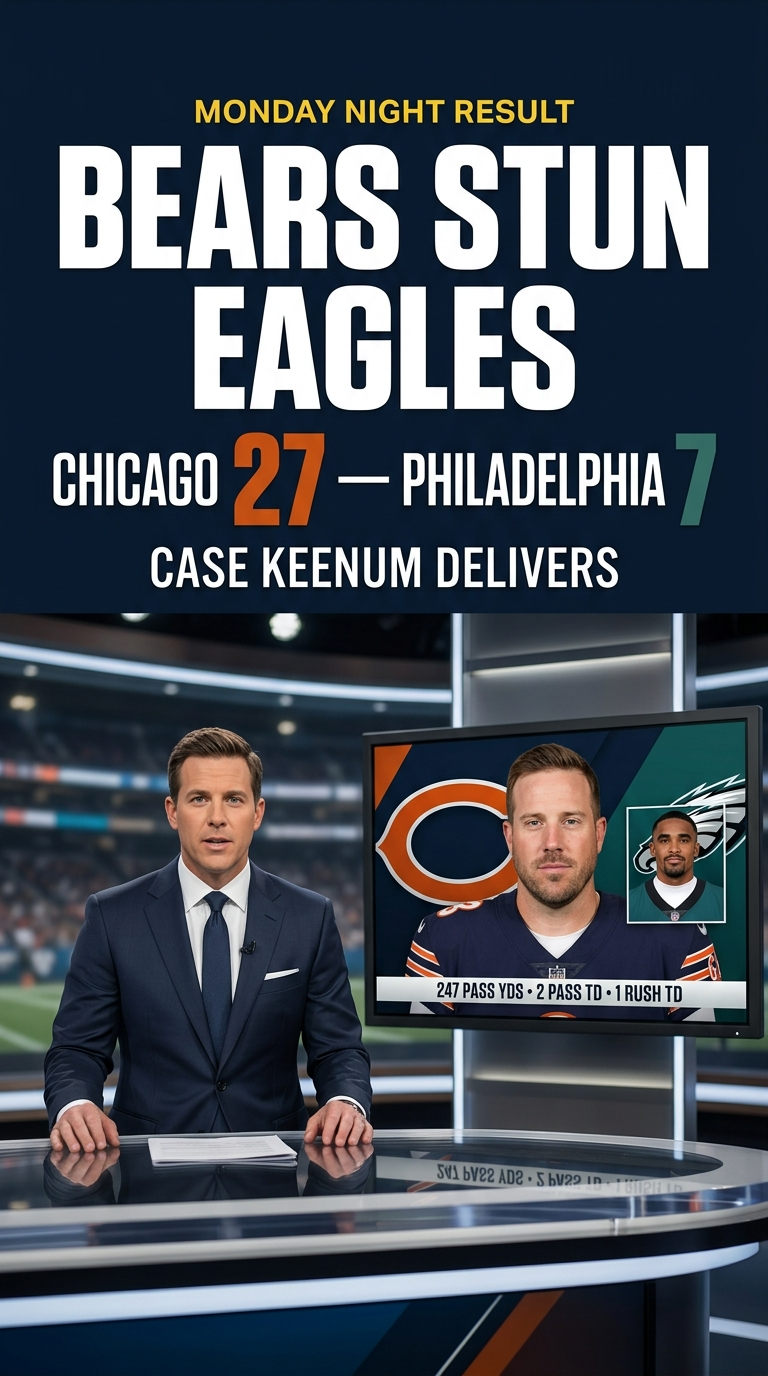
The Chicago Bears entered Monday night without starting quarterback Caleb Williams and with uncertainty surrounding the rest of the depth chart.
They left Soldier Field with a 27-7 win over the Philadelphia Eagles — and with 38-year-old Case Keenum at the center of a result few would have expected to look this comfortable.
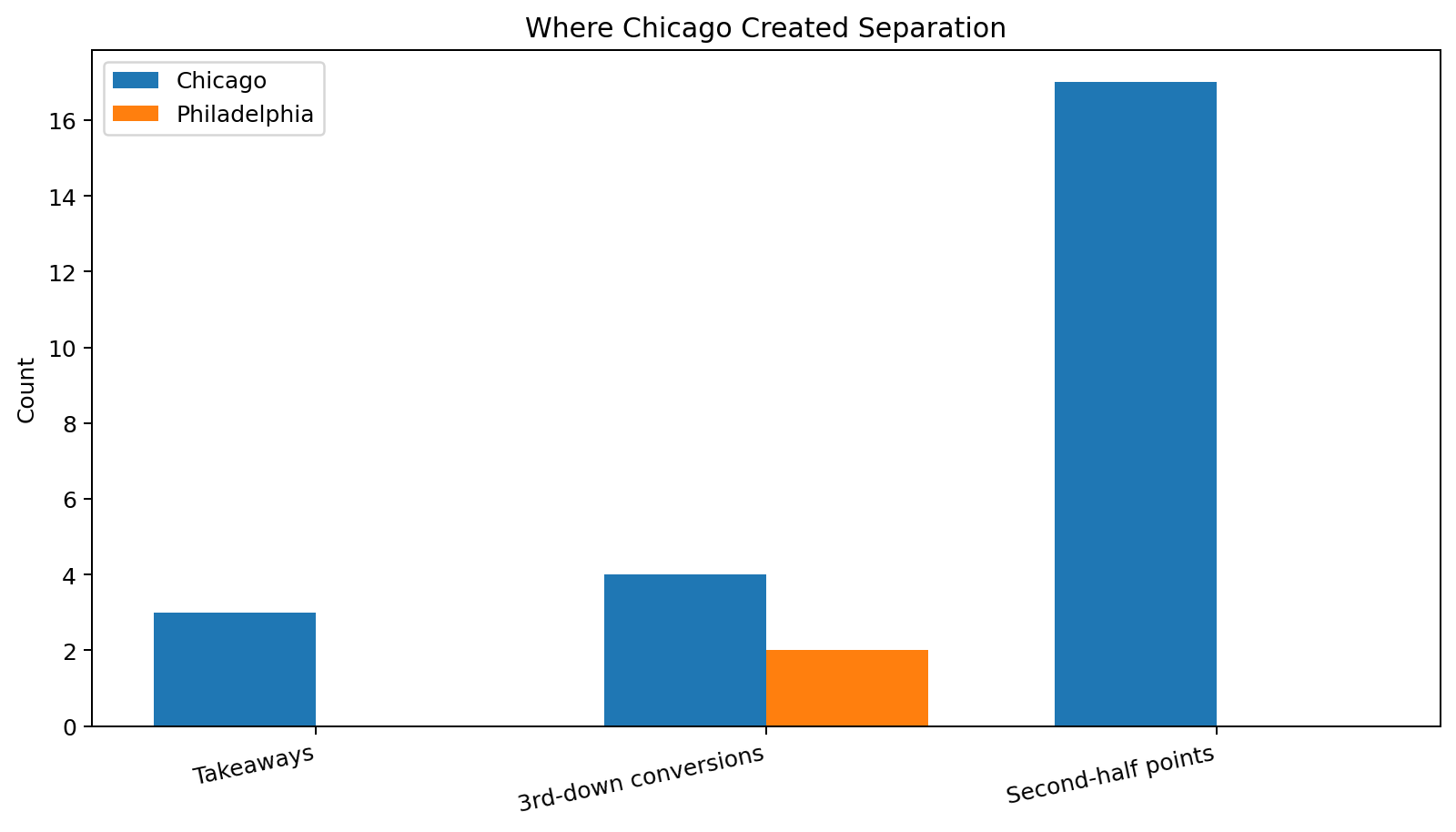
Keenum had not appeared in a regular-season NFL game since December 2023. Starting in place of the injured Williams, he completed 24 of 34 passes for 247 yards and two touchdowns, did not throw an interception and added a one-yard rushing score in the fourth quarter.
The surprise was not simply that Chicago survived with its third-string quarterback. It was how quickly the Bears looked in control.
Chicago Set the Tone on the Opening Drive
Keenum’s first possession immediately changed the feel of the game.
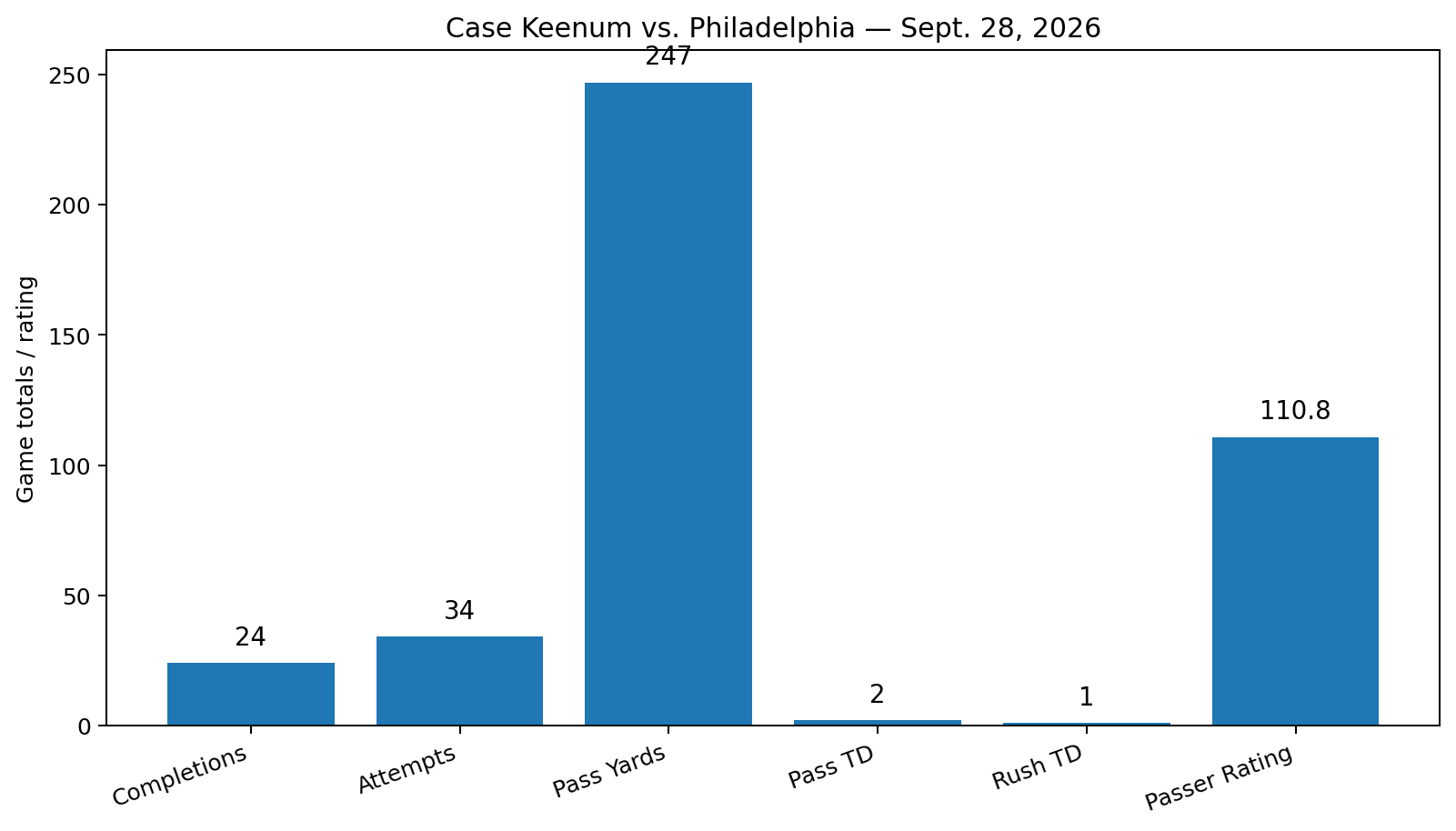
The Bears moved 66 yards in 11 plays, with Keenum completing five of six passes for 45 yards. The drive ended when he flipped an eight-yard shovel pass to rookie receiver Luther Burden III, who powered through contact and into the end zone.
For a quarterback making his first start in nearly three years, the opening sequence looked unusually calm.
Chicago was not asking Keenum merely to avoid mistakes. The offense let him throw on key downs, work the middle of the field and keep the Eagles from loading everything toward the running game.
That approach would matter even more after Philadelphia began finding opportunities of its own.
The Game Could Have Turned in the Second Quarter
Philadelphia had a chance to seize momentum after Chicago failed to convert from close range early in the second quarter.
The Eagles then drove deep into Bears territory, moving from their own end toward the Chicago goal line. But quarterback Jalen Hurts briefly left the field to be evaluated after taking a hit near the sideline.
Backup Andy Dalton entered and, with Philadelphia facing third-and-goal, threw into the end zone.
Bears rookie safety Dillon Thieneman intercepted the pass for the first pick of his NFL career.
Instead of Philadelphia taking the lead, Chicago eventually extended its advantage with a Cairo Santos field goal.
Hurts returned later in the quarter and scored on a one-yard sneak as time expired, cutting the Bears’ lead to 10-7 at halftime. At that point, the game still looked open.
The second half did not.
The Third Quarter Changed Everything
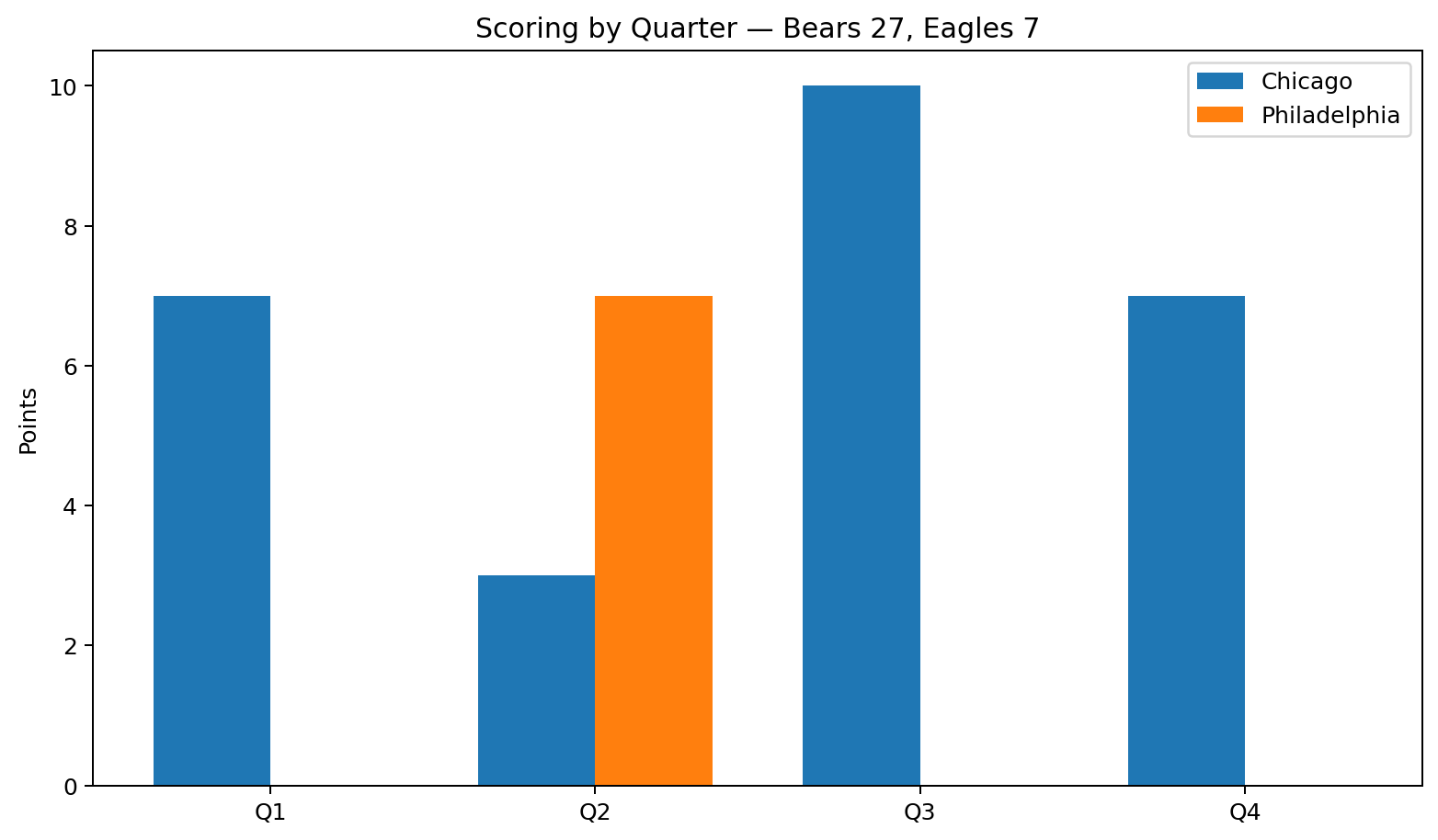
Philadelphia opened the second half with three consecutive three-and-outs.
Across those possessions, the Eagles gained only seven yards.
Chicago used that stretch to turn a three-point game into a two-score advantage. Santos hit a 48-yard field goal, and then Keenum found Kalif Raymond on a 41-yard touchdown pass that pushed the score to 20-7.
The touchdown captured what had changed.
Rather than simply managing the game, Keenum was taking advantage of openings in Philadelphia’s coverage. Raymond finished with six receptions for 90 yards, while the Bears repeatedly found enough space in the passing game to stay ahead of the chains.
At the same time, the Chicago defense became more aggressive and more disruptive.
Three Takeaways Gave Chicago Control
The Bears finished the night with three takeaways.
The first came when Austin Booker forced a fumble from Tank Bigsby, recovered by Xavier Woods. The second was Thieneman’s end-zone interception of Dalton. The third came late in the third quarter, when linebacker T.J. Edwards intercepted Hurts on fourth down.
That final turnover allowed Chicago to begin the drive that effectively ended the game.
The Bears went 58 yards in 13 plays and kept the ball for more than eight minutes. Keenum finished the possession himself with a one-yard quarterback sneak, making it 27-7 with 7:19 remaining.
The score was Keenum’s first rushing touchdown since 2019.
More importantly, the drive removed almost any realistic chance for Philadelphia to recover.
Philadelphia Never Found a Second-Half Answer
The Eagles entered the night 2-0 but struggled to generate sustained offense after halftime.
Hurts finished 16 of 25 for 153 passing yards with one interception. His one-yard rushing touchdown at the end of the first half accounted for Philadelphia’s only points.
Saquon Barkley ran for 82 yards on 15 carries, but most of that production came before halftime. He managed only nine rushing yards on four carries in the second half.
Philadelphia finished with 248 total yards and converted only two of nine third downs.
The Eagles also committed 10 penalties, repeatedly creating longer down-and-distance situations and making it harder to build rhythm against a defense that was already playing with confidence.
Chicago, by contrast, did not need spectacular yardage totals to dominate the game. It played cleaner football, protected the ball and consistently turned field position into points.
Keenum’s Performance Was More Than a Feel-Good Story
It would be easy to frame the night entirely around the veteran quarterback returning to the field.
The numbers made the performance more substantial than that.
Keenum posted a 110.8 passer rating and completed 70.6% of his throws. He delivered touchdown passes to Burden and Raymond, moved the chains on several third downs and finished without an interception.
He also did it while replacing a franchise quarterback who had been ruled out with a hamstring injury.
Tyson Bagent, who had recently cleared concussion protocol, was available as the backup. But Chicago stayed with Keenum throughout the game, and coach Ben Johnson praised the veteran’s efficiency afterward.
Keenum’s experience showed up most clearly in the moments when the Bears needed to slow the game down.
The eight-minute fourth-quarter touchdown drive was the best example: Chicago stayed patient, continued converting manageable situations and never gave Philadelphia the quick possession it needed.
Chicago’s Defense Made the Result Possible
The quarterback story will naturally draw most of the attention, but the Bears’ defense may have been the bigger reason the final margin reached 20 points.
Chicago held Philadelphia to 62 total yards in the second half.
The defense forced three turnovers, produced key stops near the goal line and limited the Eagles to a 22.2% conversion rate on third down.
Hurts was also pressured at several important moments, including a third-quarter sack by Montez Sweat and a fourth-quarter sack by Dayo Odeyingbo.
Those plays kept Philadelphia behind schedule and prevented the offense from creating the explosive sequence that might have changed the game.
By the final minutes, the Bears were no longer protecting a surprise lead. They were closing out a controlled win.
What the Result Means for Both Teams
Chicago improved to 2-1 and responded to a 9-3 loss to Minnesota with a performance that looked completely different on both sides of the ball.
The next question is at quarterback.
Williams remains sidelined by a hamstring injury, while Bagent is again available after clearing concussion protocol. Keenum’s performance gives Chicago another credible option, but the coaching staff will still have to decide how the depth chart should look when the Bears face the New York Jets in Week 4.
Philadelphia also moved to 2-1 and will have a short list of obvious corrections.
The Eagles need to reduce penalties, improve third-down execution and find a way to sustain offense after halftime. Their next game comes at home against the Los Angeles Rams.
One loss does not define either team’s season.
But Monday night created a much different conversation around Chicago than the one that existed before kickoff.
A Start Few Expected Became the Story of the Night
Keenum entered the week as the emergency option behind an injured starter and a backup coming out of concussion protocol.
By the end of Monday night, he had accounted for three touchdowns and helped the Bears hand Philadelphia its first loss of the season.
The performance did not require a last-second drive or a dramatic comeback.
Chicago scored first, protected the lead and steadily widened it.
That may be the most surprising part of the entire result.
The Bears did not win because one unpredictable play broke their way. They won because, for four quarters, the third-string quarterback, the defense and the rest of the roster played the cleaner game.
For a team facing a sudden quarterback problem, that was a much bigger answer than simply getting through Monday night.
Comments (0)
Loading comments...
May You Like

South Korea–Ukraine Rift Deepens Over North Korean POW Transfer as PURL Draws New Scrutiny

Jack Smith Defends His Integrity as Trump Investigations Face Renewed Political Firestorm

FIGHT OVER OBAMA’S IRAN POLICY













