
Clint Eastwood, Obama, and the “Greatest Hoax” Quote
Clint Eastwood, Obama, and the “Greatest Hoax” Quote
A famous 2012 campaign-season line is documented—but the political judgment behind it should not be mistaken for proof.
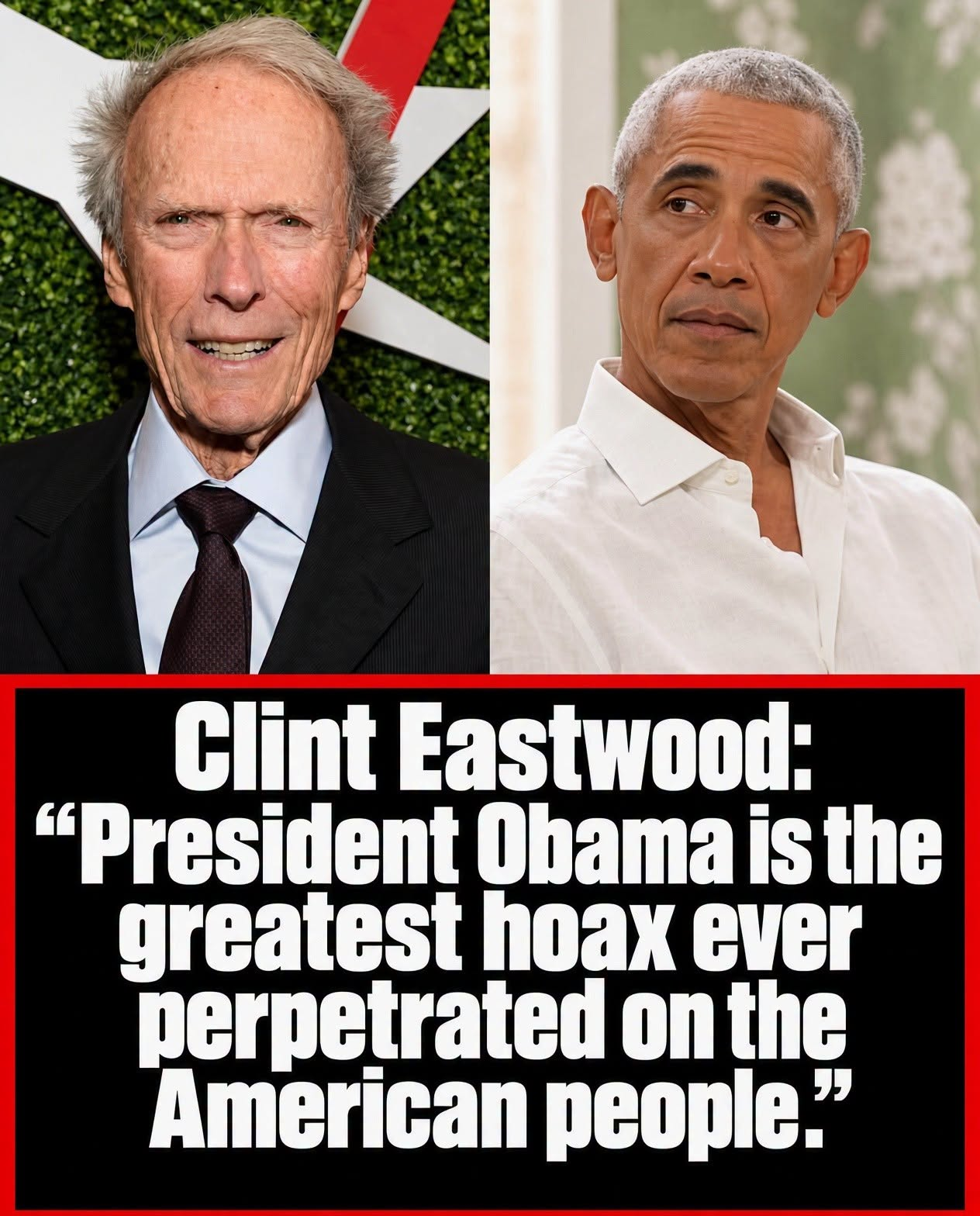
A stark political quotation graphic can travel far beyond the moment that gave rise to it. This image pairs actor and director Clint Eastwood with former President Barack Obama and presents a line that sounds like a sweeping verdict on an entire presidency. The quotation is real in its essential wording, but understanding what it means requires returning to the political setting in which Eastwood said it.
The statement dates to September 2012, when Eastwood appeared at the Republican National Convention in Tampa, Florida. The Oscar-winning filmmaker was there to support Republican presidential nominee Mitt Romney and his running mate, Paul Ryan, who were challenging Obama and Vice President Joe Biden in that year's election.
Eastwood's convention appearance became famous for an unusual improvisation: he addressed an empty chair as if Obama were sitting in it. The unscripted exchange was awkward, comic, and instantly newsworthy. It generated a storm of commentary about political theater, celebrity endorsements, and whether the performance helped or distracted from the Romney campaign.
In a follow-up interview with his hometown newspaper, The Carmel Pine Cone, Eastwood explained that he had wanted to make three points: that Hollywood was not uniformly liberal, that Obama had failed to keep promises, and that voters should feel free to replace a politician they believed was doing a poor job. He said the empty-chair idea came to him shortly before he went on stage.
It was in that post-convention interview that Eastwood delivered the line quoted in the graphic: 'President Obama is the greatest hoax ever perpetrated on the American people.' CBS News and other outlets reported the wording at the time, so the core attribution is not simply a later internet invention. The historical context matters: this was a sharp campaign-season criticism of an incumbent president, not a neutral assessment by an independent investigator.
Eastwood also said Romney and Ryan would do a better job running the country. That accompanying sentence makes the partisan purpose clear. He was not merely making an abstract statement about truth or deception; he was arguing for a change in political leadership during a closely watched presidential contest.
The word 'hoax' is forceful rhetoric. In ordinary usage, it implies deliberate deception, but Eastwood's quotation did not itself establish a specific scheme, identify evidence of a coordinated fraud, or explain which policies or promises he considered deceptive. It expressed a political judgment. Readers should distinguish the fact that a public figure made a claim from the separate question of whether the claim is substantively justified.
That distinction is often lost when a quotation is isolated from the interview around it. A short graphic offers certainty and emotional force, while the original news context provides information about timing, purpose, and the speaker's stated reasoning. The image accurately captures a famous insult, but it cannot, by itself, settle an argument about Obama's record.
Obama's presidency remains subject to competing evaluations. Supporters point to the Affordable Care Act, the recovery from the Great Recession, the killing of Osama bin Laden, and changes in financial regulation. Critics argue that his administration fell short on issues including the pace of economic recovery, health-care costs, foreign policy, and the promises made during his campaigns. These are debates about evidence, outcomes, and values—not questions answered by a memorable insult.
Eastwood's own political identity made the remark especially newsworthy. He had served as mayor of Carmel-by-the-Sea, California, in the 1980s, and he had long been willing to express views that did not fit the stereotype of Hollywood as uniformly Democratic. His appearance at the 2012 convention was therefore both a celebrity endorsement and a declaration that a prominent figure in the film industry supported the Republican ticket.

The empty-chair performance also showed how media spectacle can overshadow a campaign's formal message. Rather than focus only on Romney's policy proposals, audiences and commentators debated Eastwood's delivery, the imaginary conversation, and whether the bit was funny, confusing, or politically effective. The performance became one of the most replayed moments of the convention.
The quotation has continued to circulate because it is short, memorable, and easy to attach to a photograph. Online political content often strips away the date and the surrounding remarks, making a campaign-era statement appear like a timeless or newly issued verdict. That can mislead readers about when the words were spoken, even when the quotation itself is authentic.
There is a related problem with other posts attributed to Eastwood. Fact-checkers have repeatedly examined much longer messages that claim to be his farewell statement or a final denunciation of Obama, and later versions have recycled similar language to attack other politicians. PolitiFact and FactCheck.org found no evidence that Eastwood wrote those viral messages. Those false attributions should not be confused with the documented 2012 remark.
The difference between a genuine quotation and a fabricated elaboration is more than a technicality. A real quote can be checked against contemporaneous reporting and traced to an interview; a fabricated message often has no identifiable original publication, no corroborating record, and wording that mutates as it spreads. Reliable political reading depends on examining the provenance of each claim rather than deciding authenticity from whether it sounds plausible.
The phrase 'greatest hoax' also invites a broader question about political language. Campaigns frequently describe opponents as dishonest, dangerous, or fundamentally illegitimate. Such language can energize supporters, but it can also replace specific criticism with an all-encompassing label. A productive evaluation asks what concrete promise, policy, or result is under dispute and what evidence supports each side's account.
For people who agree with Eastwood's 2012 assessment, the quote may stand as a concise expression of disappointment with Obama's presidency. For those who disagree, it may look like a theatrical exaggeration deployed to help Romney win. Both reactions are understandable as interpretations of political rhetoric; neither reaction changes the historical fact that Eastwood said it in the context of endorsing the Republican ticket.

The image's juxtaposition of Eastwood and Obama encourages viewers to read the quote as a direct confrontation between two public figures. Yet a portrait cannot tell us what either person thought beyond what reliable records document. The image is a piece of political presentation, not independent evidence that the accusation is true or that Obama accepted its framing.
A careful reader can hold two conclusions at once: the central quotation is supported by contemporaneous reporting, and the quotation is an opinion rather than proof of a 'hoax.' That balanced approach avoids two opposite mistakes—dismissal of a real historical statement as fabricated and acceptance of a political characterization as established fact merely because a famous person said it.
The best way to assess the claim is to consult the original reporting, compare it with the wider record of Obama's presidency, and identify the specific policy or promise being criticized. Readers should also check whether a post is quoting the 2012 interview or attaching additional words that fact-checkers have found unsupported. Dates, primary context, and corroboration are especially important when political memes are recirculated years after the event.
More than a decade after the 2012 convention, Eastwood's line remains an example of how a celebrity's blunt remark can become a durable political slogan. The quotation is part of the record; its force comes from rhetoric and partisan context. Whether Obama's presidency deserves that judgment is a separate historical and political argument—one that requires more than a striking image and a sentence in oversized type.
Comments (0)
Loading comments...
May You Like

WEYMOUTH HORROR — FIRE TRUCK BRAKES TO SAVE DOG, ONE FIREFIGHTER DEAD, TWO CRITICAL!

WWE BRONSON REED DEAD AT 38, STIMULANTS DETECTED, $10M INSURANCE PAYOUT FROZEN!











Popular Posts




