
Conscientious Objector Requests from U.S. Troops Surge 1,000% Since War with Iran Began, Report Claims: 'They Are Afraid of Killing People in a War They Do Not Believe In'
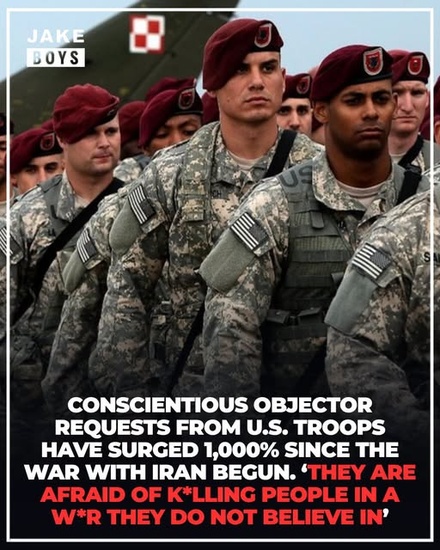
A viral social media post claims that requests for conscientious objector status have skyrocketed by 1,000% among U.S. troops since the outbreak of a war with Iran. The assertion, which has been shared widely across platforms, raises urgent questions about military morale and the legal process for service members who refuse to fight.
WASHINGTON – A graphic circulating on social media this week makes a striking claim: "Conscientious objector requests from U.S. troops have surged 1,000% since the war with Iran began." The post, attributed to the account "Jake Boys," adds a stark quote: "They are afraid of killing people in a war they do not believe in."
The image, which features a photo of U.S. Army soldiers in formation wearing maroon berets, has been shared thousands of times. But is the claim accurate? And what does it actually mean for a service member to file as a conscientious objector?
What Is a Conscientious Objector?
A conscientious objector (CO) is a person who claims the right to refuse military service on the grounds of freedom of thought, conscience, or religion. Under U.S. Department of Defense policy, service members may apply for CO status if they have a "firm, fixed, and sincere objection to participation in war in any form or the bearing of arms" due to deeply held moral, ethical, or religious beliefs.
The process is rigorous. Applicants must submit a formal request, undergo interviews with a chaplain, a psychiatrist, and an investigating officer, and appear before a board of officers. If approved, they may be reassigned to non-combatant roles — such as medics or administrative positions — or discharged from the military entirely.
Crucially, disagreement with a specific war is not sufficient grounds for CO status. The objection must apply to all wars, not just the current conflict. This is a key distinction that the viral graphic blurs.
The Claim: 1,000% Surge
The graphic asserts that CO requests have increased by 1,000% since the war with Iran began. If accurate, that would represent a tenfold increase — a staggering figure that would signal a major morale crisis within the ranks.
However, no official data has been released by the Department of Defense to confirm or deny this claim. The Pentagon has not published updated statistics on CO applications since the conflict began, and independent verification is currently impossible.
The claim appears to originate from anonymous sources and has been amplified by anti-war accounts on social media. Without official confirmation, it should be treated with caution.
Why the Claim Resonates
Even if the exact figure is unverified, the underlying sentiment is plausible. The United States has been engaged in a volatile and deeply divisive conflict with Iran, a war that has sparked protests across the country and heated debate in Congress.
For some service members, the prospect of killing people in a war they do not believe in is a profound moral crisis. The graphic's quote — "They are afraid of killing people in a war they do not believe in" — captures a sentiment that has been echoed in letters, interviews, and social media posts from active-duty troops and veterans alike.
The photo used in the graphic shows soldiers in maroon berets, typically associated with airborne units. The visual suggests that even elite troops are not immune to doubts about the mission.
Historical Context: CO Requests in Past Wars
During the Vietnam War, CO applications surged dramatically as public opposition to the conflict grew. Between 1965 and 1973, more than 170,000 men filed for CO status, and tens of thousands were granted exemptions or alternative service.
During the Iraq War, CO applications also increased, though not as dramatically. The military approved only a small fraction of requests, and many applicants faced lengthy investigations and social stigma.
If the 1,000% figure is accurate, the current surge would exceed even the Vietnam-era spike in relative terms — a remarkable development that would suggest a historic breakdown in military morale.
The Legal and Personal Toll
For service members who file as conscientious objectors, the process can be grueling. Applicants are often viewed with suspicion by their peers and commanders. Some face retaliation, harassment, or threats. Others are told their beliefs are not "sincere" enough.
If a CO application is denied, the service member may be forced to deploy anyway — or face court-martial for refusing orders. The stakes could not be higher.
The military has a legal obligation to process CO applications fairly and without prejudice. But in practice, the system is often slow, opaque, and intimidating. Many troops who might qualify never file because they fear the consequences.
What the Pentagon Says
As of now, the Department of Defense has not commented on the viral claim. Pentagon spokespeople have repeatedly declined to provide updated CO statistics, citing operational security and privacy concerns.
Critics argue that the lack of transparency fuels speculation and mistrust. If the military has nothing to hide, they say, it should release the data.
Supporters of the war, meanwhile, dismiss the viral graphic as anti-war propaganda designed to undermine the mission and demoralize the troops.
The Bottom Line
| What the graphic claims | What we know |
|---|---|
| CO requests surged 1,000% since the Iran war began | No official data confirms this figure |
| Troops are afraid of killing in a war they don't believe in | Anecdotal reports suggest morale issues, but scale is unclear |
| The photo shows elite troops in formation | The image appears to be a stock or file photo |
| The war with Iran is ongoing | The U.S. is engaged in a volatile conflict with Iran |
The viral post has struck a nerve because it touches on something deeply human: the moral weight of war. Whether or not the 1,000% figure is accurate, the conversation it has sparked is real.
For service members caught between duty and conscience, the choice is never simple. And for a nation divided over another war in the Middle East, the question of who fights — and why — has never been more urgent.
The Pentagon has not responded to requests for comment. This story will be updated as new information becomes available.
Comments (0)
Loading comments...
May You Like

Russian Drone Strikes Kyiv Bridge as German Chancellor Arrives in Ukraine

TRUMP’S OHIO WARNING UNDER THE SPOTLIGHT

gfnhgmnghnmfgnbvvvvvvvvv












