Corruption Concerns Challenge Inflation as a Top Midterm Issue — And the Trump Family Faces Renewed Scrutiny
With the November 3 midterm elections approaching, Americans are weighing more than the cost of groceries, housing, and energy. Questions about government ethics, conflicts of interest, and political accountability are also shaping the national conversation, creating another challenge for President Donald Trump and his Republican allies.
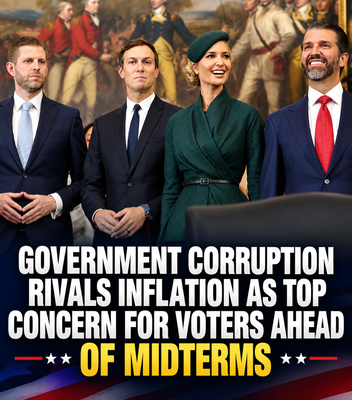
A political image featuring Eric Trump, Jared Kushner, Ivanka Trump, and Donald Trump Jr. highlights a growing debate about the relationship between political power and private financial interests. Its headline suggests that concerns about government corruption are competing with inflation as a leading issue for voters.
The image reflects a significant political argument, but it does not identify a specific opinion poll. Without the survey's methodology and results, it would be premature to conclude that corruption has overtaken inflation nationally.

For much of the election cycle, Republicans have emphasized economic growth, immigration enforcement, national security, and the administration's efforts to reshape federal policy.
Democrats have focused heavily on affordability, healthcare, government accountability, and the consequences of Trump's decisions since returning to the White House.
The competing messages reveal how elections can become contests not only over individual policies but also over public trust in the people making those decisions.
Inflation remains an especially important concern because its effects are visible in everyday life. Even when the rate of price increases slows, families may continue paying substantially more than they did several years earlier.

That distinction between inflation and the overall price level is central to understanding public dissatisfaction. Slower inflation does not mean that prices have returned to their previous levels.
Housing expenses, insurance premiums, utility bills, and food costs can place continued pressure on household budgets, regardless of which political party controls Washington.
Government ethics presents a different kind of concern. While higher prices affect household finances directly, perceived corruption can undermine confidence that elected officials are acting in the public interest.
Voters may worry about whether powerful individuals receive preferential treatment, whether private businesses benefit from political connections, and whether public officials adequately disclose financial relationships.
These concerns are not exclusive to either party. Both Republican and Democratic administrations have faced questions about political donations, lobbying, family business interests, and the revolving door between government and private industry.
Recent polling now provides clearer evidence that corruption has become a major election issue. In an August survey conducted by Change Research, 40% of registered voters selected government corruption as one of their three most important political concerns, compared with 36% who selected inflation and the high cost of goods.
That finding helps explain the political image's central message. However, it does not mean corruption ranks ahead of economic concerns in every survey.
A separate October Harris Poll found that the cost of living remained voters' leading single concern, cited by 36%, while government corruption ranked second at 12%.

The Harris survey also revealed widespread distrust of elected officials. Approximately 76% of respondents believed politicians were more interested in enriching themselves than improving economic conditions for ordinary Americans.
These findings suggest that concerns about corruption and affordability are increasingly connected. For some voters, the problem is not simply that prices remain high, but that politically connected individuals appear to enjoy financial opportunities unavailable to ordinary families.
The Trump family's business activities have become a prominent part of that debate. Donald Trump Jr. and Eric Trump have maintained extensive private business interests, while Jared Kushner has been involved in major international investment activities.
Financial arrangements involving cryptocurrency, overseas investors, and businesses with potential government interests have prompted questions from ethics specialists about conflicts of interest and access to political power.

Those concerns require careful distinctions. A business relationship involving a president's relative is not automatically illegal, and the existence of a financial benefit does not by itself establish bribery or corruption.
The central questions are whether official decisions have been influenced by private financial interests, whether appropriate disclosures were made, and whether public officials have complied with applicable ethics laws.
The White House has rejected allegations that Trump is improperly using his office for personal gain, arguing that his administration is working to reduce waste, combat fraud, and protect taxpayers.
Republicans have also accused Democratic politicians of benefiting from insider connections, campaign donations, and questionable financial transactions. Such accusations are part of a broader debate over whether ethics rules should be strengthened for lawmakers and senior government officials from both parties.

The implications for the election are significant. Candidates in competitive districts are increasingly using corruption allegations to challenge their opponents' credibility, while emphasizing the need for stronger oversight and greater financial transparency.
For independent voters, the issue may be particularly influential. Surveys suggest that many Americans distrust both political parties, creating opportunities for candidates who can demonstrate a convincing commitment to accountability.
At the same time, economic concerns remain central. An October Pew Research Center survey found that 84% of registered voters considered the economy very important to their midterm vote, demonstrating that financial pressures have not disappeared from the political agenda.
The November 3 election will therefore test two closely related questions: whether voters believe the government is improving their economic circumstances, and whether they trust the people holding power to act in the public interest.
Comments (0)
Loading comments...
May You Like