Could Canada Become the EU’s First
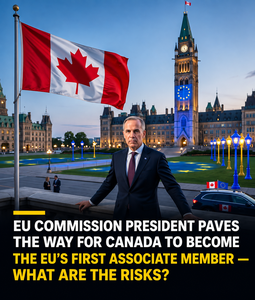
BRUSSELS — The European Union has opened an unprecedented discussion about giving Canada a new form of “associate membership,” but the proposal remains undefined and does not make Canada an EU member.
A New Proposal From Brussels
European Commission President Ursula von der Leyen announced the proposal on September 16 during her annual State of the Union address in Strasbourg, with Canadian Prime Minister Mark Carney attending.
Von der Leyen said she wanted to work with Canada on becoming the EU’s first associate member, describing closer cooperation as necessary in an increasingly uncertain geopolitical environment.


The proposal came as Canada and European countries face growing pressure from international trade disputes, Russia’s war against Ukraine, China’s economic competition and uncertainty surrounding relations with Washington.
However, “associate membership” is not currently a recognized category of membership under EU treaties, meaning the proposal would require negotiations over its legal and institutional structure.
Canada Welcomes The Idea
Carney welcomed the initiative during a speech to the European Parliament on September 17, calling for a much deeper strategic relationship between Canada and Europe.
The Canadian prime minister emphasized cooperation rather than full EU membership, saying Ottawa wants stronger connections covering trade, defense, energy, technology and other strategic sectors.
Carney also argued that Canada and Europe could strengthen their resilience by reducing vulnerabilities that allow individual countries to exert excessive economic or geopolitical pressure.
His proposed areas of cooperation include critical minerals, artificial intelligence, computing infrastructure, energy security, space, financial services, defense production and digital trade.
What Would Associate Membership Mean?
At present, there is no agreed definition of what Canadian associate membership would provide, including voting rights, market access, institutional participation or financial obligations.
The EU already maintains association agreements with numerous non-member countries, but those arrangements differ substantially and do not constitute a single standardized form of associate membership.
Any formal arrangement would therefore need approval from the EU’s member states, with unanimity potentially required depending on the legal structure ultimately negotiated.


The proposal has already generated questions inside Europe because von der Leyen announced the concept without providing detailed terms or securing broad agreement among all 27 governments beforehand.
Why Canada Is Looking Toward Europe
Canada has historically depended heavily on the United States for trade, with roughly 70% of Canadian exports going to its southern neighbor, according to Canadian officials cited by AP.
That dependence has become more politically significant as trade relations between Ottawa and Washington have deteriorated amid tariffs and disagreements over broader economic policy.
Carney has promoted greater diversification of Canada’s international trade and deeper relationships with Europe as part of a broader effort to strengthen the country’s economic resilience.
Canada and the EU already have a major economic relationship, with bilateral trade reaching approximately $147 billion in 2025, according to AP reporting.
Trump Responds
President Donald Trump reacted sharply to the proposal, warning that closer EU-Canada integration could be considered a hostile act and potentially trigger additional American tariffs.
Trump described the proposed arrangement as “laughable” and said he could impose serious tariffs or restrict trade with Europe if Washington viewed the initiative as hostile.
The comments add another layer of uncertainty because Canada remains economically connected to the United States even while Ottawa seeks to expand commercial and strategic relationships elsewhere.
What Happens Next?
The proposal is expected to receive further discussion before the planned Canada-EU summit in October, where the two sides could begin defining the substance of their proposed strategic relationship.
For now, Canada has not joined the European Union, and there is no finalized legal framework establishing an “associate member” category within the bloc.
The next stage will depend on negotiations between Ottawa, the European Commission and individual EU governments, with questions about trade, regulation, defense and institutional participation still unresolved.
The emerging Canada-EU initiative therefore represents a potentially significant diplomatic shift, but its ultimate importance will depend on whether governments can turn the proposal into a concrete agreement.
Comments (0)
Loading comments...
May You Like

Russian Drone Strikes Kyiv Bridge as German Chancellor Arrives in Ukraine

gfnhgmnghnmfgnbvvvvvvvvv

Barack Obama Draws Attention With New Literary Podcast