
Could Melania Trump Win the Nobel Peace Prize Over a Ukraine Ceasefire Deal?
Could Melania Trump Win the Nobel Peace Prize Over a Ukraine Ceasefire Deal?
The first lady’s reported role in a localized humanitarian truce has raised questions about her diplomatic influence. The immediate test is whether the agreement protects civilians; Nobel speculation remains just that.
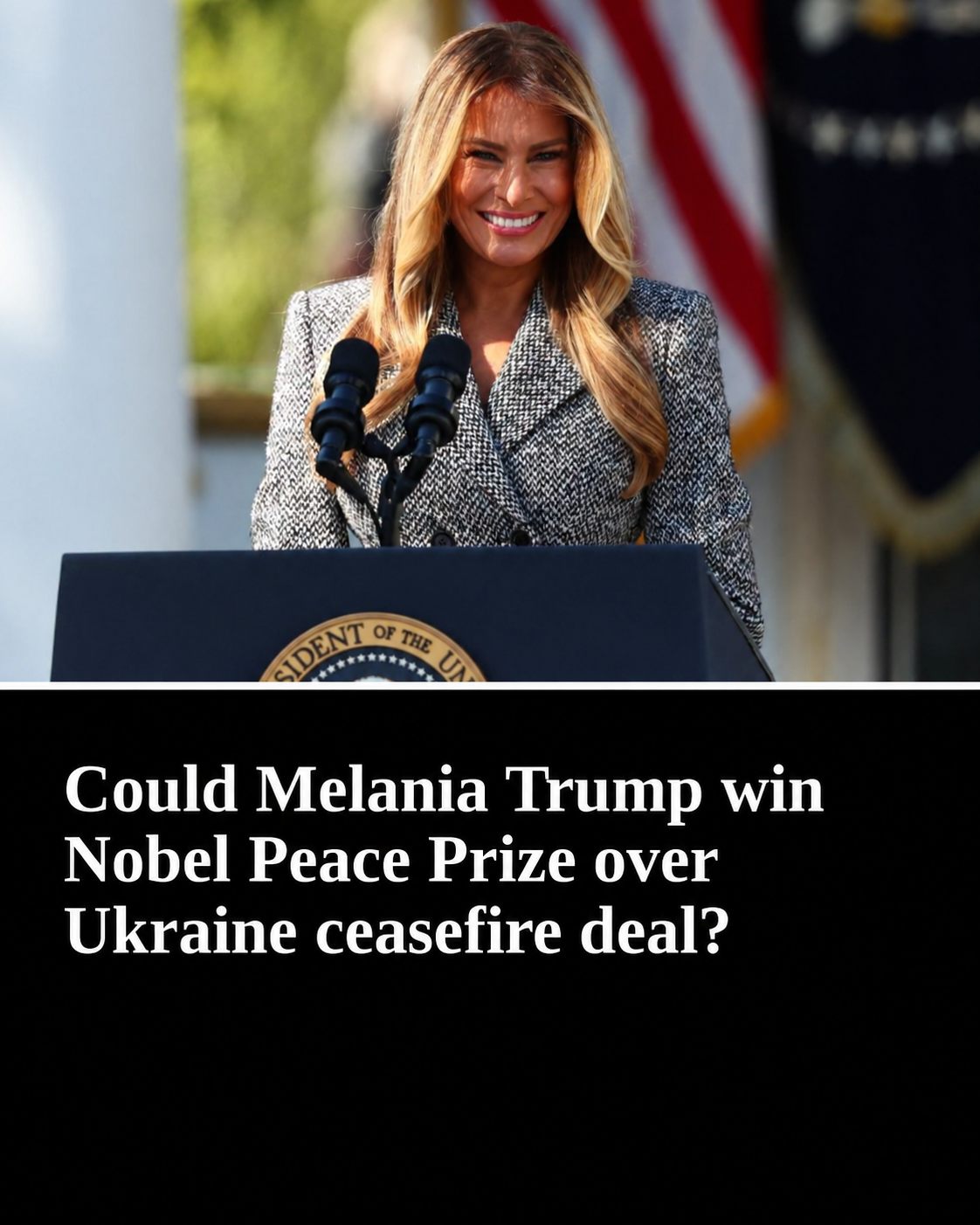
First Lady Melania Trump has drawn international attention after the White House announced that she helped secure a localized ceasefire between Russia and Ukraine in the occupied city of Oleshky. The humanitarian arrangement is intended to allow aid deliveries and civilian evacuations. The development has prompted a provocative question in the image circulating online: could the first lady one day win the Nobel Peace Prize for her role?
The agreement is notable because the first lady’s office says she worked directly with Russian and Ukrainian leadership to establish terms for a temporary pause in military activity in Oleshky. The White House announcement said the truce would enable humanitarian assistance to reach residents and prepare a safe passage for civilians who want to leave.
Oleshky lies in Ukraine’s southern Kherson region, across the Dnipro River from Ukrainian-held territory. The city has been under Russian occupation and has faced severe wartime disruption. The White House says the remaining population includes older residents and children who urgently need food, medicine, clean water, and other basic supplies.
The announcement follows Melania Trump’s earlier work drawing attention to children separated from their families during Russia’s full-scale invasion. Her office says communication channels established around those efforts helped her representative engage with both sides on the Oleshky arrangement. That background gives the ceasefire a humanitarian context distinct from negotiations over a comprehensive peace settlement.
Still, the scope of the agreement matters. A localized and temporary ceasefire in one city is not the same as ending the war between Russia and Ukraine. It may create a brief opportunity for relief and evacuation, but it does not resolve the territorial, security, and political disputes that have sustained the conflict since Russia’s full-scale invasion in February 2022.

Reports from the Associated Press say the truce is designed to support deliveries of food, medicine, hygiene products, and other essentials, alongside civilian evacuations. The operation requires coordination among Ukrainian, Russian, and U.S. representatives, and mine clearance is a key practical challenge. The success of the arrangement will depend on access, security, and whether the parties continue to observe it.
On October 29, the key question is implementation: can aid actually reach people in need, and can civilians move safely? Announcements are important, but humanitarian arrangements are judged by what happens on the ground. Residents remain exposed to the broader dangers of war, including mines, drone attacks, damaged infrastructure, and shortages.
That distinction is also central to any discussion of a Nobel Peace Prize. The Nobel Peace Prize is awarded by the Norwegian Nobel Committee, which evaluates candidates according to its own process. A diplomatic initiative may be praised publicly without making its organizer a likely winner, and public speculation should not be confused with a formal nomination or an endorsement from the committee.
Official Nobel guidance says any eligible person or organization can be nominated by someone who meets the nomination criteria. However, nominations are confidential for 50 years, and the Nobel Institute does not confirm or deny whether a particular person has been nominated. As a result, there is no reliable public basis to state that Melania Trump has been nominated for the prize over the Oleshky ceasefire.
Nomination itself is not the same as winning. The Nobel Committee receives hundreds of candidates in many years and conducts a lengthy assessment process. The 2026 Nobel Peace Prize was announced on October 9, before the White House publicized Melania Trump’s Oleshky initiative on October 23, so this particular ceasefire cannot be the basis for the 2026 award decision.

Any discussion of a future prize would therefore be hypothetical. A successful humanitarian ceasefire could contribute to a public record of peace-related work, but the committee weighs candidates in a broader context. The scale, durability, independent verification, and consequences of an initiative matter far more than a headline suggesting that a prize could be won.
Supporters of Melania Trump may argue that humanitarian diplomacy deserves recognition, especially when it helps vulnerable civilians receive food and medicine or escape a dangerous area. First ladies do not typically conduct formal foreign policy in the same way as heads of government, but they can sometimes use personal channels, advocacy, and public attention to help advance narrowly defined humanitarian goals.
Critics may reasonably ask how the agreement was negotiated, what each side has committed to, how compliance will be monitored, and whether independent observers can verify conditions on the ground. These are not merely political questions: they help establish whether civilians are protected and whether a temporary pause can deliver meaningful humanitarian benefits.
The role of Russia’s occupation of Oleshky also cannot be ignored. The city’s residents have endured years of conflict, displacement, and infrastructure damage. A ceasefire that permits relief is valuable if it works, but it does not alter the legal status of occupied territory or settle the wider war. Humanitarian access and political resolution are related, yet distinct, objectives.
Ceasefires in active war zones can be fragile. Local commanders may face communication problems, routes may remain mined, and each side may dispute what counts as a violation. Humanitarian organizations generally need clear guarantees, safe access, and dependable coordination to deliver supplies and evacuate people. Even a short pause can save lives, but only if those conditions hold.
The first lady’s office has also said that a media organization would accompany Russian and Ukrainian civilian teams to document the process. Independent reporting could help establish what is happening, provided access is genuinely impartial and safe. Transparent information is especially important when both sides and political leaders may have incentives to present the arrangement in the most favorable light.
The wider diplomatic context is complicated. Washington has been trying to influence the course of the war while debates continue over military assistance, sanctions, territorial questions, and possible future negotiations. A localized humanitarian agreement may create a channel for cooperation even while strategic disagreements remain unresolved. It should not automatically be treated as a breakthrough toward a comprehensive settlement.
Whether the initiative ultimately has lasting significance will depend on its results. Did aid reach residents? Were civilians able to leave without coercion? Was the pause respected? Did the parties learn procedures that could be used in other locations? Clear answers to these questions would provide a stronger basis for judging the initiative than speculation about an international award.
The Nobel Peace Prize discussion is therefore best framed as a question, not a prediction. Melania Trump’s role in the Oleshky ceasefire is a real and unusual diplomatic development reported by the White House and major news organizations, but public records do not establish that she has been nominated, and no one can infer a future award from a single temporary arrangement.
For now, the most important measure of success is not a medal or a headline. It is whether civilians in Oleshky receive the food, medicine, water, and safe passage they need. If the ceasefire holds and the humanitarian operation works, that achievement can be assessed on its own merits while the broader search for peace in Ukraine continues.
Comments (0)
Loading comments...
May You Like

STAR DIED AT 38, $10M LIFE INSURANCE INCREASED JUST 30 DAYS BEFORE WWE BRONSON REED'S DEATH!

COASTAL DISASTER — 112 KM/H WINDS, SEAWATER FLOODING, 79,000 NEW JERSEY HOMES AT RISK!

MINNESOTA NIGHTMARE—UNDERGROUND GAS LEAK, HUNDREDS OF HOMES AT RISK, $300M DAMAGE!








Popular Posts




